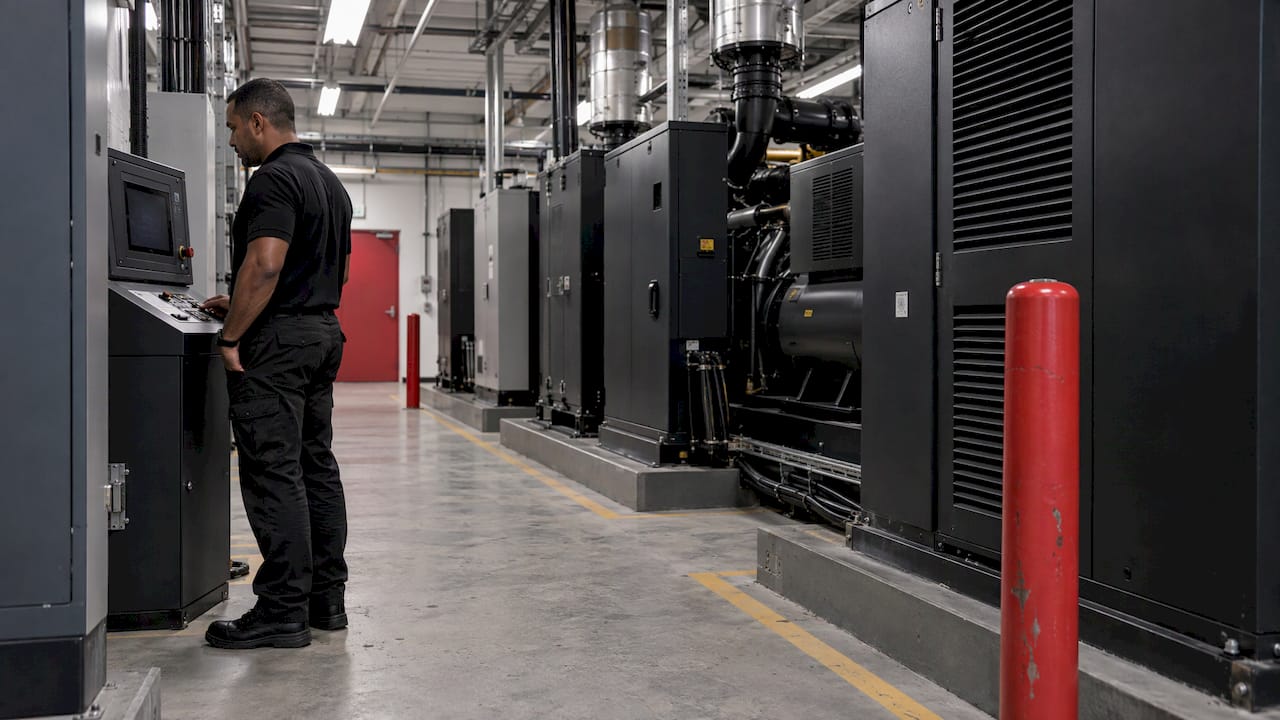
Disaster recovery testing is how you find out whether your recovery plan works before an outage finds out for you. A sound test sets objectives and success criteria, picks a test type that matches each system’s criticality, measures real recovery time and data loss against your RTO and RPO, and records every gap as an action. We build software for mission-critical infrastructure, and the pattern is consistent: teams that test against measured numbers recover faster than teams that test against a document.
Build Resilience Into Critical Infrastructure
PODTECH develops custom software for mission-critical infrastructure, including data center management, building telemetry, and critical systems integration.
VisitTL;DR
- A DR test validates that data, applications and operations can be restored within an agreed timeframe. A plan that has never been exercised is an assumption.
- Match the test to the system: tabletop for low-impact systems, functional exercises for moderate ones, full failover for high-impact ones.
- Measure four things every time: time to restore, age of recovered data, data integrity and blockers.
- Write a test plan before you test: scope, roles, scenario, schedule, escalation and quantifiable success criteria.
- Record results as the benchmark for the next test, fix what failed, and retest.
Table of Contents
- What disaster recovery testing actually validates
- Choose the right type of test
- Build the disaster recovery test plan
- Measure RTO and RPO during the test
- Make runbooks testable
- Testing power and facility systems
- Document results and close the loop
- Why we build test evidence into the software
- Put it into practice with PODTECH
- FAQ
- Sources
What disaster recovery testing actually validates
A disaster recovery test examines each step of your recovery plan to confirm the organisation can recover data and restore business-critical functions. TechTarget describes one of its main goals as determining whether the plan can meet predetermined RPO and RTO requirements, and as giving feedback so the plan can be amended when something unexpected turns up.
In US regulated sectors the expectation is explicit. The FFIEC IT Examination Handbook tells examiners to look for exercises and tests held at appropriate intervals and after significant changes to the operating environment, with objectives that validate the ability to restore critical business functions in a timely manner. The same handbook defines a test as an exercise that verifies the quality, performance or reliability of system resilience in an operational environment, using quantifiable metrics. Its example is removing power from a system or component and observing what happens.
That definition is the useful one. A test is not a meeting about the plan. It produces numbers.
Choose the right type of test
Not every system needs a full cutover every quarter, and not every system can survive a paper review alone. The vocabulary varies by source, but the ladder is consistent.
| Test type | What happens | Best for |
|---|---|---|
| Paper or plan review | Owners read and annotate the plan against the current environment | Catching stale contacts and inventories |
| Walkthrough or tabletop | A group talks through a scenario step by step | Low-impact systems, decision-making and roles |
| Component test | One system or component is restored on its own | Verifying individual backups and runbooks |
| Simulation | Teams work through a simulated disaster and restore data | Checking runbooks, RTO and RPO under realistic conditions |
| Parallel test | Recovery systems run real transactions while production keeps its full load | Moderate and high-impact systems |
| Cutover or full interruption | Recovery systems take the full production load and primary systems are disconnected | High-impact systems |
The descriptions above follow Yale University’s DR testing standard and IBM’s documentation on DR testing, which separates a dry test (a paper-based run that looks for obvious holes), a simulation and a full switch-over. Ready.gov groups tests into component, system and comprehensive forms. A comprehensive test covers all the systems and components that support the plan, for example confirming IT operations can be restored at a backup site after an extended power failure at the primary site.
How often, by system criticality
US federal guidance gives a workable frequency model. The GSA contingency planning guide requires:
- Low-impact systems: an annual tabletop exercise.
- Moderate-impact systems: a functional exercise at least once every three years, with a tabletop acceptable in other years.
- High-impact systems: an annual functional exercise, ranging from a simulated disruption to a complete failure that triggers failover to an alternate location.
The US Department of Education’s 2025 contingency planning standard is stricter for moderate systems, asking for an annual tabletop or functional exercise, and expects high-impact systems to run a full-scale functional exercise including failover to the alternate location. Yale’s standard sets a floor for everyone: test at least once a year.
If you operate in banking, healthcare or government, use your regulator’s interval as the minimum and your own change rate as the trigger for extra tests. A major platform migration or a new facility changes the environment the plan was written for.
Announced and unannounced tests
The GSA guide separates announced tests, where staff know the timing, objectives and scenario, from unannounced tests, which give no prior notice and focus on whether the procedures in place and the team’s readiness are adequate. It states that combining both improves the accuracy of recovery procedures and the readiness of participants. Start announced. Move to unannounced once the runbooks are stable.
Build the disaster recovery test plan
A test without a plan produces anecdotes. The FFIEC says test plans generally include roles and responsibilities, a consolidated schedule, objectives and methods, decision makers and succession plans, locations, escalation procedures, contact information and metrics for success or failure. Its older business continuity booklet adds that the plan should identify quantifiable measurements for each test objective and be reviewed before the test so it can be implemented as designed.
The GSA guide reduces this to six steps:
- Identify the plan elements to test.
- Define objectives and success criteria.
- Identify participants, pre-test information, location, schedule and environment.
- Define scenarios and procedures, and document steps one to four in a test plan.
- Execute the test and document the results.
- Revise the contingency plan.
That sequence is described in the GSA procedural guide. Ready.gov adds that the schedule should follow applicable regulations, standards and best practice, and that records should be kept.
A one-page test plan you can adapt
- Scope: which systems, which dependencies (power, cooling, network, identity, databases).
- Scenario: one specific failure, such as loss of the primary site, a corrupted database or a failed utility feed.
- Objectives: the RTO and RPO for each system in scope, stated as numbers.
- Participants: named owners, deputies and an observer who did not write the runbooks.
- Environment: isolated or production, and the rollback plan if the test itself causes harm.
- Schedule: start time, checkpoints, stop conditions.
- Escalation: who decides to abort, and who informs the business.
- Success criteria: pass and fail thresholds agreed before the day.
Measure RTO and RPO during the test
The test only means something if it compares results with targets. Yale’s guidance is blunt: the plan must be able to deliver a successful recovery within the defined RTO, and if it cannot, either the plan or the availability requirement has to change.
For each test, record four measures:
- Time to restore: the clock from the declared incident to a working service, against your recovery time objective.
- Age of recovered data: how old the restored data is, against your recovery point objective.
- Integrity: whether the data is usable and consistent, not merely present.
- Blockers: the missing password, the approval that took two hours, the licence key nobody could find. These become your fix list.
If these terms need a refresher, our glossary pages define RTO and RPO. For a deeper treatment of how business impact analysis and telemetry feed those targets, see our guide on proving RTO and RPO.
Where tests quietly fail
Most failed recovery tests fail on something small and human, not on the technology. The common ones:
- Contact lists that are out of date.
- Recovery steps written in the wrong order.
- System inventories that no longer match reality.
- Plans stored on the wrong system, so team members cannot open them when that system is down.
- Procedures that only the original author can execute.
Yale’s list of what an annual test must confirm reads like this exact catalogue: complete contact information, recovery steps clearly identified and in the right order, an accurate inventory, access for all team members, and execution without the subject matter expert.
Make runbooks testable
IBM’s documentation makes a point that most teams learn the hard way: under-documented runbook steps cause delays, and so does excessive or irrelevant detail. Its remedy is to have someone other than the author test the steps, so the process still works if the author is unavailable during a real disaster.
Practical rules that follow:
- One action per step, with the expected result stated.
- The system name, not a nickname.
- Decision points written as explicit branches.
- Credentials and access paths that work when single sign-on is down.
- A version date and an owner on every runbook.
We cover the structure in more depth in our piece on incident response runbooks that work.
Testing power and facility systems
For data centres and critical buildings, the recovery chain starts below the application layer. If the emergency power supply does not carry the load, no database failover matters. Facility tests should therefore sit inside the same plan as IT tests: the scenario is a utility loss, and the success criterion is that servers, cooling and monitoring stay up through the transfer.
The repeatable parts of this work are good candidates for automation: scheduled test runs, capturing transfer timings from building and power systems, comparing readings with thresholds and producing the report. Automation does not replace the people who make the safety calls. Load transfers on live critical facilities need defined stop conditions, authorised operators and a rollback path, and health and safety obligations still apply on the floor (see our notes on health and safety in data centres). The aim of automation is evidence: every test leaves a time-stamped record you can put in front of an auditor.
Document results and close the loop
The test is not finished when the systems come back. The GSA guide requires that contingency plans be exercised at least annually and that results are documented in a Contingency Plan Test Report. The FFIEC adds that management should review results, update the plan where appropriate and report the outcome to the board or its designated committee, and fold participants’ suggestions for better scenarios and scripts into the next cycle. IBM recommends recording results as the benchmark for the next test.
A useful report has five parts:
- Scenario and scope.
- Targets against actuals for RTO, RPO and integrity.
- Every blocker, with the time it cost.
- Actions, each with an owner and a due date.
- The date of the retest that proves the fix.
Why we build test evidence into the software
Disaster recovery plans fail in the gaps between systems: the building management system that nobody mapped, the monitoring that went dark with the primary site, the manual step that lived in one engineer’s head.
Our view is that testing should be a repeatable engineering routine, not an annual scramble. That means telemetry that records what actually happened during a failover, integration across BMS, PMS and NMS so facility and IT events sit on one timeline, and automation that runs the same test the same way every time. Our team has delivered over 250 projects for demanding infrastructure clients, and we build for the 99.9% uptime SLA we commit to.
When recovery time is measured by the system and not reconstructed from memory, the report writes itself, and the next test starts from a real baseline.
Harry
Put it into practice with PODTECH
If your recovery tests depend on spreadsheets and recollection, the fastest improvement is better data. PODTECH works across datacenter telemetry, BMS and PMS integration, DCIM consultancy, enterprise automation software and custom software for critical infrastructure. Our enterprise automation software service covers automating repeatable operational routines, and our datacenter services bring facility and IT systems together so test events can be tracked in one place.
PODTECH
Software, telemetry and integration for critical infrastructure teams that need recovery testing to be measurable, repeatable and auditable.
To discuss a recovery testing and monitoring project, start from the PODTECH home page.
FAQ
How often should we test our disaster recovery plan?
At least once a year, which is the baseline in guidance such as Yale’s standard and the GSA guide for federal systems. High-impact systems warrant an annual functional exercise, including failover. Run an extra test after any significant change to the environment.
What is the difference between a tabletop exercise and a full failover test?
A tabletop is a discussion: the team walks through a scenario and checks decisions, roles and contacts. A full failover actually moves production to the alternate site and disconnects the primary. The first tests the plan on paper, the second proves the technology and the timing.
What should a disaster recovery test plan include?
Scope, scenario, objectives with quantifiable success criteria, participants and deputies, schedule, location, escalation procedures, contact information and the metrics that define pass or fail. The FFIEC handbook lists these elements for regulated institutions.
Who should run the test?
The system owners run their own recovery, while an observer who did not write the runbooks records what happens. IBM advises having someone other than the author test the steps. Executive sponsors should receive the results.
Sources
- TechTarget: disaster recovery (DR) test
- FFIEC IT Examination Handbook: Exercises and Tests
- FFIEC IT Examination Handbook: Exercise and Test Plans
- FFIEC Business Continuity Planning Booklet (FDIC)
- GSA IT Security Procedural Guide: Contingency Planning
- US Department of Education IT Contingency Planning Standard 2025
- Ready.gov: Emergency Preparedness Testing
- IBM: Disaster recovery testing