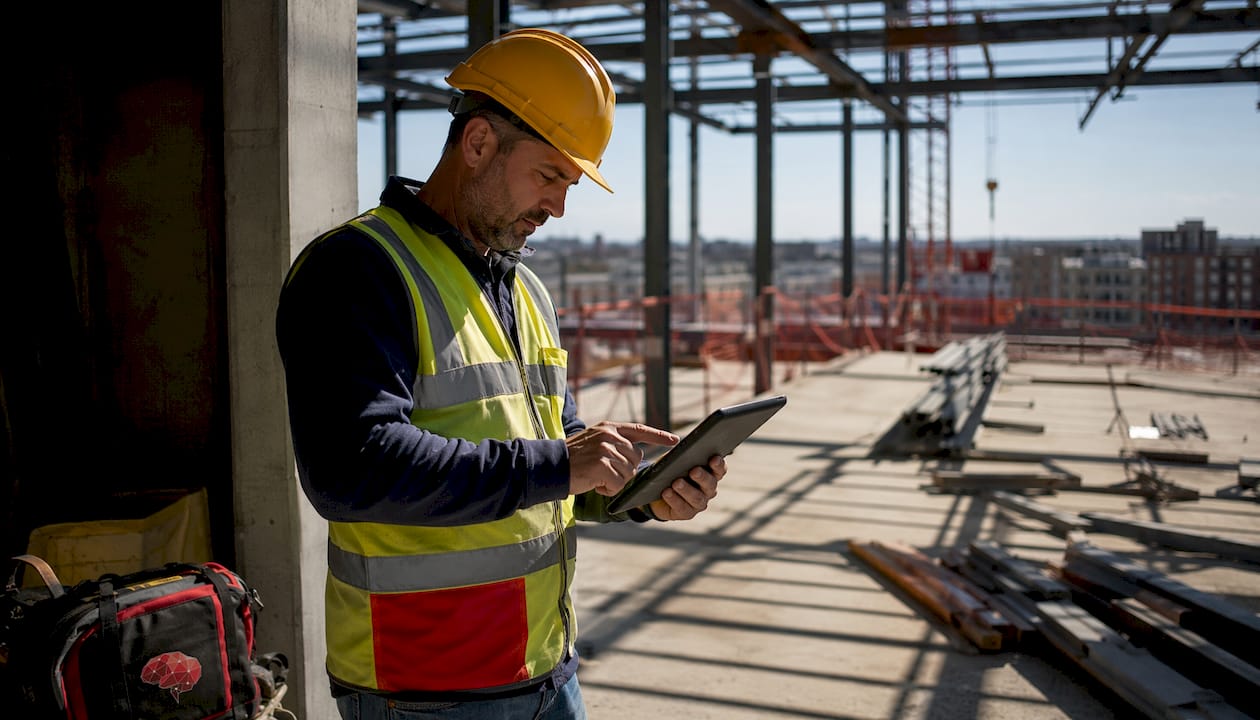
What is construction safety technology?
Construction safety technology is the integration of digital tools and software systems that shift site safety management from reactive incident response to proactive, data-driven hazard prevention. Rather than relying on paper checklists and post-incident investigations, enterprise teams use IoT sensors, AI analytics, wearables, Building Information Modelling (BIM), and drones to monitor conditions in real time and predict risks before they materialise.
The documented impact is substantial. Construction firms that combine specialised safety training with advanced safety technology can reduce job site injuries and accidents by 59%, according to insights from the American Institute of Constructors. Yet adoption across the UK remains uneven: only 11% of UK firms use digital tools for ESG and lifecycle safety management on all projects, despite 54% acknowledging their benefits.
Core technology categories include:
- IoT sensors for environmental and equipment condition monitoring
- AI-powered analytics for predictive risk assessment and incident pattern recognition
- Wearables such as smart helmets and vests that capture vital signs and issue real-time alerts
- BIM for digital safety planning across the full construction lifecycle
- Drones for aerial site surveillance and inspection of hazardous or hard-to-reach areas
Key technologies used in enterprise construction safety systems
A 2026 systematic review confirms that IoT, wearables, AI analytics, BIM, and drones collectively enable proactive hazard prevention and real-time monitoring across enterprise construction environments.
AI-driven systems go further than hardware alone. They analyse daily field communications and video data to predict risks before incidents occur, shifting safety culture from checklist compliance to continuous dynamic planning. PODTECH’s SiteChief.com exemplifies this approach: an AI-powered safety management platform that won the MK STEM AI Impact Award 2025 for advancing construction safety through real-time monitoring and predictive analytics.

The principal barrier to deploying these tools at scale is data siloing. The principal integration challenge across AI, BIM, and IoT deployments is the difficulty of consolidating information from disparate sources into coherent decision-making. Workforce resistance adds a further layer: transparent data privacy policies are critical to gaining worker acceptance of monitoring technologies.
How does the UK regulatory framework shape safety technology adoption?
UK construction safety technology operates within a framework anchored by the Health and Safety at Work etc. Act 1974, the Construction (Design and Management) Regulations 2015 (CDM 2015), and the Health and Safety Executive’s (HSE) enforcement guidance. CDM 2015 places explicit duties on principal designers and contractors to manage safety information throughout a project’s lifecycle, creating a direct mandate for digital safety management systems. Compliance with facility management compliance frameworks further reinforces the governance layer that enterprise safety platforms must satisfy.
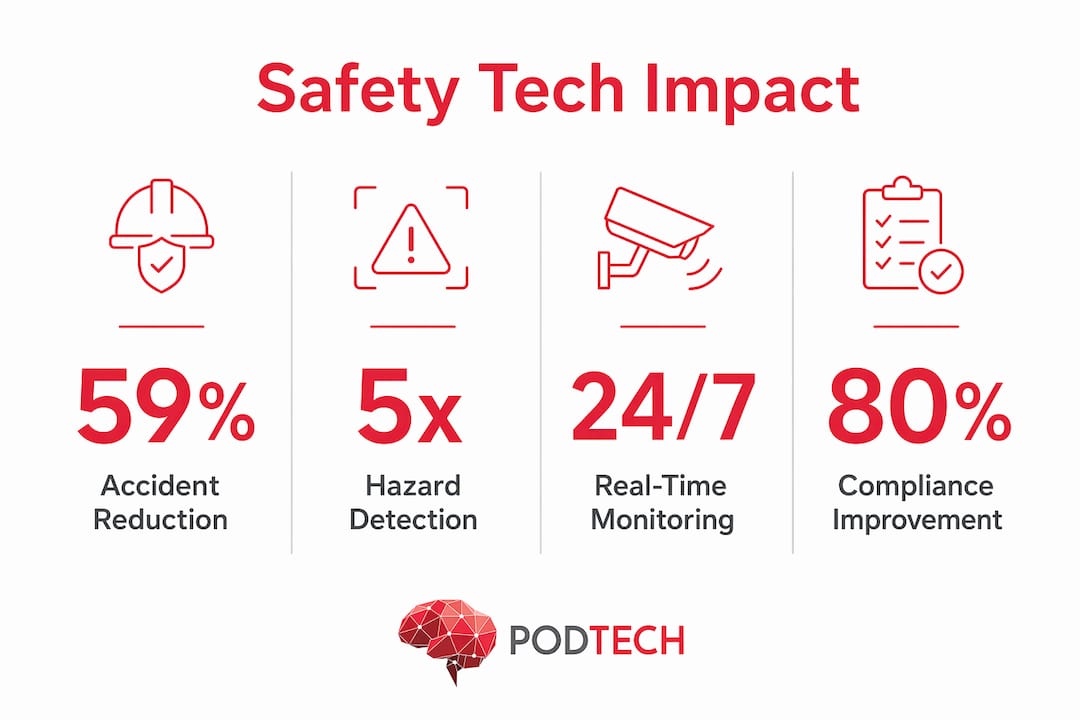
Enterprise safety management systems provide a unified safety performance view, enabling consolidated hazard identification, maintenance tracking, and incident reporting across project sites. This directly supports CDM 2015 documentation obligations and HSE audit readiness.
Evidence of effectiveness in UK construction projects
The RICS Digitalisation in Construction Report 2024 confirms that health, safety, and well-being is one of the highest-performing areas for digital data sharing across UK projects. The SiteChief.com case study demonstrates how an AI-powered platform deployed on UK construction sites delivers real-time hazard alerts, automated incident logging, and predictive risk scoring, reducing reliance on manual inspections and paper-based reporting.
PODTECH builds the safety technology your enterprise actually needs

Enterprise construction teams face a specific problem: safety data sits in silos across sensors, wearables, and legacy systems, and no single platform connects it into decisions that prevent incidents. PODTECH builds exactly that layer. From enterprise automation software that centralises safety operations to machine learning services that power predictive risk models, PODTECH delivers custom solutions built for mission-critical infrastructure. With over 250 projects delivered and a 99.9% uptime SLA, the capability is proven. Contact PODTECH to scope a safety technology platform built around your site data.
Safety technology only creates value when it turns fragmented site data into timely action.
That means integration, predictive analysis, and operational workflows have to work together—not as separate tools, but as one enterprise safety system.
Key takeaways
Construction safety technology reduces site injuries and accidents by 59% when combined with specialised training, yet only 11% of UK firms deploy it across all projects.
| Point | Details |
|---|---|
| Core definition | Digital tools including IoT, AI, wearables, BIM, and drones shift safety from reactive to proactive management. |
| Injury reduction | Firms combining safety training with advanced technology can reduce site injuries by 59%, per AIC 2025. |
| UK adoption gap | Only 11% of UK firms use digital tools for lifecycle safety on all projects, despite 54% recognising the benefits. |
| Integration barrier | Data siloing across AI, BIM, and IoT systems remains the principal obstacle to enterprise-scale deployment. |
| PODTECH solution | PODTECH’s SiteChief.com platform, winner of the MK STEM AI Impact Award 2025, delivers real-time monitoring and predictive analytics for enterprise construction safety. |