
TL;DR:
- AI is transforming construction safety through real-time hazard detection, risk scoring, and decision support systems. These tools enhance site monitoring, reduce noise, and enable targeted interventions while augmenting human safety expertise. Successful deployment depends on integration, privacy measures, worker engagement, and focused implementation.
Construction sites rank among the most hazardous working environments anywhere. With dozens of simultaneous activities, shifting conditions, and hundreds of workers operating in close proximity, the gap between a near-miss and a fatality is often measured in seconds. Traditional safety audits and manual inspections simply cannot keep pace with that reality. AI applications in construction safety are changing this equation, offering real-time hazard detection, predictive risk scoring, and decision support that no clipboard-carrying inspector could match. This article breaks down the top tools worth knowing in 2026.
Table of Contents
- Key takeaways
- AI applications in construction safety: what to look for
- 1. Computer vision PPE compliance and hazard detection
- 2. Edge AI platforms for contextual risk scoring
- 3. Mobile AI decision support tools for jobsite workers
- 4. Predictive analytics and incident forecasting
- 5. Automated safety inspections using AI and drones
- 6. Comparative overview of leading AI safety tools
- My take on AI and the future of construction safety management
- Build better safety outcomes with Podtech
- FAQ
Key takeaways
| Point | Details |
|---|---|
| Real-time detection matters | AI computer vision monitors sites continuously, catching PPE violations and hazards without manual audits. |
| Context reduces alert fatigue | Edge AI platforms reduce safety data noise by up to 95%, focusing teams on genuinely critical incidents. |
| Decision support beats enforcement | Tools designed to assist rather than police workers see significantly higher adoption and workflow integration. |
| BIM integration adds precision | Linking AI detections to BIM spatial data enables targeted safety interventions by zone, not just general site. |
| AI augments, not replaces, safety staff | The strongest programmes treat AI as a layer on top of existing safety expertise, not a substitute for it. |
AI applications in construction safety: what to look for
Before committing to any platform, you need a clear framework for evaluation. The market is flooded with tools claiming to transform site safety, and not all of them deliver under real working conditions. These are the criteria that actually separate the useful from the performative.
Real-time hazard detection. The system must identify risks as they occur, not after a shift review. Hourly batch processing is not enough when a worker enters a confined space without the correct equipment.
Integration with existing workflows. If a tool cannot connect to your BIM model, project management platform, or incident reporting system, it creates data silos rather than closing them. Look for open APIs and demonstrated integration records.
Accuracy and alert quality. False positives are not a minor inconvenience. They cause alert fatigue, which means genuine hazards get ignored. Generative AI training pipelines that produce varied photorealistic synthetic images have shown measurable improvement in model accuracy and false positive reduction.
Privacy and data governance. Cameras on site capture workers constantly. Any system you deploy must have documented PII protections, including automatic face blurring, and clear data retention policies.
Mobile accessibility. Safety managers are not at desks. Field workers certainly are not. The tool must perform on a mobile device in variable lighting and connectivity conditions.
Risk prioritisation and decision support. Raw alerts are not decisions. The best platforms attach context and severity scores so your team knows what to act on first.
Pro Tip: Ask vendors to demonstrate the tool under your specific site conditions before signing any contract. A system optimised for warehouse environments will often underperform on a complex multi-storey construction project.
1. Computer vision PPE compliance and hazard detection
Computer vision is the most mature AI safety monitoring technology currently deployed at scale on construction sites. Fixed cameras or mobile devices feed continuous video to models trained to recognise hard hats, high-visibility vests, safety harnesses, and other PPE, flagging violations the moment they occur.
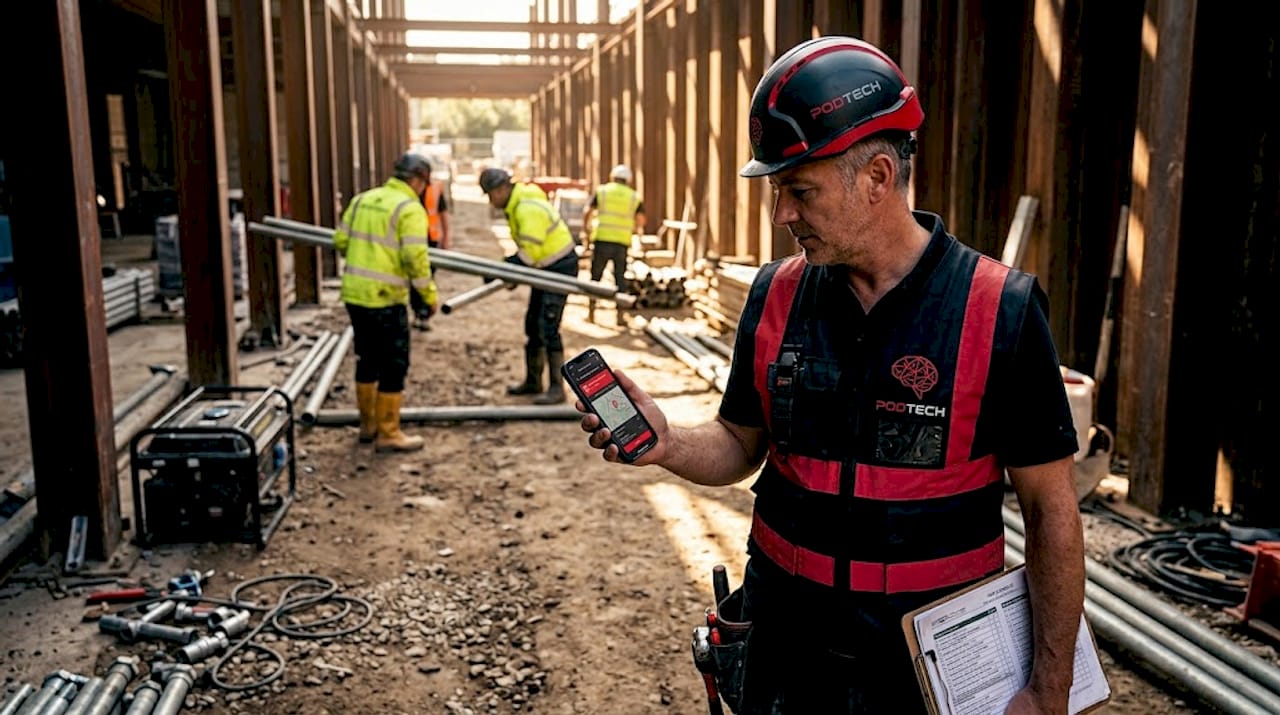
The sophistication of current systems goes well beyond simple object detection. PPE violation detection models now achieve a mean average precision of around 0.75 and link each violation spatially to BIM elements in platforms like Autodesk Revit. This means a safety manager does not just receive an alert that someone is not wearing a hard hat. They see exactly which zone of the site is generating the most violations, enabling targeted supervision rather than reactive, site-wide responses.
| Capability | Traditional audit | AI computer vision |
|---|---|---|
| Monitoring frequency | Periodic spot checks | Continuous, 24/7 |
| PPE detection accuracy | Variable, observer-dependent | ~0.75 mAP |
| Spatial risk mapping | Manual, static | Linked to BIM zones |
| Privacy protection | None required | Automated face blurring |
| Response time | Hours to days | Near real-time |
Privacy safeguards are not optional. Face blurring and PII protection are now standard in leading architectures, with image collection, inference, and analytics handled in separate layers. This distributed design protects sensitive data while still enabling fast hazard alerting. It also makes deployment significantly easier in jurisdictions with strict data protection requirements.
The spatial linkage to BIM is worth dwelling on. Targeted safety interventions by zone are measurably more effective than generic site-wide corrections. When you know that Level 3 of a steel frame structure is generating 60% of PPE violations, you can direct your safety officer there rather than spreading attention thinly across the entire project.
2. Edge AI platforms for contextual risk scoring
The volume of data generated by sensors on a modern construction site is enormous. Wearables, cameras, environmental monitors, access control systems, and plant telemetry all produce continuous streams. Without intelligent filtering, this data does not help safety managers. It buries them.
Edge AI platforms address this by running risk assessment locally on dedicated hardware, rather than sending everything to the cloud for centralised processing. The result is dramatically reduced latency and far better signal-to-noise ratios. Platforms like Nexus AI have demonstrated a 95% reduction in industrial safety data noise through contextual, scenario-based risk scoring.
That scoring system is what makes these platforms genuinely useful. Rather than classifying every sensor event as equally important, the AI evaluates combinations of conditions. A worker in a confined space during an air quality drop at a time of high plant activity gets a different risk score than the same worker during a low-activity period. This contextual awareness is what prioritising high-criticality incidents actually looks like in practice.
| Risk category | Response protocol |
|---|---|
| Low | Logged for trend analysis |
| Medium | Supervisor notification within 15 minutes |
| High | Immediate supervisor alert and intervention |
| Critical | Automated escalation, site section pause |
Pro Tip: When evaluating edge AI platforms, ask specifically how they handle connectivity failures. A system that relies entirely on cloud sync will go blind during network interruptions, which are common on large construction sites.
Live trials on UK infrastructure projects have shown that frontline teams respond more consistently when alerts are tiered rather than uniform. When every event triggers the same notification, nothing gets treated as urgent. When the system has already assessed context and assigned severity, teams know immediately whether to monitor, intervene, or escalate.
3. Mobile AI decision support tools for jobsite workers
Computer vision and edge AI largely serve supervisors and safety managers. Mobile AI apps bring the same intelligence directly into the hands of the worker making the decision in the moment.
Turner Construction’s SafeT Coach is the most documented example currently in wide deployment. Rather than forcing workers to consult dense safety manuals or wait for a supervisor, the tool accepts natural language queries and image inputs. A worker can photograph a confined space entry point and ask whether the conditions meet entry requirements. The system responds based on the company’s own safety standards, not generic online guidance. Over 25,000 field interactions have now been recorded through the platform, giving the development team a substantial dataset for ongoing improvement.
The distinction between decision support and enforcement matters enormously for adoption. Tools designed as decision support rather than enforcement mechanisms see meaningfully less resistance from workers. When the tool says “here is what the guidance says, here is the risk” rather than “you are in violation,” it becomes something workers reach for rather than avoid.
Key use cases recorded in live deployments include:
- Confined space entry evaluation, checking atmospheric conditions and access requirements
- Reviewing and clarifying safety submittals before work begins
- Generating clear hazard communications for toolbox talks
- Identifying fall protection requirements based on site photographs
- Providing real-time guidance during non-routine maintenance tasks
The AI-powered roofing operations insights space has seen similar patterns, where mobile decision support tools embedded in daily workflows perform significantly better than stand-alone safety apps treated as separate compliance tools.
4. Predictive analytics and incident forecasting
Computer vision catches hazards that already exist. Predictive analytics in construction works one step earlier, identifying conditions that are likely to produce an incident before anything has gone wrong.
Oracle’s Advisor for Safety draws on data from more than 10,000 project records to identify patterns associated with elevated incident risk. That includes combinations of subcontractor history, schedule pressure, work type, weather conditions, and prior near-miss data. Instead of waiting for a lagging indicator like an injury report, safety teams can act on leading indicators that suggest a site or activity is drifting into a higher-risk state.
This is where AI starts to become strategically valuable rather than merely operationally useful. If a platform can tell you that excavation work on a specific package is trending toward elevated risk because of crew turnover, compressed sequencing, and recent environmental alerts, you can intervene before the first serious event occurs.
| Predictive input | Why it matters |
|---|---|
| Near-miss history | Reveals recurring unsafe conditions before injury occurs |
| Schedule compression | Time pressure often correlates with shortcut-taking and coordination failures |
| Subcontractor performance | Historical patterns can indicate elevated supervision needs |
| Weather and environment | Heat, wind, dust, and visibility directly affect exposure |
| Crew changes | New teams and altered handoffs increase coordination risk |
The limitation, of course, is data quality. Predictive systems are only as good as the records they are trained on. If incident logs are inconsistent, near-misses are underreported, or work packages are poorly categorised, the forecasts become less trustworthy. That is why the best predictive programmes start with disciplined data hygiene before they start promising AI-driven foresight.
Used well, predictive analytics does not replace the judgement of a safety manager. It sharpens it. It helps teams allocate inspections, coaching, and supervision where the probability of harm is rising fastest.
5. Automated safety inspections using AI and drones
Drones are increasingly being paired with AI vision systems to automate inspections in areas that are difficult, dangerous, or time-consuming for people to access. Roof edges, façades, temporary works, excavation perimeters, and elevated steel can all be surveyed more frequently when image capture is automated.
The value here is not simply that drones can see more. It is that AI can review what they see at scale. Instead of a human manually scanning hundreds of images after a flight, models can flag missing edge protection, unstable material storage, unauthorised access routes, or incomplete barricading almost immediately after capture.
- High-risk access reduction: fewer manual inspections in exposed or elevated areas
- Repeatable coverage: the same route can be flown on a schedule for consistent comparison
- Faster documentation: visual evidence is captured and stored automatically
- Trend visibility: recurring housekeeping or protection failures become easier to spot over time
There are practical constraints. Flight permissions, weather, battery life, and line-of-sight rules all affect deployment. AI review also depends on image quality and camera angle. But where the operating environment supports it, drone-assisted inspections can extend the reach of a safety team without requiring more people to enter hazardous zones.
The strongest use case is not replacing inspectors. It is allowing inspectors to spend less time gathering raw visual data and more time interpreting it, prioritising corrective action, and coaching crews.
6. Comparative overview of leading AI safety tools
By 2026, the market has started to separate into distinct categories rather than one-size-fits-all “AI safety platforms.” That is a good thing. Different tools solve different problems, and buyers should evaluate them accordingly.
| Tool type | Primary strength | Best fit | Main caution |
|---|---|---|---|
| Computer vision PPE systems | Continuous visual monitoring | Large active sites with repeat exposure | False positives and privacy governance |
| Edge AI risk platforms | Contextual prioritisation | Sensor-rich projects and critical operations | Integration complexity |
| Mobile decision support apps | Worker-level guidance | Distributed field teams and dynamic tasks | Adoption depends on trust and usability |
| Predictive analytics tools | Leading risk indicators | Firms with strong historical data | Poor data quality weakens forecasts |
| Drone + AI inspection systems | Remote visual coverage | Large, elevated, or hard-to-access sites | Operational and regulatory constraints |
If you are choosing between categories, start with the problem rather than the technology. Organisations with recurring PPE and access-control issues often get the fastest return from computer vision. Firms drowning in sensor alerts benefit more from edge AI prioritisation. Teams trying to improve worker decision-making in the field may see the biggest gains from mobile support tools.
In other words, there is no universal “best” AI safety tool. There is only the best fit for your operating model, risk profile, and data maturity.
My take on AI and the future of construction safety management
The most important thing to understand about AI in construction safety is that it works best as an augmentation layer, not a replacement strategy. The strongest programmes are not trying to automate safety leadership out of existence. They are trying to give safety professionals better visibility, faster feedback loops, and more precise intervention points.
That distinction matters because construction safety is not just a detection problem. It is also a culture problem, a coordination problem, and a trust problem. AI can identify a missing harness, forecast elevated risk, or answer a worker’s question in seconds. It cannot, by itself, build a reporting culture, repair a broken subcontractor relationship, or create psychological safety on site.
The companies that will get the most value from these tools in 2026 are the ones that deploy them narrowly at first, prove usefulness quickly, and integrate them into existing operational routines. They will also be the ones that communicate clearly with workers about what is being monitored, why it is being monitored, and how the data will be used.
- Start with one high-value use case rather than a site-wide AI rollout
- Measure intervention quality, not just alert volume
- Design for worker trust with transparent privacy and governance rules
- Integrate with BIM, reporting, and planning systems so insights are actionable
- Keep human safety expertise central to interpretation and response
If that sounds less glamorous than the usual “AI will eliminate accidents” marketing line, good. It is also more realistic. The future of construction safety management is not autonomous compliance. It is better-informed people making better-timed decisions with better tools.
Build better safety outcomes with Podtech
AI safety tools only create value when they fit the way your projects actually run. That means integrating with existing systems, surfacing the right signals to the right people, and building workflows that teams will genuinely use in the field.
At Podtech, we help organisations design and implement practical AI systems for complex operational environments. Whether you are evaluating computer vision, edge analytics, mobile decision support, or custom safety dashboards, the goal is the same: turn fragmented site data into usable action without adding friction.
Want a safer, smarter construction workflow?
Podtech builds tailored AI and software systems that connect operations, monitoring, and decision support into one usable platform.
Talk to PodtechFAQ
What are the main AI applications in construction safety?
The main applications include computer vision for PPE and hazard detection, edge AI for contextual risk scoring, mobile decision support tools for workers, predictive analytics for incident forecasting, and drone-assisted automated inspections.
Does AI replace construction safety managers?
No. The most effective deployments use AI to augment safety professionals, not replace them. AI improves visibility and prioritisation, while human teams still interpret context, manage relationships, and lead interventions.
How accurate are AI PPE detection systems?
Current documented systems can achieve around 0.75 mean average precision in PPE violation detection, though real-world performance depends heavily on camera placement, lighting, training data, and site complexity.
What should companies look for before buying an AI safety platform?
Focus on real-time detection, integration with existing workflows, alert quality, privacy protections, mobile usability, and contextual risk prioritisation. Vendor demos should be run against your actual site conditions whenever possible.
Are privacy concerns a barrier to AI safety monitoring?
They can be if not handled properly. Leading systems now include face blurring, PII protection, and clear retention policies. Transparent communication with workers is essential for trust and adoption.