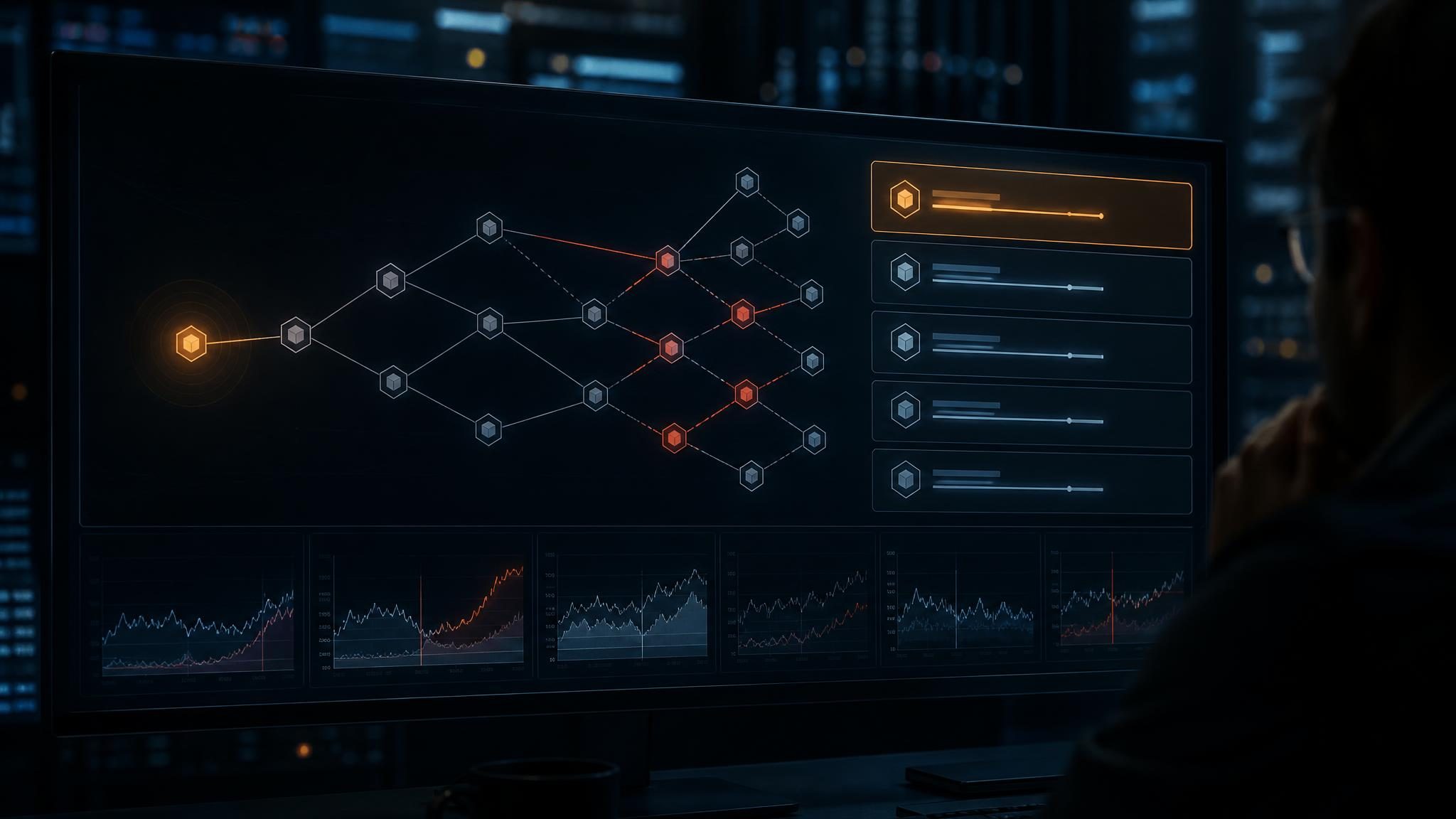
Automated root cause analysis reduces mean time to repair by minutes. Instead of waiting hours for an engineering team to manually dig through logs, metrics and traces to find root cause, automated RCA surfaces ranked, evidence-backed hypotheses about the cause of your service disruptions from telemetry data in minutes. Developed and managed according to NIST’s AI Risk Management Framework, SigLens transforms your loosely-coupled logs, metrics and traces into a prioritized list of actionable explanations.
TL;DR:
- Standardize metrics, logs, and traces prior to piloting.
- Link topology and change records together.
- Create an indexed repository of historical incidents, issues, and their resolutions.
Launch with one service domain, monitor MTTR, top N hypothesis accuracy, false positives, and related metrics, then turn on suggestions in shadow mode.
LLM based systems require incident evidence to retrieve and need external validation. They can hallucinate without grounding and reasoning over unseen scenarios will introduce latency.
PODTECH turns infrastructure insight into action
PODTECH creates software built specifically for the unique needs of critical infrastructure facilities. We design and develop building telemetry systems, sophisticated data analytics software, and machine learning applications that leverage your data.
Learn MoreTable of Contents
- What automated root cause analysis is and how it works
- How automated RCA cuts MTTR and lifts operational performance
- Causal graphs, LLM agents and the trade-offs between them
- Integration checklist: the telemetry and tooling you need first
- A pragmatic roadmap to pilot automated RCA
- How a systems integrator supports automated RCA projects
- Lessons from the field
- Turning a pilot into a working RCA system with PODTECH
- FAQ
- Sources
What automated root cause analysis is and how it works
Automated RCA takes observability data, metrics, logs, traces, change data and service topology as input. It outputs a ranked list of likely causes with evidence. We depend on automated RCA to do for us what manually correlating dashboards feels like in an incident: a slog.
The pipeline normally consists of four stages. Detection raises alerts when something deviates from normal behaviour. Hypothesis generation suggests possible reasons, either by querying causal graphs derived from service dependencies or using LLM agents to reason about recent events and observed symptoms. Validation compares each hypothesis to past incidents or live feeds to rule out poor fits. The last step ranks remaining hypotheses by probability and potential impact.
What output engineers see is never just one verdict. It's a ranked list of causes, each accompanied by an evidence trail, timestamps, affected services, related change events, so the on-call engineer can double check before responding rather than blindly trusting a black box. That evidence trail is more important than the ranking itself: it's what makes the finding testable, auditable and defensible ex post facto.
How automated RCA cuts MTTR and lifts operational performance
MTTR decreases since automatic RCA eliminates the slowest portion of incident response: correlating incident symptoms manually across dozens of dashboards. Triage speeds up since it's already been preformed by the system narrowing down candidates by potential impact, and escalations reduce since less incidents are escalated to be investigated that a model has already handled.
MetaRCA bested the best baseline by 29 points at service level, and 48 points at metric level. (arxiv.org/pdf/2603.02032) It reached accuracies of over 80% on 252 public and 59 production failures. That much improvement is the gap between research-grade RCA and the dashboard-correlation habits most teams settle for.
Beyond just the incident itself, linking ranked findings with evidence trails directly into post-incident reviews allows teams to use review time to improve fixes instead of rehashing what occurred. Across multiple incidents, you begin to build up that knowledge base for the next detection cycle to pull from.
Causal graphs, LLM agents and the trade-offs between them
There are three technical families of design for current automated RCA. Each has its own ideal operating constraint.
Causal-graph-first approaches explicitly model dependencies between services. MetaRCA constructs a meta causal graph offline from prior failures from multiple systems, then cheaply instantiate it online to the current topology at time of incident. The resulting combination of offline learning with online specialization allows it to generalize to unseen system topologies better than purely rule-based or purely learnt models.
Multi-agent and agentic approaches divide responsibility, having different agents responsible for retrieval, validation and reporting. An agentic RCA model achieved high F1 scores on Nezha and power benchmark datasets. This model grounds potential hypotheses in historical diagnostic information, then has another agent perform validation. By dividing these responsibilities, hallucination can be mitigated: one agent is never tasked with guessing unchecked.
LLM-based methods with structured reasoning give flexibility on unseen incident types. Retrieval-augmented generation keeps them grounded, but incurs real latency and risk of hallucination if not. FoundRoot trains models with supervised fine-tuning and reinforcement learning objectives to produce more complete reasoning. https://netman.aiops.org/wp-content/uploads/2026/01/foundroot_camera_ready.pdf It forces models to work through metric scanning, propagation analysis, reflection and ranking as discrete substeps. The result is more complete, verifiable reasoning traces. Grounded reasoning with retrieved historical evidence, and validating every output before sending to an engineer, is the pattern we see emerge for safely deploying LLM-based RCA.
Integration checklist: the telemetry and tooling you need first
Automated RCA is only as good as the information you feed it. Make sure you have these things checked off your list before testing out any pilots.
Interested in learning more?
Automate your root cause analysis with our RCA software that seamlessly integrates with your CMMS. Start managing maintenance more efficiently today!
- Telemetry coverage and quality: ensure metrics, logs and traces are being emitted at consistent sampling rates, with cardinality under control and a stable schema across your services.
- Incident archive: searchable history of past incidents, causes and resolutions, as this is the data that will ground AI reasoning and keep it from making stuff up.
- Integration points: live hooks into APM tools, centralised logging, a CMDB/topology map, your change-management platform, and related systems.
- Validation capability: means to validate hypotheses through fault injection, replay of historical incidents, or running hypotheses against scripted input.
Our Industrial Automation Setup Process guides you through comparable instrumentation sequencing for automation setups. This aligns well with RCA readiness tasks.
Tip: Before you work with any model, perform an audit of your incident archive. You can't possibly be grounded if you don't have a clean and searchable history of what's gone wrong in the past.
A pragmatic roadmap to pilot automated RCA
A successful pilot moves in controlled phases rather than jumping straight to automation.
- Define scope and KPIs: pick one service domain and track MTTR, top-N hypothesis accuracy and false positive rate from day one.
- Prep data and instrumentation: close telemetry gaps and build the incident archive.
- Run in shadow or assist mode: let the system run hypotheses in parallel with human investigations but don't apply them.
- Action validated findings: move, with one click, to action on highest priority findings still in validation.
- Gradually introduce controlled automation: only automate remediation paths that have the lowest risk. Anything impacting production safety or compliance standards should have human-approval thresholds.
Perform your review cadence on incident performance and revise playbooks as patterns emerge. NIST’s AI RMF describes this governance loop nicely: risk mapping, measuring system behaviour, and managing that behaviour through documented testing versus one-time validation.
How a systems integrator supports automated RCA projects
It spans telemetry integration, data engineering and machine learning in one project. That's where a systems integrator justifies its value-add. We've built telemetry and monitoring platforms at scale in our enterprise automation team, and our machine learning team has applied similar platforms to mission critical infrastructure as part of our LifeSafety.ai health and safety monitoring efforts. You can read about how we deal with the integration debt that typically kills RCA pilots: siloed data warehouses, undocumented schemas, legacy change-management processes in our legacy modernisation case study.
Lessons from the field
Regardless of what model you pick, three things will always be more important: start with one service domain rather than your entire estate. Focus on telemetry hygiene before model complexity. Bad telemetry will lead your model to make very wrong answers with high confidence. Lastly, maintain a human in the loop until proven otherwise across multiple incident iterations.
Best Practice: Check accuracy of your hypothesis monthly while piloting. Drift occurs quicker than you think.
— Harry
Turning a pilot into a working RCA system with PODTECH
The telemetry, model, and integration layers automated RCA relies upon are built by us. We make sure pilots don't grind to a halt on data plumbing or validation gaps. We help with everything from:
- Enterprise Automation Software for orchestrating detection, validation and remediation workflows.
- Machine Learning Development for developing the causal models and retrieval-grounding layers required for an RCA system.
- Datacenter Telemetry and BMS/PMS integration for connecting the observability sources RCA relies on.
When considering a pilot, we begin with a readiness assessment, scope out a measurable POC/Pilot, and build from there. Contact us to learn more about your infrastructure and what a pilot may look like for you.
FAQ
What is automated root cause analysis?
Automated root cause analysis tools take telemetry, logs, traces, and change data as input and automatically output ranked, evidence-supported explanations for an incident, eliminating the need for manual dashboard correlation. Detection, hypothesis generation, validation, and ranking are usually executed as separate stages in a pipeline.
How much can automated RCA reduce diagnosis time?
Results differ per system and deployment; however, results from one production deployment of a multi-stage agentic RCA system showed a dramatic decrease in time to diagnosis. Improvements rely greatly on telemetry quality and quantity of incident archive used for grounding.
What causes hallucination in LLM-based RCA systems?
Hallucination usually arises when LLM reason free-form without referencing grounded historical diagnostic data or real-time validation data. Distributing retrieval and validation responsibilities across agents can help prevent hallucinations by validating hypotheses against retrieved evidence before producing a ranked response.
Do I need a large incident history before starting?
Grounding any causal model or LLM reasoning step is possible with a searchable incident archive. Therefore, it is valuable to start compiling one as early as possible, even if there aren't many reports to include. Most teams start with one service domain and expand the archive throughout the pilot.
How is automated RCA governed for safety and compliance?
The majority of more developed deployments tend to scope governance around a risk-management framework like NIST’s AI RMF. This requires mapping risks, measuring system behaviour and continuously documenting testing. Human-in-the-loop thresholds for automated remediation steps are standard in that governance.
Sources
MetaRCA: Generalizable Root Cause Analysis Framework for Cloud-Native Systems with Meta Causal Knowledge. (https://arxiv.org/pdf/2603.02032)