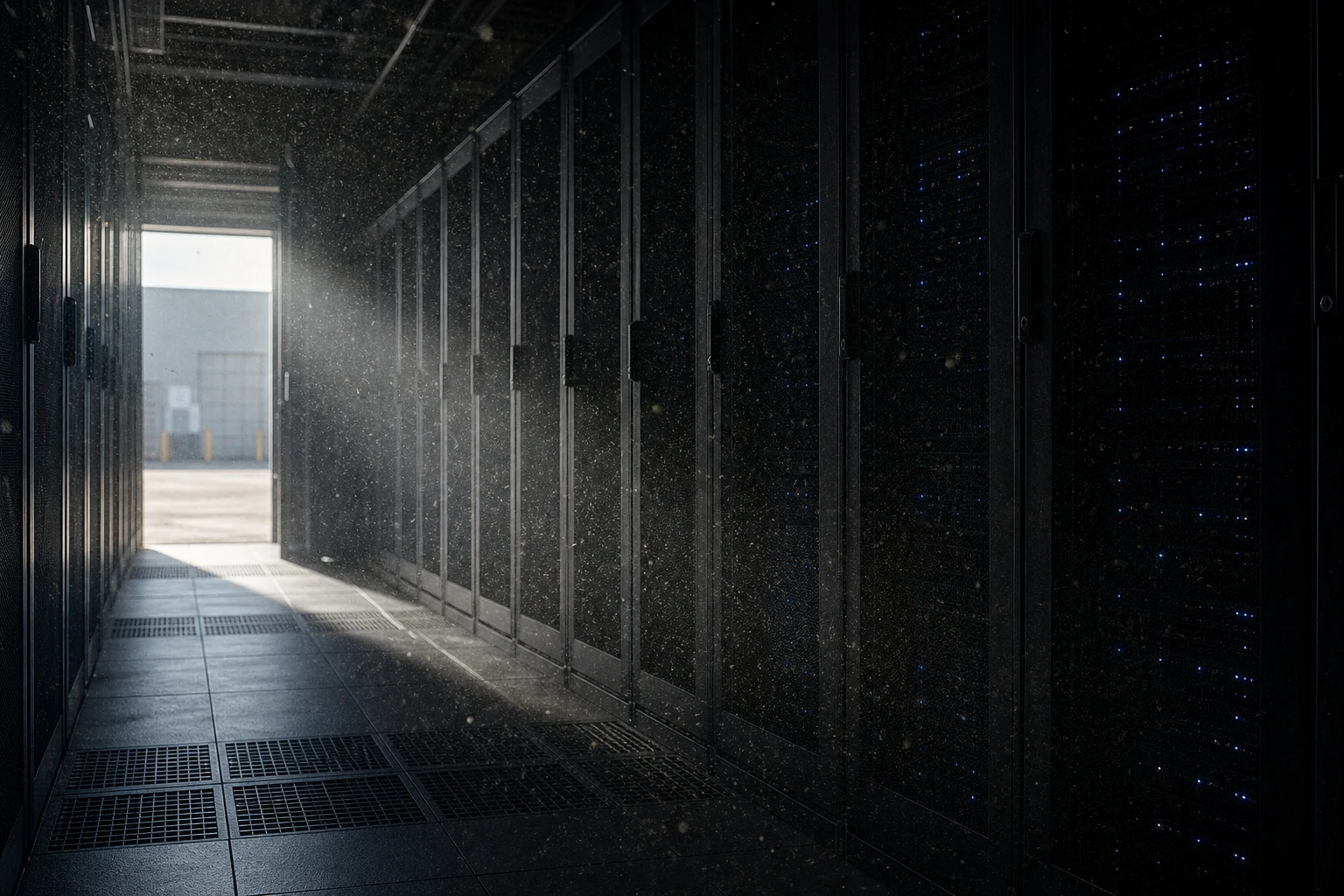
The majority of data halls still manage airborne contamination as a housekeeping task. The contractor turns up, filters are replaced, surfaces are wiped down, and someone takes a particle reading so the clean can be signed off. That snapshot is helpful. It is not a monitoring programme.
Particles do not wait for the next scheduled clean. They come in with cardboard. They arrive with people. They come through a loading-bay door left open, and from a neighbouring plot that has just started breaking ground. If you only count them when you clean, you are measuring the room after you have already spent the money to make it look right. You are not seeing what the kit actually lived through.
Why particles belong on the same board as temperature
Operators monitor inlet temperature because a few degrees can trip an SLA. Airborne particulate is slower and easier to ignore, which is why it is usually parked under facilities rather than operations. That split is a problem.
Dust loads filters and coils. Loaded filters increase fan energy and reduce the cooling you thought you had bought. Fine particulate settles on boards, heat sinks and optical faces. In a dense GPU hall that is already running close to thermal limits, a dirty heat sink is not a cosmetic issue. It is a derate waiting to happen.
The larger risk is the event you never see. A short construction spike on a Saturday. A filter bypass during a CRAC changeout. A delivery of unwrapped kit through the goods-in route. None of those show up on a quarterly clean certificate. They do show up as unexplained hardware faults six months later, when nobody can prove what the air was doing at the time.
A clean is an action. Monitoring is evidence.
A particle count after a clean answers one question: did this visit work. Continuous monitoring answers different ones.
Did the hall stay inside the band you sold the customer, every hour, not just on the afternoon of the audit. Did a filter reach end of life two weeks early. Did last night's delivery leave a plume that took four hours to clear. Did the neighbouring build start putting PM10 into your intake.
Those questions need a time series, not a clipboard. They also need the same qualities you already demand from temperature and leak detection: sensors that stay in place, data that lands in the same platform as the rest of the hall, and an alert when the line moves rather than when someone happens to walk the floor.
ISO 14644 and similar cleanroom methods are built around classified air and scheduled tests. Most colocation and enterprise halls are not cleanrooms. They still have a contamination budget, whether it is written into the SLA, the customer contract, or an internal standard copied from ASHRAE thermal guidance. Spot tests can support a classification exercise. They cannot prove the hall held that class between visits.
For compliance teams, the difference is the audit pack. An auditor who asks "show us environmental conditions for the last twelve months" expects logs, not a folder of contractor worksheets. Temperature and humidity already live in that pack. Particle counts should too, on the same clock, with the same retention.
Neighbouring builds will not tell you when they start cutting concrete
Campus growth is now the normal condition, not the exception. A live hall can sit metres from a plot that is still a hole in the ground. Piling, concrete cutting, facade work and diesel plant all throw dust. Wind and loading-bay pressure do the rest.
You cannot rely on the contractor's method statement. You cannot rely on a weekly walk. The only way to know whether a close-site build is contaminating your environment is to measure your air, continuously, on your side of the fence, at the points that matter: CRAH and CRAC intakes, the goods-in route, the cold aisle that faces the construction elevation, and any make-up air path that is not fully filtered.
If the trace is flat while the neighbour is cutting, you have evidence the envelope is holding. If it is not, you have a timestamp, a magnitude and a location. That is what you take to the project meeting. It is also what you take to the customer who just asked why their inlet filters are blocking early.
The same pattern applies inside the building. A hall refit two rooms over, a raised-floor cut, a packing station that started using a new void-fill. Continuous particle data turns "we think the dust came from next door" into a graph.
What to measure, and where
For a live data hall, PM1.0, PM2.5 and PM10 are the useful bands. They map to the fine fraction that stays airborne and the coarser fraction that tracks construction and cardboard. A laser scatter sensor covering those three, with a range up to 1,000 µg/m³, is enough to see both a dirty filter and a demolition spike. Precision around ±10 µg/m³ is enough to trend; a low annual drift matters more than a laboratory certificate you will never use in the aisle.
Placement is not "one sensor per room". Put a head on the intake that actually feeds the hall. Put another on the cold aisle that would see a containment breach. Put one on goods-in. If a neighbour is building, put one on the elevation that faces them, upstream of the last filter if you can. Then leave them there.
Wireless mesh is the practical choice in a live hall. You do not want a cable run through a contained aisle for a sensor that should have been in last week. External power is worth taking on a particle head: optical chambers should not be fighting a battery budget. The data should leave on an open protocol — Zigbee onto the mesh, MQTT into the collector — so it lands in the same historian as temperature, humidity, differential pressure and leak.
That last point is the one operators miss. A standalone particle meter with a USB stick is still a snapshot, just a more expensive one. The value appears when the count is a point next to inlet temperature, when an excursion opens a ticket, and when the monthly compliance pack includes particulate without a separate export.
What this does not replace
Continuous monitoring does not replace filtration, pressure control, or a competent clean. It tells you whether those controls are doing their job on Tuesday at 03:00, not only after the visit you paid for.
It also does not turn a data hall into a cleanroom. The point is not to chase ISO class numbers you never sold. The point is to stop treating contamination as an event and start treating it as a condition, with a baseline, a threshold and a record.
PODTECH's POD-Z4 is a laser particle head for that job: PM1.0, PM2.5 and PM10, 0–1,000 µg/m³, ±10 µg/m³, low drift, on the same encrypted Zigbee mesh as the rest of the environmental kit. It reports. It does not command the plant. The reading sits in PODVIEW with the rest of the hall, which is where a compliance officer and a duty engineer should both be looking.
If you only count particles when you clean, you will always get a good number. The hall does not live on that number. It lives on the other 8,700 hours of the year.