
TL;DR:
- Most enterprise automation focuses on simple, repetitive tasks, but true value lies in connecting complex workflows across systems.
- Effective automation reduces errors, cycle times, and enhances compliance, delivering measurable ROI and freeing skilled staff for strategic tasks.
- Combining RPA, BPA, and AI strategically, with strong governance and process clarity, maximizes enterprise performance and growth.
Most enterprise leaders assume process automation is about eliminating simple, repetitive tasks. That assumption is costing them. What is process automation in its fullest sense? It is the systematic execution of complex, multi-step workflows across departments, systems, and data sources with minimal human involvement. The distinction matters enormously. When you treat automation as a task-level tool, you capture perhaps 20% of its value. When you approach it as an architectural layer that connects your operational technology (OT) and information technology (IT) environments, you begin to see the measurable ROI that justifies board-level investment.
Table of Contents
- Understanding process automation: definitions and scope
- The measurable benefits and ROI of process automation
- Comparing automation types: RPA, BPA, and AI automation
- Implementing process automation effectively in the enterprise
- Rethinking automation strategy: balancing reliability and innovation
- Unlock your enterprise potential with PODTECH automation solutions
- Frequently asked questions
Key Takeaways
| Point | Details |
|---|---|
| Broad definition of automation | Process automation involves technology executing recurring workflows across IT and OT with minimal human input. |
| Multiple ROI components | Automation ROI includes labour savings, error reduction, cycle time improvement, scalability, and employee redeployment. |
| Different automation types | RPA, BPA, and AI automation serve distinct functions and can be combined in hybrid solutions. |
| Start with process mining | Process mining reveals real process execution to prioritise automation investments effectively. |
| Strategic maturity matters | Successful automation balances technological tools with organisational readiness and governance. |
Understanding process automation: definitions and scope
Process automation, at its core, executes recurring workflows based on predefined rules and triggers, reducing the need for manual coordination at every step. But the modern enterprise definition goes well beyond scheduling batch reports or routing approval e-mails. Today, process automation connects systems, routes information, triggers actions, and completes routine tasks automatically, freeing your people to focus on work that actually requires human judgement.
What makes this genuinely difficult to scope is that enterprise workflows rarely live in one system. A compliance check might touch your building management system (BMS), your ERP, a third-party risk register, and a regulatory reporting portal. Automation at enterprise scale must account for all of those touchpoints simultaneously.
Here is what process automation practically encompasses in a mature enterprise environment:
- Approval and routing workflows across finance, procurement, and legal
- Data ingestion and validation from multiple sources including IoT sensors and legacy systems
- Monitoring and alerting for infrastructure thresholds, SLA breaches, and anomalies
- Compliance documentation generation and audit trail maintenance
- Cross-system data synchronisation between OT and IT platforms
Understanding process automation properly also means recognising what it sits alongside. It intersects with cybersecurity policy (automated access controls), change management (automated deployment pipelines), and data governance (automated lineage tracking). Organisations that treat automation as a standalone IT project, rather than a component of enterprise architecture, consistently underperform against their projected ROI. Connecting your automation strategy to enterprise automation software purpose-built for complex infrastructure environments is where that gap gets closed.
To build on this foundational understanding, it is critical to explore how process automation delivers tangible value and measurable benefits to organisations.
The measurable benefits and ROI of process automation
The business case for automation is well-evidenced, but it is often presented in headline numbers that obscure where the value actually comes from. Let us be specific.
Manufacturers implementing process automation gained 10 to 20% in production output, 7 to 20% in employee productivity, and 10 to 15% in capacity over 12 months. These are not efficiency estimates. They are outcomes measured against pre-automation baselines, which is precisely why establishing those baselines before deployment is non-negotiable.

Across sectors, the ROI breakdown tends to follow a consistent pattern. Process automation delivers 40 to 50% of ROI from direct labour savings, 15 to 25% from error reduction, and 10 to 20% from cycle time savings over a 6 to 12 month horizon.
| ROI source | Typical contribution | Timeframe |
|---|---|---|
| Direct labour savings | 40 to 50% | 6 to 12 months |
| Error and rework reduction | 15 to 25% | 3 to 9 months |
| Cycle time improvement | 10 to 20% | 6 to 12 months |
| Capacity and scalability gains | 10 to 15% | 12 months+ |
| Employee redeployment value | Variable | 12 to 24 months |
The benefits of process automation that leaders most frequently undercount are the strategic ones. When skilled engineers are no longer manually compiling compliance reports, they are available for architecture reviews, incident response, and innovation. That redeployment value does not show up in a spreadsheet easily, but it is real and it compounds.
“The organisations that extract the most from automation are those that treat labour savings as the floor, not the ceiling, of their business case.”
Key benefits worth quantifying in your business case:
- Reduction in process error rates (measure defects per thousand transactions)
- Decrease in cycle time for approval or data handling workflows
- Audit readiness improvements (time-to-evidence for compliance reviews)
- Reduction in unplanned downtime for monitored infrastructure
For infrastructure-intensive sectors, the compliance dimension is particularly material. Our automation compliance case study illustrates how automated audit trails and real-time monitoring reduced compliance preparation time significantly. Early coordination across systems, as covered in our work on automation and compliance in data centres, is where the real efficiency gains begin.
Pro Tip: Before deploying any automation, spend two weeks documenting actual process execution, not the process as it is supposed to run. You will almost always find undocumented exception handling and manual workarounds that will break your first automation build if left unaddressed.
Having established the measurable benefits, it is important to understand how different automation approaches compare and when to apply each for best results.
Comparing automation types: RPA, BPA, and AI automation
The phrase “process automation” covers three meaningfully different technologies. Choosing the wrong one for the wrong task is one of the most common and costly mistakes in enterprise automation programmes.
Robotic process automation (RPA) uses software bots to mimic human interactions with user interfaces. It reads screens, enters data, clicks buttons. It is fast to deploy and requires no changes to underlying systems. That is also its weakness: it is fragile by nature, breaking whenever a UI changes.
Business process automation (BPA) takes a broader view, automating entire multi-step workflows and integrating directly with system APIs and databases. BPA is more durable and better suited to enterprise-scale complexity, though it requires deeper upfront process analysis.
AI automation handles what neither RPA nor BPA can: unstructured data, variable inputs, and decisions that require contextual interpretation. Natural language processing, computer vision, and machine learning models sit at this layer.
| Capability | RPA | BPA | AI automation |
|---|---|---|---|
| Rule-based tasks | Excellent | Excellent | Moderate |
| Structured data handling | Good | Excellent | Excellent |
| Unstructured data | Poor | Poor | Excellent |
| System integration depth | UI only | API and DB | API, DB, and model |
| Maintenance overhead | High | Moderate | Moderate to high |
| Audit and compliance fit | Strong | Strong | Emerging |
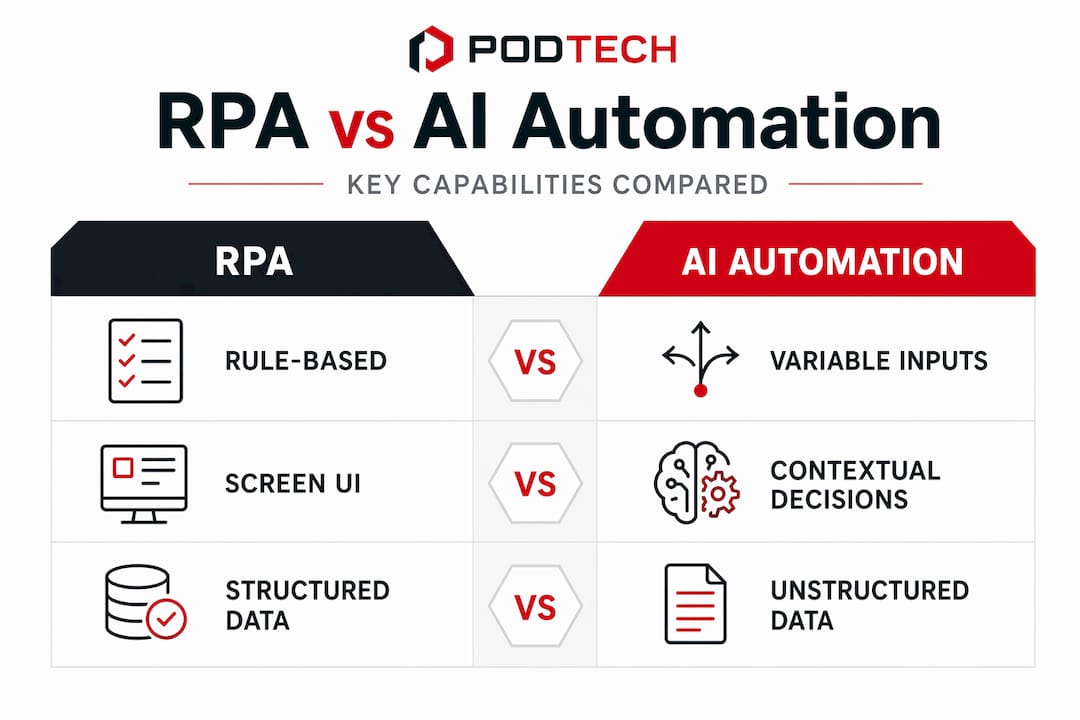
Traditional automation approaches such as RPA and BPA excel at rule-based, repetitive tasks, delivering predictable and auditable results critical for compliance environments. This makes them the right default for regulated sectors including financial services, data centre operations, and critical infrastructure management.
AI automation, by contrast, needs to be earned. It requires clean training data, organisational processes stable enough to generate consistent signals, and teams capable of interpreting model outputs. Deploying AI automation into a chaotic process does not fix the chaos: it amplifies it.
The most practically effective models we see in complex enterprise environments combine all three layers. Hybrid automation combining RPA with AI offers a sustainable long-term approach, balancing the reliability of rule-based execution with AI’s capacity to adapt to variable inputs.
For organisations building towards AI-powered workflows, our machine learning services and AI application deployment capabilities support the full spectrum from model development to production integration.
Pro Tip: Before labelling a use case as needing AI, ask whether the decision it involves has fewer than ten possible outcomes. If yes, a decision tree inside a BPA workflow will often be more reliable, cheaper to maintain, and easier to audit than a model.
Once the technology choices are clear, the next challenge is execution. Enterprise automation succeeds or fails less on tooling than on implementation discipline.
Implementing process automation effectively in the enterprise
Most failed automation programmes do not fail because the software was incapable. They fail because the organisation automated a broken process, underestimated integration complexity, or lacked governance over ownership and change.
Effective implementation starts with process mining or equivalent discovery. You need to understand how work actually moves through the organisation, where exceptions occur, which systems are authoritative, and where human judgement is genuinely required. Without that, automation simply hardcodes confusion.
A practical enterprise implementation sequence usually looks like this:
- Map the current-state process using real execution data, not policy documents
- Identify bottlenecks and exception paths that create delay, rework, or risk
- Prioritise high-value workflows with measurable ROI and manageable complexity
- Define system ownership and integration points across OT and IT
- Build governance for security, auditability, and change control
- Deploy in phases with baseline metrics and post-launch monitoring
The sequencing matters. Executives often want to start with the most visible workflow, but the better starting point is usually the process with the clearest data, the fewest edge cases, and the strongest operational pain. Early wins create internal credibility and provide the evidence needed to scale.
Integration design is where enterprise context becomes decisive. In infrastructure-heavy environments, automation may need to coordinate between BMS platforms, ticketing systems, maintenance records, compliance repositories, and analytics layers. That is why implementation should be treated as an architecture exercise, not just a workflow configuration task.
- Security controls should be embedded from the start, especially around access rights and service accounts
- Audit trails must capture who triggered what, when, and under which rule set
- Fallback procedures are essential for exception handling and business continuity
- Change management should include process owners, not just technical teams
Another common implementation mistake is measuring success too narrowly. If the only KPI is time saved, you miss the broader enterprise impact. Better scorecards include error reduction, compliance readiness, throughput, resilience, and employee redeployment into higher-value work.
At PODTECH, we see the strongest outcomes when automation is implemented as part of a connected digital operations strategy. That means integrating workflow logic with monitoring, analytics, and operational systems rather than layering isolated bots on top of fragmented processes.
Rethinking automation strategy: balancing reliability and innovation
Enterprise leaders are under pressure to pursue AI-led transformation, but the most effective automation strategies are not the most fashionable ones. They are the ones that balance reliability, auditability, and innovation in the right order.
Reliability comes first. In regulated and operationally sensitive environments, automation must be predictable. If a workflow affects compliance evidence, infrastructure alerts, procurement approvals, or safety procedures, deterministic execution matters more than novelty.
Innovation still matters, but it should be layered onto stable foundations. Once a process is standardised, instrumented, and governed, then AI can add value through classification, forecasting, anomaly detection, or decision support. Without that foundation, innovation becomes operational risk.
The strategic question is not “How much AI can we add?” It is “Which parts of this workflow need certainty, and which parts benefit from adaptive intelligence?”
Executives should evaluate automation maturity across five dimensions:
- Process clarity — are workflows documented and stable enough to automate?
- Data quality — are inputs consistent, accessible, and trustworthy?
- Integration readiness — can systems exchange data reliably across OT and IT?
- Governance maturity — are ownership, controls, and audit requirements defined?
- Organisational adoption — do teams understand how work changes after automation?
This is where many organisations need to rethink their roadmap. Rather than launching dozens of disconnected pilots, it is often more effective to build a small number of high-value, deeply integrated automations that establish reusable patterns for identity, logging, exception handling, and reporting.
A mature strategy also recognises that automation is not a one-time deployment. Processes evolve, systems change, regulations shift, and business priorities move. The organisations that sustain value are the ones that treat automation as a managed capability with ongoing ownership, not a project that ends at go-live.
Unlock your enterprise potential with PODTECH automation solutions
Process automation delivers its greatest value when it is designed around the realities of your environment: your systems, your compliance obligations, your operational constraints, and your growth goals. That is especially true in enterprise settings where OT and IT must work together without compromising reliability.
PODTECH helps organisations move beyond isolated task automation toward integrated, scalable automation architectures. Whether you are modernising compliance workflows, connecting infrastructure systems, or preparing for AI-enabled operations, our approach is built around measurable outcomes and long-term maintainability.
- Enterprise automation design for complex, cross-system workflows
- OT/IT integration across infrastructure, monitoring, and business platforms
- Compliance-ready implementations with auditability and governance built in
- AI enablement for organisations ready to extend beyond deterministic automation
If your current automation efforts are delivering incremental gains but not strategic impact, the issue may not be ambition. It may be architecture. The next step is to align your automation roadmap with the systems and workflows that actually drive enterprise performance.
Explore PODTECH's enterprise automation solutions to see how connected workflow design can unlock greater efficiency, resilience, and growth.
Frequently asked questions
What is process automation in simple terms?
Process automation is the use of technology to execute recurring workflows automatically based on rules, triggers, and system events. In enterprise settings, it often spans multiple systems and departments rather than a single repetitive task.
What is the difference between task automation and process automation?
Task automation handles one isolated activity, such as copying data from one system to another. Process automation coordinates an entire workflow, including approvals, data validation, routing, exception handling, and reporting across multiple systems.
How do RPA, BPA, and AI automation differ?
RPA mimics human actions in user interfaces, BPA automates broader workflows through direct system integration, and AI automation handles unstructured data or variable decisions that require contextual interpretation. Many enterprise programmes combine all three.
What are the main benefits of process automation?
The main benefits include labour savings, fewer errors, faster cycle times, improved compliance readiness, better scalability, and the ability to redeploy skilled staff toward higher-value work.
Where should an enterprise start with process automation?
Start with process discovery and baseline measurement. Identify workflows with clear pain points, stable rules, measurable ROI, and manageable integration complexity. Avoid automating poorly understood processes.
Is AI necessary for successful process automation?
No. Many of the highest-value automation use cases are solved effectively with deterministic workflows using RPA or BPA. AI becomes valuable when the process involves unstructured data, ambiguous inputs, or decisions that cannot be handled reliably with rules alone.