
TL;DR:
- AI has shifted from experimentation to production, demanding infrastructure upgrades to support agentic AI at scale.
- Hybrid multicloud and edge computing have become standard, driven by data sovereignty, resilience needs, and operational efficiency.
The tech trends for infrastructure 2026 are defined by one central shift: AI has moved from experimental workload to production-grade operational driver, and the physical infrastructure beneath it must now keep pace. 83% of organisations recognise they need significant infrastructure upgrades to support agentic AI at scale. That figure signals a structural reckoning, not an incremental refresh. Alongside agentic AI, hybrid multicloud adoption has reached a majority, with 52% of organisations already running hybrid multicloud architectures. Energy has become a strategic constraint, edge deployments are now operationally critical, and Power Usage Effectiveness (PUE) has shifted from a sustainability metric to a regulatory requirement. The organisations that understand these forces together will make better capital decisions in 2026.
What are the top tech trends for infrastructure in 2026?
Agentic AI is the defining infrastructure driver of 2026. Unlike traditional AI models that respond to discrete queries, agentic AI systems plan, act, and iterate autonomously across multi-step workflows. That behaviour generates sustained, unpredictable compute demand rather than burst inference spikes. Legacy architectures were not designed for this pattern.

The operational implications are significant. Agentic AI workloads require unified compute layers and dynamic silicon orchestration, meaning infrastructure teams must match workloads to the right processor type in real time. The “inference tax,” the hidden cost of running continuous AI reasoning across distributed systems, makes legacy fixed-resource architectures financially unsustainable.
Infrastructure teams are responding with orchestrated heterogeneous compute, combining CPUs, GPUs, and purpose-built AI accelerators within a single managed layer. This is not a future architecture. It is the present requirement for any organisation running production-grade AI.
Edge deployments are central to this picture. Latency-sensitive agentic workloads cannot tolerate round trips to centralised cloud regions. Edge computing brings compute closer to the data source, reducing latency and improving resilience when connectivity to core infrastructure is interrupted.
- Agentic AI requires dynamic silicon matching, not static resource allocation.
- Inference tax is a real financial cost that fixed-capacity architectures cannot absorb.
- Orchestrated heterogeneous compute combines CPUs, GPUs, and AI accelerators under unified management.
- Edge deployments reduce latency for real-time AI workloads and improve fault tolerance.
- Unified infrastructure layers allow governance, observability, and cost control across compute types.
Pro Tip: Before committing to new hardware, map your agentic AI workloads by compute type. GPU-heavy inference tasks and CPU-bound orchestration tasks have different cost profiles. Mixing them on the same silicon wastes both money and capacity.
Why are hybrid multicloud and edge computing now the standard?
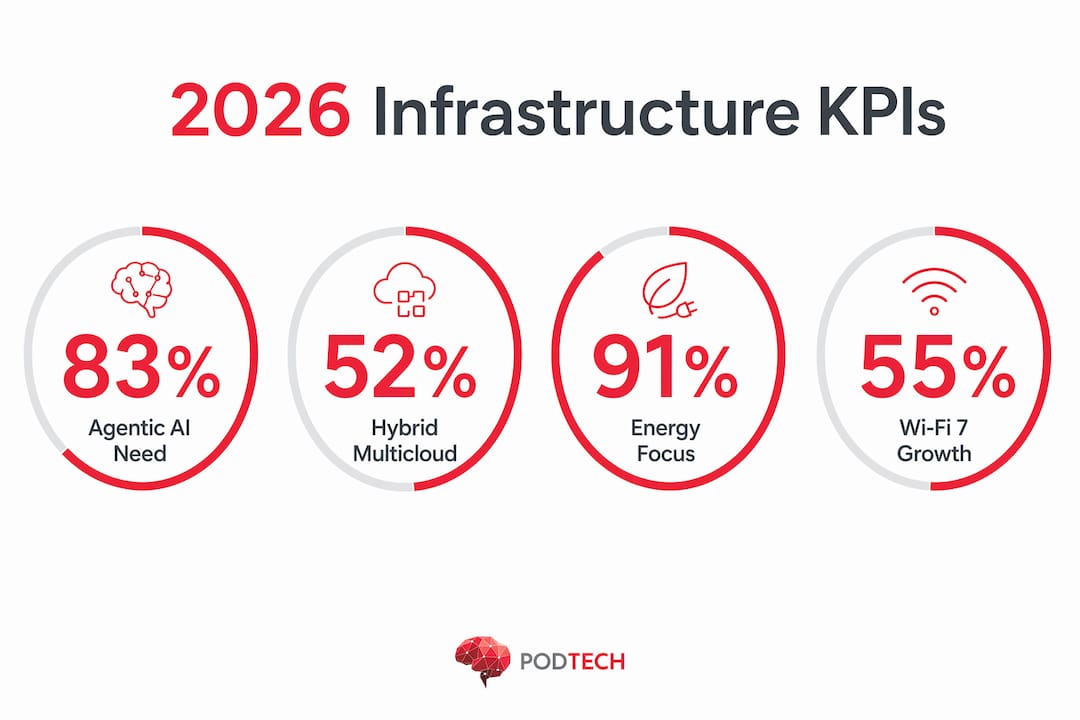
Hybrid multicloud is no longer a transitional architecture. 52% of organisations now use it as their steady-state operating model, driven by data sovereignty requirements and what practitioners call “digital gravity,” the tendency for data to accumulate where it is created rather than where it is cheapest to store.
Data residency regulations across the EU, UK, and Asia-Pacific mean that certain datasets cannot leave specific jurisdictions. Hybrid multicloud solves this by allowing organisations to keep regulated data on-premises or in local cloud regions while running less sensitive workloads on public cloud infrastructure. This is a compliance decision as much as an architectural one.
Edge computing extends this model further. For critical infrastructure environments such as power grids, water treatment facilities, and transport networks, edge nodes provide local processing that continues operating even when WAN connectivity fails. That resilience is not optional in sectors where downtime carries safety consequences.
The practical deployment sequence for hybrid multicloud and edge adoption follows a consistent pattern across mature infrastructure organisations:
- Audit data residency obligations across all active workloads and identify which datasets are subject to jurisdictional controls.
- Classify workloads by latency sensitivity to determine which must run at the edge versus which can tolerate cloud round trips.
- Establish a unified management plane that provides visibility across on-premises, cloud, and edge environments from a single control surface.
- Define data movement policies that govern when and how data moves between tiers, with automated enforcement rather than manual review.
- Test failover scenarios at the edge to confirm that local nodes sustain operations during WAN outages before going live.
How does energy consumption shape infrastructure decisions in 2026?
Energy is no longer a facilities concern. 91% of senior IT leaders now incorporate power consumption as a primary factor in hardware selection. That shift reflects a fundamental change in how infrastructure is costed and governed.
Regulatory pressure is accelerating this. Germany mandates a PUE of 1.2 or lower for new data centres, while Ireland requires on-site dispatchable generation capacity before grid connections are approved. These are not aspirational targets. They are conditions for operating licences.
The hardware response is performance-per-watt co-design, where silicon architecture and cooling systems are engineered together from the outset rather than treated as separate procurement decisions. This approach reduces energy consumption per unit of compute without sacrificing throughput. For organisations running AI inference at scale, the savings compound quickly.
| Energy constraint | Regulatory or operational driver | Infrastructure response |
|---|---|---|
| PUE 1.2 or lower | German data centre regulation | Liquid cooling, co-designed silicon |
| On-site generation | Irish grid connection mandate | Diesel or battery backup integration |
| Power consumption in hardware selection | 91% of IT leaders cite it as primary factor | Performance-per-watt procurement criteria |
| Grid scarcity | Urban power infrastructure limits | Distributed edge deployments |
Pro Tip: Treat “time to power” as a project KPI alongside time to deployment. Skilled labour shortages and permitting delays are the primary execution risks in 2026 infrastructure delivery. If your power connection is delayed, your entire deployment schedule shifts.
What does Wi-Fi 7 mean for enterprise infrastructure?
Wi-Fi 7 has become the default choice in enterprise network refreshes. Projected at 55% CAGR through 2030, its adoption rate reflects genuine performance gains rather than marketing momentum. The standard delivers lower latency, higher throughput, and reliable support for high-density device environments, all of which matter directly for AI-assisted workflows and real-time operational data.
The latency improvements are particularly relevant for infrastructure environments where sensor data, building management systems, and edge AI nodes must communicate without perceptible delay. Wi-Fi 7’s multi-link operation allows devices to transmit across multiple frequency bands simultaneously, reducing congestion in environments with hundreds of connected endpoints. For organisations planning wireless infrastructure upgrades, understanding how Wi-Fi 7 integrates with existing cabling and switching infrastructure is a prerequisite before procurement.
Network digital twins are the complementary technology that makes Wi-Fi 7 deployments safer to manage. Network digital twins create virtual replicas of physical network infrastructure, allowing teams to test configuration changes, simulate failure scenarios, and validate upgrades before touching production systems. That capability reduces the risk of outages during network transitions significantly.
- Multi-link operation allows simultaneous transmission across frequency bands, reducing congestion in dense environments.
- Lower latency supports real-time AI inference and sensor data pipelines at the edge.
- Network digital twins enable safe pre-production testing of configuration changes and firmware upgrades.
- High-density device support makes Wi-Fi 7 suitable for smart building and industrial IoT deployments.
How are programmable and robotic systems reshaping infrastructure?
Distributed robotics is moving from research into applied infrastructure. MIT’s FloatForm project demonstrates this directly: autonomous aquatic robots self-assemble into reconfigurable floating platforms with minimal human input. The system uses distributed coordination algorithms rather than centralised control, meaning the platform adapts as individual units join or leave the formation.
The infrastructure applications extend well beyond novelty. Emergency response platforms that can be deployed on flooded terrain, temporary urban public spaces assembled on water, and adaptive sensor networks for environmental monitoring are all within the operational scope of this technology. The key characteristic is that distributed robotic swarms are inherently resilient. The failure of one unit does not collapse the system.
For civil and emergency infrastructure planners, the practical deployment sequence for programmable robotic systems follows a clear progression:
- Define the reconfiguration requirement by identifying which infrastructure elements need to change shape, position, or function in response to environmental or operational conditions.
- Select the coordination model between centralised orchestration and fully distributed swarm behaviour, based on the reliability requirements of the application.
- Integrate sensor feedback loops so that the robotic system responds to real-world conditions rather than pre-programmed sequences.
- Plan for unit-level failure by designing the system to degrade gracefully when individual robots malfunction, rather than requiring full-system restarts.
The “Living Infrastructure” model, where edge modules autonomously orchestrate and learn from operational data, points toward the next stage of this evolution. Building management systems integrated with physical AI at the edge can adjust energy consumption, reconfigure space usage, and respond to safety events without human intervention.
Key takeaways
- Agentic AI is now the primary infrastructure catalyst, forcing organisations to move beyond static architectures toward orchestrated heterogeneous compute.
- Hybrid multicloud and edge are no longer optional patterns; they are the standard operating model for balancing compliance, latency, and resilience.
- Energy has become a board-level infrastructure variable, with power availability, PUE, and performance-per-watt shaping procurement and deployment strategy.
- Wi-Fi 7 matters because it supports real-time, high-density operations, especially when paired with network digital twins for safer rollout and optimisation.
- Programmable and robotic systems are expanding the definition of infrastructure, enabling adaptive, resilient physical environments that can respond autonomously to changing conditions.
- The winning infrastructure strategy in 2026 is integrated: compute, cloud, edge, energy, networking, and automation must be planned as one system rather than separate projects.