Most carbon reduction plans fall over at the first step, which is knowing what you actually use. Not what the utility invoice said you used last quarter. What the chiller on the third floor was drawing at four in the morning last Tuesday. That is a measurement problem before it is an engineering one, and it is why so many net zero programmes stall once the obvious wins are done. POD-A1 exists to close that gap.
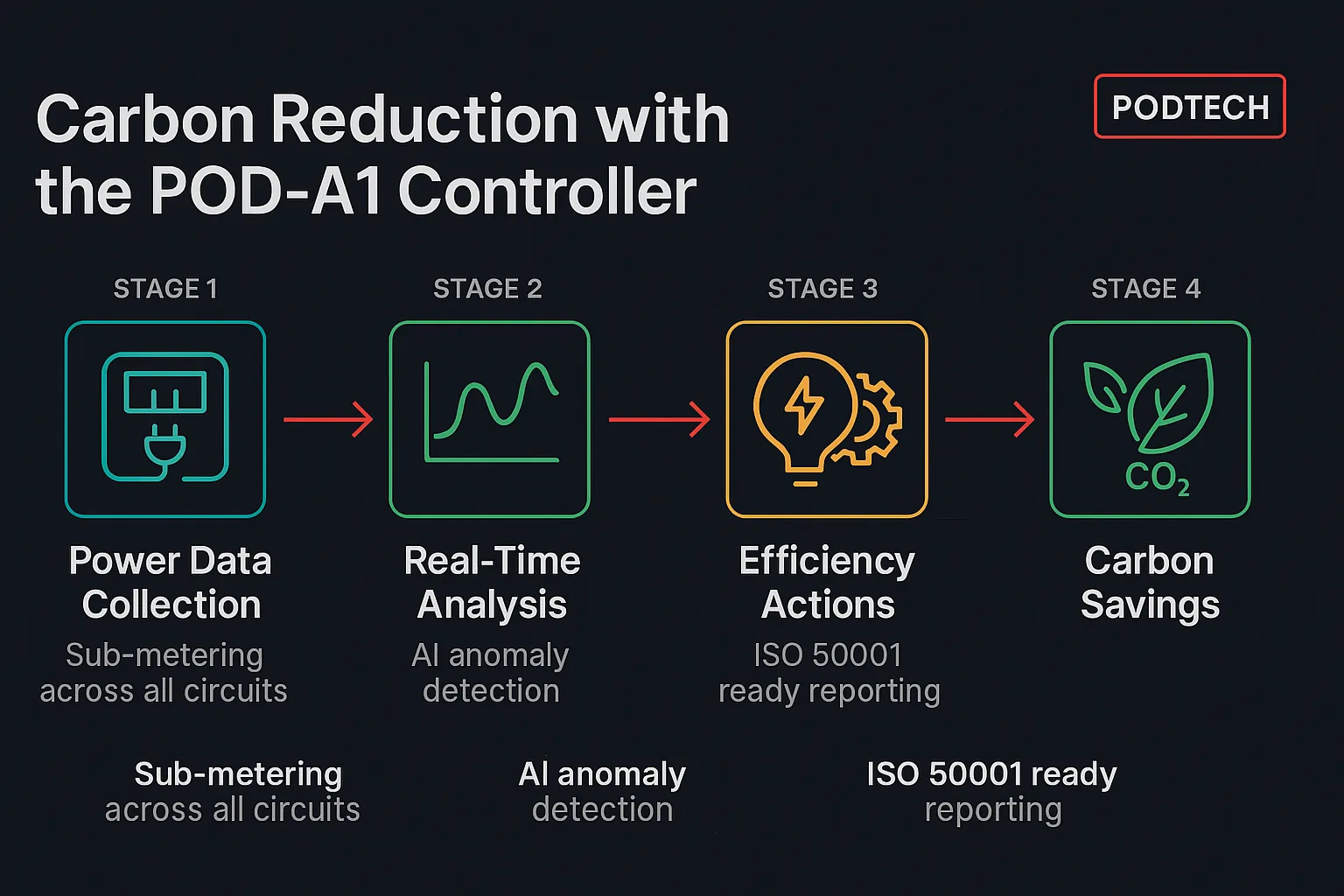
Why Most Energy Baselines Are Guesswork
Scope 2 reporting needs consumption data an auditor can follow: per circuit, per system, across every site in the estate. Plenty of organisations are still working from monthly invoices and a spreadsheet that somebody updates from manual meter reads.
Aggregate a whole building into one figure and you lose the thing you needed it for. You cannot separate HVAC from IT load. You cannot see that a pump has been running flat out since a controls change back in March. And when you do install something more efficient, you have no way to prove it worked, because the before and after are buried inside a number that moves for a dozen unrelated reasons.
So teams end up defending estimates. That is an uncomfortable position, and it gets less comfortable every time the reporting requirements tighten.
Reading the Plant That Is Already There
POD-A1 sits on site and reads the systems you already run. BACnet/IP and BACnet MS/TP, Modbus TCP and RTU, SNMP v2c and v3, MQTT, OPC-UA where it is available, and the awkward stuff too: dry contacts, 4–20 mA loops, M-Bus meters. Fifteen-plus protocols on one appliance, legacy serial kit and modern IP kit on the same box. Nothing gets ripped out to make room for it.
The work it does next is unglamorous, and it is the part that matters. Every vendor names things differently. One manufacturer's register 40021 is another's analogue input 7. POD-A1 maps those to a consistent tag set on site, timestamps them, and buffers them locally, so nothing downstream has to know what a particular panel manufacturer called anything.
If the uplink drops, polling carries on regardless and the backlog replays once the link returns. For a compliance dataset that counts for more than it sounds like it should. A gap in the record is a gap you have to account for later.
POD-A1 Power Collection Capabilities
- Fifteen-plus southbound protocols: BACnet/IP and MS/TP, Modbus TCP and RTU, SNMP v2c and v3, MQTT, OPC-UA, KNX, DALI, M-Bus
- Circuit and panel level sub-metering, attributed by zone, system or individual asset
- Read-only acquisition: no setpoints written, no commands issued into BMS, EPMS or fire systems
- Store and forward through link loss, with automatic backlog replay
- Thresholds and alerting held on the appliance, so they still fire with the cloud link down
- Normalised output to POD View, plus REST, MQTT, SNMP traps or webhooks in parallel
Spotting Waste While It Is Still Happening
A cooling unit pulling forty per cent above its usual overnight draw is telling you something. Could be a failing compressor. Could be a door propped open. Could be that somebody changed a schedule in the BMS and never changed it back. On a quarterly bill it surfaces as a slightly larger number that nobody queries.
POD-A1 profiles what normal looks like for each point and raises the deviation when it happens rather than six weeks afterwards. Thresholds and alerts are configured on the appliance itself, not in the cloud, which means they still fire when the platform link is down or when a customer never bought the platform in the first place.
We are deliberately conservative about what happens after that. The appliance is read-only. It will not write a setpoint or issue a command into a BMS, EPMS or fire system. In a datacentre or a hospital that is not a limitation we apologise for. It is usually the reason the security team signs off on the deployment at all.
Turning Measurement Into a Programme
Once the data is trustworthy you can start running real experiments. Shift a load. Move a batch process to a window when the grid is cleaner. Nudge a setpoint by a degree and leave it alone for a fortnight to see what happens.
What you get out of that is a defensible before and after. Measured savings rather than modelled ones, taken from the same instrument on both sides of the change. Most of the internal arguing about whether an efficiency measure actually paid for itself tends to stop once that evidence exists.
ISO 50001, EED and the Audit Trail
ISO 50001 asks for a systematic approach to energy performance: baseline it, measure it, show continual improvement, evidence all of it. Continuous metering with consistent tags and an unbroken time series is most of what a certification body wants to look at.
The same stream feeds EU Energy Efficiency Directive reporting, and it can go to more than one destination at once. POD View is the usual one. If there is already a data platform in the business, point a second output at that as well. There is no rule saying the compliance dataset and the operations dataset have to live apart.
Getting It In Without a Shutdown
Installation is where most energy monitoring programmes lose their nerve. POD-A1 goes in alongside what is already there. Connections are outbound only, mutual TLS, TLS 1.3 in transit, and BMS credentials sit encrypted in a hardware security module instead of in a config file somewhere. It is built in the UK and mapped against IEC 62443 and the NIST framework, which is invariably the first thing asked when anything new goes near OT.
Most sites are collecting inside a day of the appliance turning up. The honest bottleneck is almost never the hardware. It is getting a current point list out of whoever commissioned the BMS, which is a different sort of problem and one we can help with.
Carbon reduction comes down to something fairly boring in the end. Measure the right things, keep measuring them, and be able to prove the numbers when somebody asks. POD-A1 is the part that does the measuring. Everything else in a net zero programme rests on that being right.