TL;DR:
- Modern data centre operations depend on sophisticated software layers like DCIM, AIOps, and device management to optimise infrastructure.
- Proper scoping and seamless integration of these tools are crucial to unlocking operational visibility, reducing downtime, and achieving measurable efficiencies.
- Prioritising interoperability over feature count ensures reliable, scalable, and future-proof data centre management.
Throwing hardware at operational inefficiencies is an approach that enterprise IT leaders have long outgrown. The real competitive advantage in modern data centre operations lies not in rack density or processor upgrades, but in the sophistication of the software layer that governs, monitors, and optimises every interaction within your infrastructure.
Understanding the distinct roles of DCIM platforms, AIOps tooling, and device management software is no longer optional — it is the foundation upon which scalable, resilient, and cost-effective data centre operations are built. This guide cuts through the confusion and gives you a clear-eyed view of each software category, how they integrate, and how to futureproof your selection decisions.
Table of Contents
- Core categories of data centre software
- DCIM platforms: Beyond traditional monitoring
- AIOps and event correlation: Reducing noise, accelerating response
- Device management software: The bridge between physical and digital
- Perspective: Why integration trumps feature count in data centre software selection
- Powering tomorrow’s data centre: How PODTECH supports your software ecosystem
- Frequently asked questions
Key Takeaways
| Point | Details |
|---|---|
| Clarify software roles | Distinguish DCIM, AIOps, and device management to ensure you invest in complementary solutions. |
| Prioritise integration | Integrated platforms drive measurable efficiency improvements and centralise operational control. |
| Adopt data-driven workflows | Use correlated incident workflows and visual dashboards to accelerate issue response and decision making. |
| Enforce labelling standards | Consistent service and environment labelling are essential for successful AIOps automation. |
| Leverage expert support | Specialist partners can bridge expertise gaps and deliver tailored deployment outcomes. |
Core categories of data centre software
With the importance of advanced software established, it is critical to break down exactly which types of platforms comprise a modern data centre software toolkit. Many procurement exercises fail precisely because teams conflate three distinct software disciplines, leading to capability gaps, redundant spending, and integration headaches that slow down every team that touches operational infrastructure.
The three categories that enterprise IT leaders must understand are Data Centre Infrastructure Management (DCIM), AIOps platforms, and device management software. These are complementary, not interchangeable.
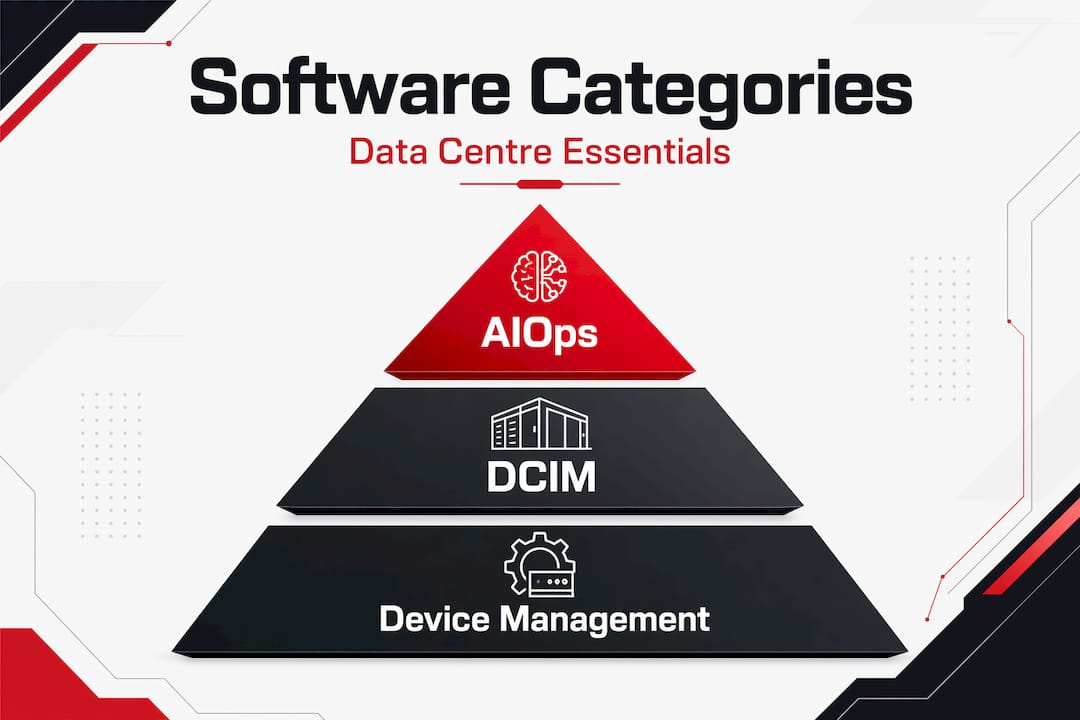
DCIM consultancy services consistently highlight that DCIM platforms are designed to operate from utility to application. Eaton Brightlayer’s DCIM suite illustrates this well, providing 3D visualisations, thermal imaging, capacity planning, dashboards, and role-based KPI reporting. The scope is infrastructure-wide and facility-level, covering physical plant alongside IT systems.
Device management software occupies a distinctly different lane. AMI’s Data Centre Manager explicitly states it is not classified as DCIM, focusing instead on real-time monitoring of IT device health, power conditions, thermal status, utilisation, and firmware across multi-vendor environments. It aggregates and analyses data from diverse hardware, acting as a complement to DCIM rather than a replacement.
AIOps sits above both, applying machine learning to event streams, correlating incidents, and routing actionable alerts to the right teams. Modern data architecture approaches, including event-driven frameworks are increasingly influencing how AIOps platforms ingest and process signals from infrastructure tools.
| Software category | Primary scope | Key capability | Integration role |
|---|---|---|---|
| DCIM | Facility to application | Capacity planning, thermal imaging, 3D visualisation | Aggregates facility and IT data |
| AIOps | Event streams and incidents | Correlation, anomaly detection, root-cause analysis | Sits above DCIM and device tools |
| Device management | Individual device health | Multi-vendor firmware, power, and health monitoring | Feeds into DCIM and AIOps |
Key pitfalls when procuring without scoping these categories clearly:
- Purchasing a DCIM platform and expecting it to replace device management, leaving firmware monitoring blind spots.
- Deploying AIOps before establishing clean event correlation standards, generating excessive noise.
- Expecting any single platform to cover all three disciplines without integration work.
“Clarifying whether a product covers physical infrastructure and capacity planning versus device-level monitoring is not a procurement formality. It shapes every integration decision, ROI metric, and operational workflow that follows.”
As the DCIM solutions case study on our site demonstrates, organisations that scope these categories correctly before selection consistently achieve faster deployment timelines and measurable gains in operational visibility.
DCIM platforms: Beyond traditional monitoring
Now that each type of platform’s role is mapped, it is valuable to dig deeper into where DCIM brings transformative value over traditional monitoring tools. Legacy monitoring platforms were largely reactive — they logged what happened. Modern DCIM platforms are prescriptive. They tell you what is likely to happen and give you the tools to intervene before impact occurs.
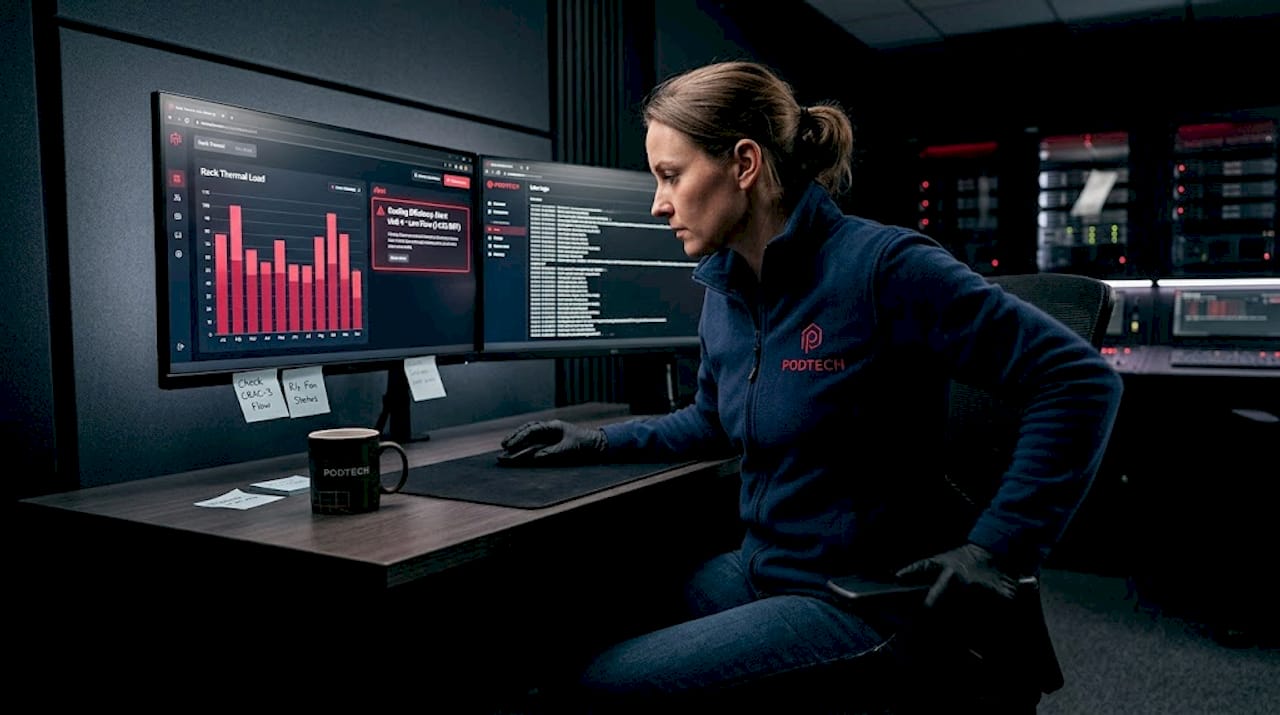
The Eaton Brightlayer platform is a strong reference point for understanding the breadth of advanced DCIM capabilities. Core features span real-time 3D rendering of physical assets, thermal imaging that maps heat distribution across racks and aisles, capacity planning workflows, and what-if scenario analysis. What-if analysis deserves particular attention: it allows infrastructure teams to model the impact of proposed changes — adding hardware, shifting load, decommissioning racks — without touching the live environment.
| DCIM capability | Operational benefit | Relevant to |
|---|---|---|
| 3D visualisation | Reduces physical audit time by up to 70% | Facilities and IT teams |
| Thermal imaging | Identifies hotspot risks before failure | Cooling and power engineers |
| Capacity planning | Prevents over-provisioning and stranded capacity | IT directors, procurement |
| What-if scenario analysis | Supports change management with zero risk | Operations and architecture teams |
| Role-based dashboards and KPI trending | Aligns reporting with business objectives | C-suite and team leads |
Pro Tip: Configure your DCIM dashboard views by stakeholder role from day one. A cooling engineer and a CTO require fundamentally different data slices. Role-based KPIs prevent information overload and ensure that each team acts on signals that are genuinely relevant to their remit. Failing to configure this early means dashboards become ignored over time, undermining the entire investment.
Broader industry analysis, including Data Centre World insights, consistently confirms that the organisations seeing the strongest ROI from DCIM are those treating it as a living operational tool rather than a static asset register. Regular what-if modelling, quarterly capacity reviews tied to DCIM outputs, and integration with procurement workflows are the hallmarks of mature DCIM adoption.
The jump from traditional monitoring to custom DCIM software is not trivial, but the operational return — particularly in avoiding unplanned downtime and stranded capacity — makes it one of the highest-impact infrastructure investments available to enterprise IT teams today.
AIOps and event correlation: Reducing noise, accelerating response
Where DCIM provides clarity at the infrastructure layer, intelligent incident detection and remediation are the next frontiers, particularly where systems must parse signals from noise. A large-scale data centre generates tens of thousands of events per day. Without the right correlation methodology, even the best AIOps tooling becomes a source of fatigue rather than clarity.
The foundational principle is this: event correlation must precede anomaly detection. Correlation is the mechanism that groups related events into actionable incidents. Anomaly detection only adds genuine value once that foundation is in place. Jumping straight to anomaly detection without correlation means your teams are chasing individual signals rather than understanding incident patterns.
Here is how an effective AIOps correlation and incident response workflow functions in practice:
- Event ingestion: All monitoring tools, DCIM platforms, device managers, and network systems feed normalised event data into the AIOps platform.
- Normalisation and enrichment: Raw events are standardised and enriched with context, including service identity, environment labels, and change management data.
- Correlation: Related events are grouped into incidents based on topology, timing, and service dependency maps.
- Prioritisation: Incidents are ranked by probable business impact, reducing the volume of alerts requiring human attention.
- Root-cause analysis: Probable root-cause analysis is surfaced, enriched with change feeds from CI/CD pipelines and change management systems, enabling faster investigation.
- Routing and remediation: Actionable incidents are routed to the appropriate team with full context attached.
Customer surveys cited in Dell’s AIOps product brief suggest that connected infrastructure observability can speed time to resolution of issues by up to 10 times, a figure that reflects the compounded benefit of reduced noise, faster root-cause identification, and contextual change data.
One of the most common and damaging implementation failures is inconsistent service labelling. When service identities, environment labels, or change tracking are applied inconsistently, the AIOps platform loses the context it needs to correlate events accurately. The result is predictable: duplicate incidents, poor routing, and a flood of low-value alerts that erode trust in the system.
To avoid that outcome, teams should establish a minimum metadata standard before onboarding sources into the platform. That standard should define naming conventions, environment tags, ownership fields, and service dependency mappings. Without this groundwork, even sophisticated machine learning models will struggle to produce reliable operational outcomes.
- Standardise labels early across infrastructure, applications, and change systems.
- Correlate before automating so remediation workflows act on incidents, not raw noise.
- Feed change data into AIOps to improve root-cause confidence and reduce investigation time.
In mature environments, AIOps is not a replacement for operational discipline. It is an amplifier of it. Organisations that pair strong event hygiene with well-integrated observability stacks consistently see the greatest gains in response speed, escalation quality, and cross-team coordination.
Device management software: The bridge between physical and digital
Device management software is often underestimated because it lacks the broad strategic framing of DCIM or the intelligence narrative of AIOps. In practice, however, it plays a critical role: it is the layer that exposes the real-time condition of the hardware estate and turns individual devices into manageable, observable assets.
This category focuses on the health and control of servers, power devices, sensors, and other infrastructure components across multi-vendor environments. It typically includes firmware visibility, thermal and power telemetry, utilisation monitoring, alerting, and remote management functions. That makes it the operational bridge between the physical device and the higher-level platforms that depend on accurate device data.
Solutions such as AMI’s Data Centre Manager demonstrate why this layer matters. They aggregate telemetry from diverse hardware, normalise it, and present a unified operational view that can then feed into DCIM and AIOps systems. Without this layer, teams often rely on fragmented vendor tools, each with its own interface, data model, and alerting logic.
| Device management function | Why it matters | Downstream value |
|---|---|---|
| Firmware monitoring | Identifies drift, vulnerabilities, and unsupported versions | Improves compliance and maintenance planning |
| Power and thermal telemetry | Surfaces localised stress before failure occurs | Feeds DCIM capacity and cooling decisions |
| Multi-vendor visibility | Reduces dependence on siloed OEM tools | Creates cleaner data pipelines for AIOps |
| Remote health and utilisation monitoring | Supports proactive maintenance and lifecycle decisions | Improves asset efficiency and service continuity |
The key mistake is assuming device management is optional if a DCIM platform is already in place. In reality, DCIM depends on accurate, timely device-level data to deliver meaningful capacity, thermal, and utilisation insights. If the underlying device telemetry is incomplete or inconsistent, the higher-level dashboards will reflect that weakness.
- Use device management to unify hardware telemetry across mixed-vendor estates.
- Treat firmware and health data as operational inputs, not just maintenance records.
- Integrate device data upward into DCIM and AIOps rather than managing it in isolation.
When deployed correctly, device management software reduces blind spots at the edge of the infrastructure stack. It gives operations teams confidence that the data feeding strategic platforms is grounded in the real condition of the hardware itself.
Perspective: Why integration trumps feature count in data centre software selection
Software selection in the data centre market is too often distorted by feature comparison sheets. Vendors compete on the length of their capability lists, while buyers are pressured to evaluate dozens of functions in isolation. But in operational reality, the decisive factor is rarely how many features a platform offers. It is how well that platform integrates into the environment you already run.
A tool with fewer headline features but strong interoperability will usually outperform a more ambitious platform that cannot exchange data cleanly with your BMS, PMS, network monitoring, CMDB, ticketing, and change systems. Integration is what turns software from a dashboard into an operational system.
What to prioritise
- Open APIs and documented connectors for existing systems.
- Data model compatibility across facilities, IT, and service operations.
- Operational workflow fit for the teams who will use the platform daily.
What to avoid
- Feature-heavy platforms with weak integration depth.
- Closed ecosystems that force expensive custom work for basic interoperability.
- Procurement decisions based on demos alone without real environment validation.
This is especially important in data centres where operational maturity varies across teams. Facilities, network, server, and service management groups often work with different tools and different assumptions about ownership. The right software strategy does not erase those differences overnight. Instead, it creates a shared operational layer where data can move reliably between them.
Integration also has a direct impact on ROI. When platforms exchange data cleanly, teams spend less time reconciling dashboards, duplicating tickets, or manually validating incidents. That translates into faster response, better planning, and lower operational friction — outcomes that matter far more than a long list of underused features.
In data centre software, the best platform is rarely the one that promises to do everything. It is the one that fits your operating model, integrates cleanly, and keeps delivering value as your environment evolves.
For that reason, selection processes should include integration workshops, proof-of-value exercises, and architecture reviews — not just procurement scoring. The goal is not to buy the most software. It is to build the most coherent software ecosystem.
Powering tomorrow’s data centre: How PODTECH supports your software ecosystem
Selecting and deploying the right mix of DCIM, AIOps, and device management software is not simply a tooling exercise. It is an architectural decision that shapes visibility, resilience, and efficiency across the whole data centre. That is why many organisations turn to specialist partners rather than trying to navigate the process alone.
PODTECH supports operators by aligning software strategy with real operational requirements. That includes helping teams define scope correctly, assess integration constraints, map data flows, and implement solutions that work across both facilities and IT domains. The objective is not to force a generic stack into place, but to create a software ecosystem that reflects the realities of your environment.
- DCIM advisory and implementation to improve capacity planning, visualisation, and operational control.
- Integration-led architecture support across infrastructure, monitoring, and service workflows.
- Custom software and consultancy where off-the-shelf tools do not fully match operational needs.
If your organisation is evaluating how to modernise its data centre software stack, the most effective next step is to start with clarity: define the role of each platform, identify the data that must flow between them, and prioritise interoperability from the outset.
Explore PODTECH’s expertise in DCIM consultancy, review our DCIM solutions case studies, or learn more about our approach to custom DCIM software. The right software ecosystem does more than monitor infrastructure — it enables better decisions at every layer of the data centre.
Frequently asked questions
What is the difference between DCIM and device management software?
DCIM provides a broad operational view from facility systems through to IT capacity and planning, while device management software focuses on the health, firmware, power, and telemetry of individual devices. Device management complements DCIM by supplying the detailed hardware data that DCIM platforms rely on.
Why is event correlation so important in AIOps?
Event correlation groups related signals into meaningful incidents before anomaly detection and automation are applied. Without it, teams receive too many disconnected alerts, making it harder to identify root cause and respond efficiently.
Can one platform handle DCIM, AIOps, and device management?
In most enterprise environments, no single platform fully replaces all three disciplines. Some tools overlap, but organisations usually achieve better outcomes by combining specialised platforms with strong integration between them.
What should teams prioritise when selecting data centre software?
Prioritise integration capability, data quality, workflow fit, and interoperability ahead of raw feature count. A platform that connects cleanly to your existing environment will usually deliver more value than one with a longer but less usable feature list.
How can PODTECH help with data centre software strategy?
PODTECH helps organisations scope requirements, evaluate platforms, design integrations, and implement software ecosystems that support both facilities and IT operations. This reduces deployment risk and improves the likelihood of measurable operational gains.