When it comes to Datacenter Infrastructure Management (DCIM), the build-versus-buy decision can make or break your operational efficiency. While off-the-shelf DCIM solutions promise quick deployment and standardised features, the reality for most modern datacenters is far more nuanced.
The Off-the-Shelf Promise vs Reality
Commercial DCIM platforms market themselves as comprehensive, turnkey solutions. They offer impressive feature lists, slick demos, and the appeal of immediate deployment. However, the moment you attempt to integrate one into your actual datacenter environment, the cracks begin to show.
Most off-the-shelf solutions are built for the "average" datacenter—a mythical facility that exists primarily in vendor marketing materials. Your datacenter, however, isn't average. It has unique equipment configurations, specific compliance requirements, particular client needs, and distinct operational workflows that evolved for good reasons.
Integration: Where Theory Meets Reality
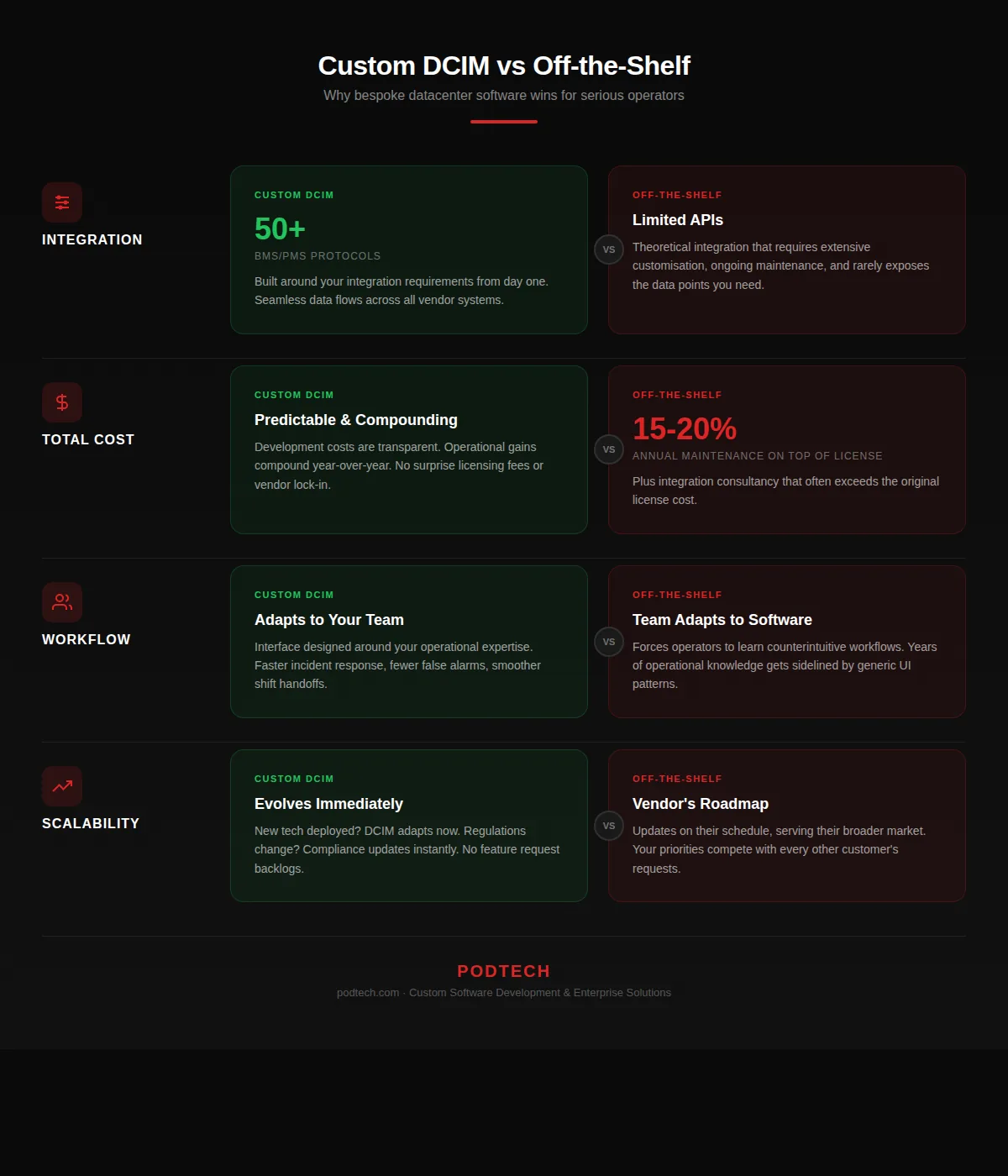
The integration challenge represents the single biggest pitfall of off-the-shelf DCIM. Modern datacenters run on ecosystems of Building Management Systems (BMS), Power Management Systems (PMS), and legacy monitoring tools—often from dozens of different vendors. Each speaks its own protocol dialect, exposes different data structures, and updates at different frequencies.
"Commercial DCIM vendors claim broad integration capabilities, but 'supports integration with System X' often means 'can theoretically connect via a limited API that requires extensive customisation and doesn't expose the data points you actually need.'"
At PODTECH, we've worked with clients who spent years trying to coerce off-the-shelf platforms to properly integrate with their existing infrastructure, only to abandon the effort. Custom DCIM, by contrast, is built around your integration requirements from day one. We've successfully integrated with over 50 different BMS and PMS vendor protocols, creating seamless data flows that commercial platforms simply cannot match.
Total Cost of Ownership: The Hidden Expenses
The sticker price of commercial DCIM software rarely tells the complete story. Licensing costs are just the beginning.
Hidden Costs of Off-the-Shelf
- • Annual maintenance fees (15-20% of license)
- • Integration consultancy (often exceeds license cost)
- • Customisation charges for missing features
- • Training for counterintuitive interfaces
- • Opportunity costs from operational inefficiencies
Custom DCIM Value
- • Predictable development costs
- • Integration built-in from day one
- • Interface designed for your team
- • Minimal training overhead
- • Operational gains compound over time
A five-year TCO comparison consistently shows custom solutions delivering better value, particularly for mid-sized and large facilities where the operational gains compound significantly.
Operational Workflow: Built for Your Team
Your operations team has developed workflows over years of experience. They know which alerts require immediate attention versus routine monitoring. They understand the cascade effects when specific systems fail. They've optimised handoff procedures between shifts.
Off-the-shelf DCIM forces your team to adapt to its workflow model. Custom DCIM adapts to your team's expertise. The difference in operational efficiency is measurable: faster incident response, reduced false alarms, smoother shift transitions, and ultimately, better uptime.
Scalability and Future-Proofing
Datacenter requirements evolve rapidly. Edge computing, GPU clusters for AI workloads, liquid cooling systems, renewable energy integration—the infrastructure landscape shifts constantly.
Commercial DCIM vendors update on their schedule, addressing their priorities, serving their broader market. Custom DCIM evolves with your needs. When you deploy new technology, your DCIM system adapts immediately, not in the next major release cycle. When regulatory requirements change, your compliance reporting updates accordingly. When you identify an operational bottleneck, the solution gets built, not added to a feature request backlog.
The PODTECH Approach: Best of Both Worlds
At PODTECH, we've refined an approach that delivers custom DCIM without the traditional drawbacks of bespoke software development. Our methodology combines:
Proven Core Frameworks
Accelerated development using battle-tested components and architecture patterns.
Pre-Built Integration Modules
Ready-made connectors for 50+ BMS/PMS systems, dramatically reducing integration time.
Rapid Mobilisation Teams
Deploy expert teams on-site for fast delivery comparable to commercial DCIM timelines.
Ongoing Evolution
Continuous support and development as your datacenter needs change and grow.
Making the Right Choice
Off-the-shelf DCIM may suit small facilities with standard configurations and modest integration requirements. For everyone else—which is most serious datacenter operators—custom DCIM delivers measurably better outcomes.
"The question isn't whether you can afford custom DCIM. It's whether you can afford the operational inefficiency, integration headaches, and hidden costs of forcing a generic solution onto your specific requirements."
If you're evaluating DCIM options, we'd be happy to discuss your specific requirements and show you what's possible when software is built around your operation rather than the other way around.