
TL;DR:
- Enterprise workflows coordinate tasks, decisions, and data across systems for operational efficiency.
- Hybrid and agentic models offer flexibility but require careful governance and testing.
- Proper orchestration, oversight, and testing are essential for safe, compliant infrastructure management.
Enterprise workflows are frequently dismissed as glorified checklists. That assumption is costly. In sectors like wastewater treatment, district heating, and data centre management, workflows are the operational backbone that determines whether systems stay compliant, assets remain healthy, and teams respond before failures occur. Modern workflows enable predictive maintenance, energy optimisation, and regulatory auditability at a scale no manual process can match. This article clarifies what enterprise workflows truly are, traces their evolution from rigid rule sets to adaptive agentic models, compares orchestration strategies, and offers practical governance guidance for IT leaders managing mission-critical infrastructure.
Table of Contents
- Understanding enterprise workflows
- Evolution from rigid to agentic workflows
- Event-driven, workflow engines and hybrid orchestration
- Human oversight and governance: testing nondeterministic workflows
- What most IT leaders miss about enterprise workflows
- Next steps: implementing a workflow solution
- Frequently asked questions
Key Takeaways
| Point | Details |
|---|---|
| Workflows power resilience | Enterprise workflows help deliver reliable, auditable operations across critical sectors. |
| Hybrid models are essential | Blending deterministic and agentic approaches maximises agility and predictability. |
| Oversight prevents risk | Human governance and staged testing are crucial for AI-driven, adaptive workflow success. |
| Orchestration strategies differ | Choosing between event-driven, workflow engines, or hybrid approaches depends on operational needs. |
Understanding enterprise workflows
An enterprise workflow is a structured sequence of tasks, decisions, and data exchanges that coordinates people, systems, and machines to achieve a defined business outcome. Unlike a simple to-do list, it carries logic. It knows who acts next, under what conditions, and what data must flow between steps.
At their core, enterprise workflows consist of three elements. Triggers initiate the process, whether that is a sensor reading breaching a threshold, a scheduled event, or a manual request. Rules govern how the workflow branches, escalates, or terminates based on conditions. Actors execute tasks, and in modern infrastructure these actors are increasingly a mix of human operators and automated systems.
In large-scale environments such as utilities, district heating networks, and pipeline management, these workflows span multiple systems and departments simultaneously. A single pressure anomaly in a pipeline might trigger a workflow that alerts a field engineer, logs the event in a compliance system, schedules a maintenance task, and notifies a regulatory body, all without human initiation.
Common features of mature enterprise workflow platforms include:
- Conditional branching based on real-time data inputs
- Role-based task assignment with escalation paths
- Audit trails for regulatory and compliance reporting
- Integration hooks connecting BMS, PMS, NMS, and SCADA systems
- SLA monitoring with automatic alerts on deadline breaches
- Version control for workflow logic changes
The value in critical sectors is substantial. Wastewater process visibility improvements at facilities like the City of Tacoma plant demonstrate how workflows provide predictive maintenance and regulatory auditability, reducing unplanned downtime and keeping operations within permitted parameters.
For IT managers evaluating enterprise automation platforms, the key distinction is whether the workflow engine can handle stateful, multi-actor processes with full traceability. That capability separates genuine enterprise tooling from lightweight task managers.
Evolution from rigid to agentic workflows
For decades, enterprise workflows followed a deterministic model. Every branch, every rule, every outcome was pre-defined by a human designer. These rigid workflows are predictable, auditable, and straightforward to certify for regulated environments. Their weakness is inflexibility. When conditions change, someone must manually update the logic.
Agentic workflows represent a fundamentally different approach. Rather than following a fixed path, they are given an outcome and allowed to determine the steps autonomously, using AI reasoning to adapt in real time. The upside is remarkable flexibility. The risk is equally significant: outputs can be unpredictable, which is a serious concern in environments where a wrong decision can affect safety or compliance.
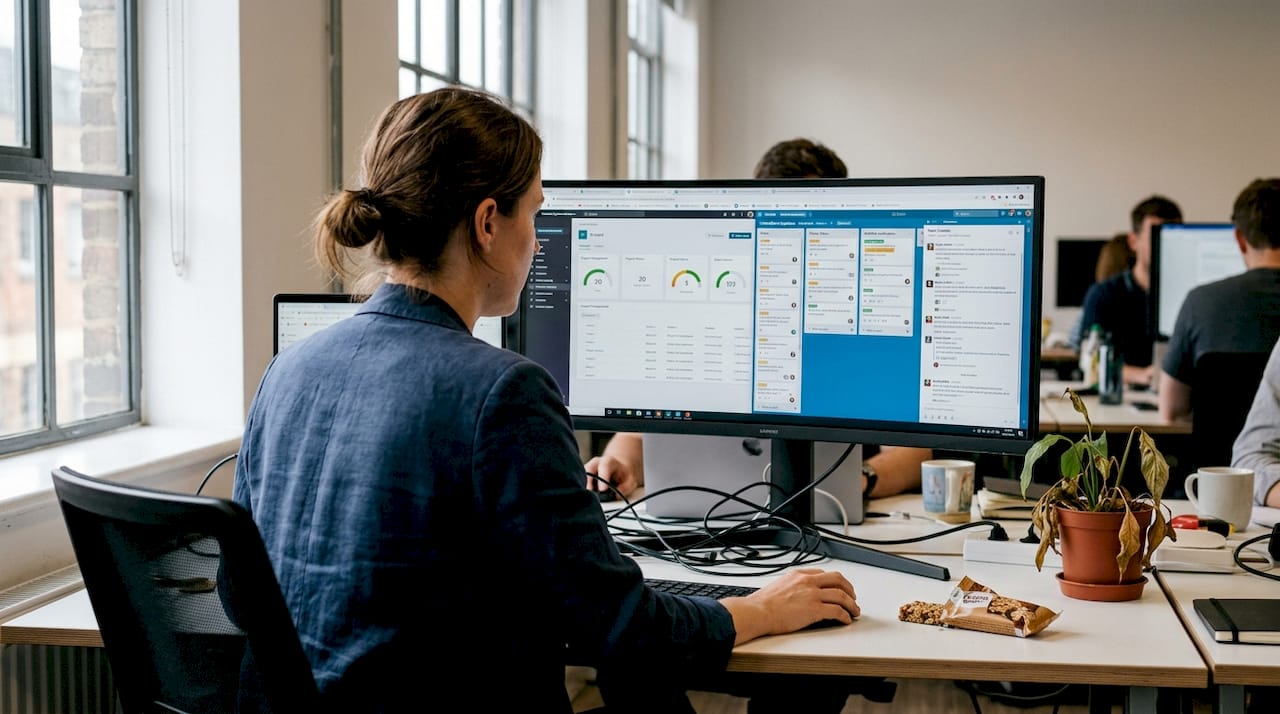
Hybrid approaches are recommended for most critical infrastructure contexts, combining the auditability of deterministic components with the adaptability of nondeterministic AI layers. A hybrid model might use rigid logic to handle regulatory reporting while deploying an agentic layer to optimise energy scheduling dynamically.
| Feature | Rigid workflow | Agentic workflow | Hybrid workflow |
|---|---|---|---|
| Predictability | High | Low | Medium |
| Auditability | High | Challenging | High (for deterministic layers) |
| Adaptability | Low | High | High |
| Governance complexity | Low | High | Medium |
| Suitability for regulated sectors | Excellent | Limited | Recommended |
The market is shifting decisively. Over 50% of enterprises are expected by Gartner to abandon assistive AI in favour of outcome-focused workflows by 2028, signalling a broad move towards agentic and hybrid models.
“By 2028, more than 50% of enterprises that have deployed AI will have shifted from assistive AI to outcome-focused agentic AI.” — Gartner, 2026
For sectors where PODTECH deploys solutions, such as AI construction safety and machine learning development, the hybrid model is not a compromise. It is the architecture that delivers both resilience and intelligence.
Pro Tip: Before deploying any agentic workflow component in a regulated environment, run it in shadow mode alongside your existing deterministic process for at least 30 days. Compare outputs, log divergences, and only promote it to live once governance criteria are satisfied.
Event-driven, workflow engines and hybrid orchestration
As workflow models evolve, so do the underlying orchestration strategies. Understanding the technical distinctions between event-driven architectures, workflow engines, and hybrid orchestration is essential before committing to any platform.
Event-driven workflows react to signals from systems in real time. When a sensor fires, a message is published, or a threshold is crossed, the workflow responds immediately. This model is highly scalable and well-suited to high-throughput environments like data centre telemetry or smart grid management. The trade-off is that state management becomes complex, and tracing a full process history can be difficult.
Workflow engines maintain explicit state. Every task, decision, and transition is recorded. This makes them inherently auditable and easier to govern. They are better suited to processes requiring human approval steps, regulatory sign-off, or long-running operations spanning days or weeks.
Hybrid orchestration blends both. Business orchestration strategies that combine event-driven responsiveness with stateful engine control are increasingly the standard for complex infrastructure environments.
| Approach | Best use case | Auditability | Scalability |
|---|---|---|---|
| Event-driven | Real-time telemetry, IoT, alerts | Moderate | Very high |
| Workflow engine | Approval chains, compliance, long-running tasks | Very high | Moderate |
| Hybrid orchestration | Complex infrastructure, multi-system integration | High | High |
When choosing an approach, consider the following:
- Use event-driven when response latency is critical and volume is high
- Use a workflow engine when auditability and human oversight are non-negotiable
- Use hybrid orchestration when your environment spans both real-time and long-running processes
- Consider your system integration case study requirements early, as integration complexity often dictates the orchestration model
For critical infrastructure, the hybrid model almost always wins. The ability to audit every decision while still responding to live system events is not a luxury. It is a requirement.
Human oversight and governance: testing nondeterministic workflows
With new orchestration models come new risks. Nondeterministic workflow components, those driven by AI or machine learning, can produce outputs that vary even when inputs appear identical. In a financial system or a utility network, that variability is not acceptable without robust governance.
Hybrid deterministic and nondeterministic processes require human oversight as a structural element, not an afterthought. Gartner’s research reinforces this: governance frameworks must be embedded into the workflow architecture itself, not bolted on after deployment.
Here is a practical sequence for testing nondeterministic workflow components before live deployment:
- Define expected output boundaries. Establish what constitutes an acceptable output range before testing begins. Without this baseline, you cannot identify when the system has failed.
- Run in parallel with the existing process. Shadow mode testing allows you to compare AI-driven outputs against your current deterministic process without operational risk.
- Log every divergence. Record all instances where the nondeterministic component produced a different result. Analyse patterns, not just individual anomalies.
- Stress-test with edge cases. Feed the workflow inputs that represent rare but plausible operating conditions, including sensor faults, delayed data, conflicting signals, and incomplete records.
- Insert human approval gates. Require operator review for high-impact decisions until the system demonstrates stable performance over time.
- Document rollback procedures. If the workflow behaves unexpectedly, teams must know exactly how to revert to the deterministic path immediately.
- Promote in stages. Move from shadow mode to limited production, then to broader deployment only after governance, safety, and compliance criteria are met.
Governance also requires clarity around accountability. If an AI-assisted workflow recommends a maintenance deferral that later contributes to an outage, who owns that decision? The answer must be defined before deployment, not after an incident review.
Strong governance frameworks typically include:
- Named workflow owners responsible for logic, outcomes, and approvals
- Versioned change control for every workflow update
- Human-in-the-loop checkpoints for safety, compliance, or financial risk
- Comprehensive logging of prompts, outputs, decisions, and overrides
- Periodic revalidation as operating conditions, regulations, and models change
In critical infrastructure, the goal is not to eliminate AI variability entirely. It is to constrain it within safe, observable, and governable boundaries.
What most IT leaders miss about enterprise workflows
Many IT leaders evaluate workflow platforms primarily through a software lens: features, integrations, licensing, and deployment speed. Those factors matter, but they are not the whole picture. In operational environments, workflows are not just software assets. They are control mechanisms.
What gets missed most often is the relationship between workflow design and operational resilience. A workflow that routes alarms poorly, escalates too slowly, or lacks state visibility can create the same practical impact as a hardware fault. The system may still be running, but the organisation is no longer responding effectively.
There are several recurring blind spots:
- Underestimating integration depth. Connecting to a system is not the same as operationally integrating with it. Data quality, timing, and semantics matter.
- Ignoring statefulness. If you cannot reconstruct what happened, when, and why, you do not have enterprise-grade workflow control.
- Over-automating too early. Removing human checkpoints before the workflow has proven itself increases risk rather than efficiency.
- Separating governance from architecture. Compliance, approvals, and audit logging must be designed in from day one.
- Optimising for demos instead of operations. A polished interface means little if the workflow cannot handle edge cases, outages, or conflicting inputs.
Another common mistake is assuming that workflow maturity is mainly about automation volume. In reality, maturity is about decision quality, traceability, and recovery. A smaller number of well-governed workflows often delivers more value than a large estate of brittle automations.
This is especially true in sectors where PODTECH operates. Whether the challenge is energy optimisation, compliance reporting, predictive maintenance, or multi-system coordination, the winning architecture is usually the one that balances speed with control.
A practical mindset shift:
Treat workflows as part of your operational infrastructure, not just your software stack. That means designing for failure handling, auditability, escalation, and human override from the start.
Next steps: implementing a workflow solution
If you are planning to implement or modernise enterprise workflows, the best results come from a staged approach. Start with operational priorities, not platform marketing. Identify the processes where better coordination, faster response, or stronger auditability will create the most measurable value.
A practical implementation roadmap looks like this:
- Map your highest-impact workflows. Focus first on processes tied to downtime, compliance exposure, safety, or energy cost.
- Document triggers, rules, actors, and systems. Build a clear picture of how work currently moves across teams and platforms.
- Choose the right orchestration model. Decide where event-driven response, stateful workflow control, or hybrid orchestration is most appropriate.
- Design governance before automation. Define approvals, audit requirements, ownership, and rollback procedures up front.
- Integrate with core operational systems. Prioritise reliable connections to SCADA, BMS, PMS, NMS, CMMS, and compliance platforms where relevant.
- Test in shadow mode. Especially for AI-assisted or adaptive components, validate outputs against existing processes before going live.
- Roll out in phases. Start with one domain, prove value, then expand to adjacent workflows and teams.
- Measure outcomes continuously. Track SLA performance, incident response time, downtime reduction, compliance accuracy, and operator workload.
Vendor selection should also reflect your operating reality. Ask whether the platform can support long-running stateful processes, human approvals, detailed audit trails, and complex integrations. If AI features are included, ask how outputs are logged, governed, tested, and overridden.
For organisations operating critical infrastructure, implementation is not just a technology project. It is an operational transformation initiative. The right workflow solution should improve resilience, not just efficiency.
If you are exploring workflow modernisation across infrastructure, automation, or AI-enabled operations, PODTECH’s work in enterprise automation, machine learning, and system integration offers a practical path from concept to governed deployment.
Frequently asked questions
What is an enterprise workflow?
An enterprise workflow is a structured sequence of tasks, decisions, and data exchanges that coordinates people and systems to achieve a business outcome. It includes triggers, rules, actors, and state tracking rather than functioning as a simple checklist.
How are enterprise workflows different from task management tools?
Task tools usually track assignments and deadlines. Enterprise workflows add branching logic, system integrations, audit trails, escalation paths, and orchestration across multiple teams and platforms.
What is the difference between rigid, agentic, and hybrid workflows?
Rigid workflows follow predefined rules and are highly predictable. Agentic workflows use AI to determine steps dynamically, which increases adaptability but reduces predictability. Hybrid workflows combine both approaches to balance control and flexibility.
When should I use event-driven orchestration?
Use event-driven orchestration when you need fast responses to real-time signals such as telemetry, alerts, or IoT events, especially in high-volume environments.
When is a workflow engine the better choice?
A workflow engine is better when processes require explicit state tracking, human approvals, compliance evidence, or long-running coordination across multiple systems.
Why is governance so important for AI-driven workflows?
AI-driven workflows can behave nondeterministically, meaning outputs may vary. Governance ensures those outputs remain observable, testable, auditable, and constrained within safe operational boundaries.
What should be tested before deploying a nondeterministic workflow?
You should test acceptable output ranges, divergence from current processes, edge cases, human approval checkpoints, rollback procedures, and staged production rollout criteria.
What systems do enterprise workflows typically integrate with?
In infrastructure environments, workflows often integrate with SCADA, BMS, PMS, NMS, CMMS, compliance systems, ticketing platforms, and telemetry pipelines.
What is the best workflow model for regulated sectors?
In most regulated sectors, a hybrid model is the strongest option because it preserves deterministic control and auditability while allowing selective use of adaptive AI where it adds value.
Build workflows that improve resilience, not just speed
PODTECH helps organisations design and deploy enterprise workflows that integrate with operational systems, support governance, and scale safely across critical infrastructure environments.