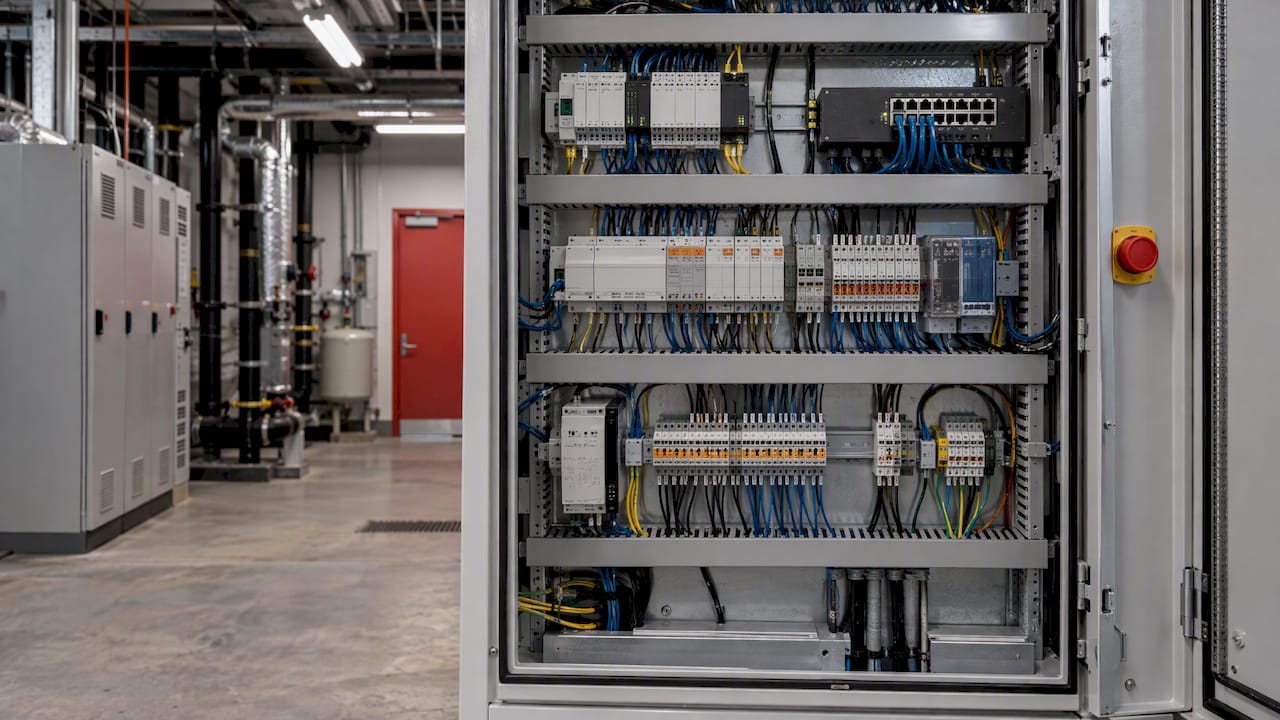
IoT data governance are the policies, roles, and controls that ensure sensor and device data remain accurate, secure, traceable, and lawful from creation to destruction. It's not device security, or network management. It's the information those devices generate, and it spans edge gateways, on-prem systems, and cloud platforms built without each other in mind. Here's a practical framework for who owns what data, how to classify it, how to manage data quality and lineage, which US regulations may apply, and how to begin.
Learn to Build Better IoT Data Platforms. PODTECH creates custom software to build telemetry and critical infrastructure platforms for enterprise teams operating connected data. Learn more at podtech.com.
TL;DR
IoT data governance treats data as an asset throughout its entire lifecycle. Device and network governance deals with the underlying infrastructure.
Beginning with ownership and classification. If you don't have an owner associated with every data stream, file, folder, link, or dataset, as well as a sensitivity level, everything else you try to control is a guess.
Do quality checks and provenance at ingest time, not after data arrives in a warehouse.
The United States does not have an overarching IoT data law. The FTC Act, sector specific regulations, and state laws may apply depending on the nature of the data and the individuals about whom it is collected.
Start with a single site and a single data domain, validate that controls work, then scale up.
Table of Contents
- What data governance for IoT actually covers
- Why IoT data is harder to govern than enterprise data
- The six building blocks of an IoT data governance framework
- Which US rules apply
- Common risks to design against
- A 90-day plan to get started
- Where governance meets the datacenter and the building
- Perspective
- Build governance into your platform with PODTECH
- FAQ
- Sources
What data governance for IoT actually covers
Published literature from 2019 defines data governance in IoT-enabled environments as follows: "...formal decision-making policies and processes aimed at governing data throughout the complete lifecycle from acquisition to disposal in distributed heterogeneous ecosystems." That publication also helpfully notes that IT governance is concerned with infrastructure assets, whereas data governance pertains to data assets and "desired business outcomes."
In practice that gives you a clear division of labour:
| Layer | Question it answers | Typical owner |
|---|---|---|
| Device governance | Is this device enrolled, patched and authorised? | Infrastructure or OT team |
| Network governance | Can this device reach only what it should? | Network and security team |
| Data governance | Ownership, quality, availability, retention? | Data owners and stewards, with business sponsors |
IoT solutions often spend the majority of their money on rows one and two and wing it on row three. The outcome is recognizable to any facilities executive who oversees multiple buildings: thousands of telemetry points, dashboards that don't agree with each other, and no one who can declare which reading is correct.
Why IoT data is harder to govern than enterprise data
Three properties make IoT different from a customer database.
Heterogeneity. One survey of the IoT-Edge-Cloud continuum observed that governing it is complex because the systems are massively heterogeneous and requires hardware-agnostic and technology-agnostic protocols for interoperability and scale. Within a datacenter or smart building that translates to BACnet, Modbus, SNMP and vendor APIs all feeding one picture.
Silos of knowledge. Researchers writing a 2024 paper about managing data within IoT-Edge-Cloud architectures note that expertise in each of these areas rarely coincide. Someone must connect the dots in design time, and there's rarely an all-encompassing standard governing integrations. Inefficient deployments and security holes to exploit emerge from there.
Speed and independence. Velocity, heterogeneity and autonomy. Conference presenters at MODSIM 2025 claim DAMA and MIKE2.0 assume centrally governed, static IT landscapes and are incapable of dealing with the velocity, diversity, and independence of IoT environments. Feel free to use their lexicon: owner, steward, policy, quality rule. However those controls need to operate near the data source, not as part of a quarterly business review.
Who does the data belong to is another question. NIST's risk guidance for IoT observes that device ownership can be diverse, and that cloud providers may have access to some or all of the data contained on a device. Manufacturer, cloud platforms, system integrators, and end users could all have access to the same data stream, which muddies accountability if contracts and policies don't define it.
The six building blocks of an IoT data governance framework
1. Ownership and stewardship
Each data stream should have one responsible owner on the business side and one steward responsible for day-to-day data quality. At the datacenter level, the owner of rack power telemetry data might be the facilities director and the steward might be a DCIM administrator. At the building level, the owner of occupancy data might be a property manager.
Document three things by domain: who has authority to determine use of the data, who is responsible to correct it when incorrect, and who else, including vendors, cloud hosts, and integrators, can access it. If ownership must be shared with a manufacturer or service provider, get those terms in writing in the contract.
2. Classification
Sensitivity first. One guide from the MetroLab Network's model order of business recommends that you classify your data into tiers, beginning with Level 0, open data. You then apply collection, retention, storage, dissemination and disposal policies from there. While it's aimed at cities and counties, the rationale applies directly to enterprise IoT.
A workable scheme for an industrial or facilities estate:
- Public or open: published energy performance figures.
- Internal: ambient temperature, humidity, fan speeds.
- Confidential: power draw per tenant, equipment inventories, network topology, process parameters.
- Restricted: any information that can be used to identify individuals, such as badge events, camera analytics, worker location, or data that would assist an attacker in mapping your facility.
Most important of all is the fourth category. Worker-safety wearables and access controls contain personally identifiable information. NIST advises maintaining an up-to-date, correct map of the PII lifecycle: what data are being acted upon, what specific data elements are processed, and who is doing the processing.
3. Data quality at ingestion
Bad data is less expensive to filter at the gateway than to clean in the lake. Recommended baseline assessments by the MetroLab guide include completeness, uniqueness, accuracy and timeliness: missing values, duplicates, anomalies and update frequency.
Translated into IoT rules:
- Completeness: raise an alert on a sensor that fails to report for longer than a configurable number of periods.
- Uniqueness: deduplicate messages replayed after a network drop.
- Accuracy: reject physically impossible values and flag sudden jumps against neighbouring sensors.
- Timeliness: record both device time and ingest time, and alert on drift.
Document these policies in the same catalogue where you store your data so analysts are aware of what processing a value has already undergone.
4. Provenance and lineage
If someone asks you why a number is the number that it is, lineage is your answer. As part of a 2026 industrial IoT reference architecture, authors propose that provenance assertions accompany every batch, with a logical identity, calibration reference, and ingest timestamp embedded with it. Instead of treating provenance as an afterthought, it becomes a first-class ingestion concern.
It also describes separating ingestion, an append-only provenance ledger, and policy enforcement into independently versioned layers. A practical advantage is that you can change a retention rule or an access policy without re-plumbing the pipeline. The MetroLab guide makes a similar point about keeping provenance records available even after systems are decommissioned. That's important for legacy modernisation, where the old system's history is often the only evidence you have.
5. Access control and data flow
Role-based dataset access is the foundation. Alone it isn't sufficient for IoT however. Work on flow-based data control says that on distributed systems you have to control how data is aggregated and shared to protect trade secrets and private parameters, not just who can access a resource.
Best practice: bind access to classification level, audit every export, and inspect joins that correlate datasets. Innocuous inputs, such as a shift schedule and a door access log, can create something classified.
6. Security and privacy controls
NIST identifies three objectives when mitigating IoT risks: securing the device, securing data and privacy for individuals. The latter two fall under data governance. Requirements for securing the device are described in an IoT cybersecurity baseline including identification, software and firmware updates, data protection, and limiting logical access in NIST's IoT cybersecurity baseline documentation. The same document advocates for writing requirements in an outcome-based manner. You should define what you need, but allow each environment to do so in a way that works for them.
See our post about identity-first controls for remote monitoring for this side of the equation, and our comprehensive industrial IoT security roadmap for phased implementation.
Which US rules apply
There is no single US "IoT data law". It depends on the data and industry sector.
FTC Act. The FTC's staff has said that the Act is the principal federal statute prohibiting unfair or deceptive privacy and security practices. That same comment also suggests adopting reasonable security programs, including security designed into the system from the beginning, employee training, vendor management to protect downstream users and customers, and defense in depth. It also references sector specific laws that cover credit and financial information, like the FCRA and GLBA.
- Federal IoT procurement. The IoT Cybersecurity Improvement Act of 2020, signed as Public Law 116-207 in December 2020, tasks NIST and OMB with establishing guidelines for federal agencies to follow when procuring and operating IoT tech. If you have federal agencies in your customer base, it will affect what they require of you.
- Sector and state rules. Financial services, health care and critical infrastructure operators have their own sets of rules to follow. Many state privacy laws also come into play if you handle any personal information. Have your lawyer tell you which ones apply to your operations before setting retention periods.
FTC staff believes technology-neutral privacy and security rules trump IoT-specific legislation. What you should plan for: your governance policy should be able to demonstrate reasonable, documented, proportionate practice that you actually implement. Regulators won't care about a policy that says one thing while the system does another.
Common risks to design against
NIST's IoT security guidance names unauthorized access, misuse of data and the re-identification of supposedly anonymised data as some of the primary risks. Throw in the operational ones:
- Orphaned data streams. A sensor network running in pilot mode with no identified owner continues to collect and expose data.
- Vendor sprawl. Each new platform multiplies the copies of the data and creates another way to access that data.
- Silent quality decay. Calibration drift goes unnoticed because dashboards still look plausible.
- Retention by accident. Raw telemetry kept indefinitely because deletion was never specified.
Weak devices as initial attack vectors matter too. Poor IoT governance provides openings for weaponised DDoS attacks as described in the MODSIM paper, using the loss of the Mars Orbiter as an example of how much things can cost due to data-governance failures.
A 90-day plan to get started
Don't attempt to control all sensors at once. Choose one area where data already dictates action, like datacenter power and cooling telemetry or site safety analytics.
Days 1 to 30: map and assign.
- Inventory data streams: source, protocol, destination, consumers.
- Name an owner and a steward for each.
- Classify each stream and mark anything that touches personal data.
- Map the lifecycle of personal data using the NIST elements above.
Days 31 to 60: control.
- Write a short, formal data security and retention policy.
- Implement the four quality checks at the gateway or ingestion layer.
- Attach provenance metadata to each batch.
- Align access roles with classification levels.
Days 61 to 90: monitor and train.
- Measure what percentage of your streams have a named owner.
- Track the share of assets failing quality rules.
- Monitor how long it takes to revoke vendor access.
- Conduct your first audit on data management. The MetroLab playbook advises periodic audits with position-appropriate training for staff members and relevant third parties.
- Review results with the business sponsor, then extend to the next domain.
To ensure continuous confidence, NIST's risk management guidance recommends continuous monitoring and ongoing authorization. Build security and privacy controls into your system development lifecycle. Don't gate governance at the end of delivery.
Where governance meets the datacenter and the building
Facilities management usually sees the governance issue manifest at the integration layer. Building management systems, power monitoring systems, and network management systems each have a piece of the truth, and the integration layer decides if the converged data can be trusted. Our writeup on DCIM hardware: Unique Challenges demonstrates how much of the inconsistency begins with the hardware itself, and our DCIM datacenter glossary definition explains the breadth of that solution.
Safety data should be treated differently. Camera and sensor analytics can include people on job sites, so classification and retention policies should be considered during the first pilot. Learn how construction site leaders leverage safety data here. Read about one specific deployment here.
Perspective
Same thing applies with most critical infrastructure projects: sensors check OK, dashboards installed. Nobody confidently knows which number to believe. That is a governance gap. Not a hardware gap.
We believe that governance needs to be baked into the integration layer, rather than applied retrospectively. Data from BMS, PMS and NMS sources which is normalised, tagged with source system information and validated at ingest time automatically has quality and lineage built into the design. Applying it after the fact to multiple disparate systems takes longer and costs more.
That's how we tackle custom software and integrations projects. Working on over 250 delivered projects, many in highly regulated, compliance-driven spaces, we've learned to ask who owns the data before we ask what protocol it speaks. Teams that start with the former end up with platforms that are easier to audit, easier to extend and easier to hand off.
The software layer between failure and success is often a single well-governed data model.
Harry
Build governance into your platform with PODTECH
When your telemetry covers multiple systems and no one owns the full stack, the fastest improvement is often in the glue. We design and develop custom software for data centres, intelligent buildings and industrial facilities. That includes BMS, PMS and NMS integration, datacenter telemetry, legacy modernisation and machine learning. Whether dedicated teams or staff augmentation, we can work with your existing staff.
Learn more about our BMS and PMS integration solutions, our legacy modernisation strategy or contact us about a custom project.
FAQ
What is the difference between IoT governance and IoT data governance?
IoT governance spans the devices, the networks they connect to and their security: enrolment, patching and connectivity. IoT data governance spans the information those devices collect: ownership, classification, quality, lineage, access and retention. Both are required. The data layer is most often orphaned.
Who should own IoT data?
There should be a business-side owner responsible for each data domain who delegates day-to-day quality maintenance to a technical steward. Since the same stream can be touched by manufacturers, cloud providers and end users alike, NIST points out that ownership will often be shared, so define roles and access conditions in contractual agreements as well as policy.
Is there a US law specifically for IoT data?
Not one federal law. Depending on your customers and the data involved, the FTC Act, industry regulations like GLBA and FCRA, various state privacy laws, and for federal customers the IoT Cybersecurity Improvement Act of 2020 will apply. Verify with legal what applies to your industry.
Where should data quality checks run?
Validate as near to origin as is reasonable: at the gateway or ingestion pipeline. Validate completeness, duplication, aberrations and timeliness there. Log what passed for each batch. It's less expensive than cleaning data post-distribution to dashboards and reports.
How long does it take to start?
Take about 90 days to map, classify, and implement basic controls for a single focused domain. Then continue to scale one domain at a time, using your defined indicators to demonstrate the controls are effective.
Sources
- A Conceptual Framework for Data Governance in IoT-enabled Environments
- A Survey on IoT-Edge-Cloud Continuum Systems
- A Set of Tools and Data Management Framework for the IoT-Edge-Cloud Continuum
- Toward an Internet of Things data governance approach (MODSIM 2025)
- NIST IR 8228: Considerations for Managing IoT Cybersecurity and Privacy Risks
- MetroLab Model Data Governance Policy and Practice Guide
- A Reference Architecture for Industrial IoT Data (JIPCET, 2026)
- LUCON: Data Flow Control for Message-Based IoT Systems
- NIST IoT cybersecurity baseline presentation (2020)
- FTC staff comment on the Internet of Things (2016)
- IoT Cybersecurity Improvement Act of 2020, H.R.1668
- NIST SP 800-37 Rev. 2 discussion draft
Recommended
- 3–12 Month Industrial IoT Security Roadmap for Enterprise Teams
- Top telemetry tools for UK enterprise infrastructure in 2026
- Start With Telemetry: OT Engineers' SCADA Cloud Migration Blueprint
Map MQTT QoS to Risk for IoT Engineers: 3 Levels and When to Use Each