TL;DR:
- Standard infrastructure often limits performance and flexibility under demanding workloads like AI and HPC.
- Custom physical and software solutions optimise power, cooling, and management for higher density and better efficiency.
- Strategic implementation with early stakeholder engagement helps ensure tailored environments meet operational needs and future growth.
Standard infrastructure assumptions are quietly costing data centres performance, money, and future flexibility. As the role of custom solutions in data centres becomes harder to ignore, IT leaders and facility decision-makers are rethinking the off-the-shelf default. AI workloads, high-performance computing, and hybrid cloud architectures are placing demands on infrastructure that generic configurations were never designed to meet. This guide covers what actually changes when you move from standardised to tailored approaches, across physical infrastructure, modular construction, software-defined management, and practical implementation.
Table of Contents
- Key takeaways
- Why standardised solutions fall short in modern data centres
- Custom physical infrastructure and its impact
- Modular and digitally orchestrated infrastructure
- Custom software and automation in data centre operations
- Implementing custom solutions strategically
- My honest take on custom solutions
- How Podtech supports custom data centre environments
- FAQ
Key takeaways
| Point | Details |
|---|---|
| Standard kit has limits | Off-the-shelf infrastructure creates bottlenecks under AI, HPC, and high-density workloads. |
| Physical customisation matters | Tailored racks, power distribution, and cooling directly improve efficiency and reduce fitment failures. |
| Modular builds accelerate delivery | Factory-built modular components reduce onsite labour and support consistent operational governance. |
| Software customisation is equally critical | Custom automation and DCIM integration reduce manual overhead and improve predictive reliability. |
| Telemetry must be planned upfront | Defining DCIM and BMS integration contracts before customising hardware prevents costly operational blind spots. |
Why standardised solutions fall short in modern data centres
The role of custom solutions in data centres becomes clearest when you look at what standardised infrastructure cannot do. A decade ago, most racks held similar 1U or 2U servers. Cooling was a facility concern, not a per-rack concern. Power distribution was largely predictable. That world has changed considerably.
AI training clusters and HPC nodes now draw between 30kW and 100kW per rack. Standard 42U cabinets with basic top-of-rack cooling cannot handle that thermal density. GPU-accelerated workloads require bespoke configurations matching performance, density, and thermal requirements that generic hardware solutions simply cannot match. When you force a high-density AI server into a rack designed for conventional compute, you are accepting compromises in airflow, cable management, and power delivery before you have even powered the system on.
The bottlenecks compound quickly:
- Power distribution: Standard PDUs and busbar configurations are sized for average loads, not peak AI inference or training demands.
- Cooling pathways: Generic hot-aisle/cold-aisle containment works for moderate densities but breaks down above 15kW per rack without modification.
- Rack dimensions: Many liquid-cooled or direct-to-chip cooling solutions require non-standard rack depths and widths not accommodated by catalogue options.
- Scalability ceilings: Facilities built on standardised, inflexible components struggle to expand without expensive retrofits.
Hybrid cloud adds another layer of complexity. When you need on-premises infrastructure to mirror the performance characteristics and API behaviour of cloud environments, standardised physical plant rarely keeps up. The gap between what you need and what off-the-shelf provides is precisely where tailored data centre strategies deliver measurable returns.
Custom physical infrastructure and its impact
The most immediate benefits of custom solutions appear in the physical layer. Racks, power distribution, and cooling are the three areas where tailored design produces the most direct gains in efficiency and operational reliability.
Racks built for the actual workload
Custom rack solutions meet the exact physical constraints of AI deployments, accommodating non-standard server and cooling equipment sizes with configurations that include variable rack dimensions, panel styles, cable management, and rPDU plug options. The practical benefit is straightforward: you stop forcing equipment into spaces that do not fit and start building environments where every component was specified for purpose.
Colour coding and consistent labelling within custom rack designs also reduce human error during maintenance. When your operations team can identify power circuits, network connections, and cooling lines by colour at a glance, incident response times improve and misrouting errors drop.
Power distribution tailored to your load profile
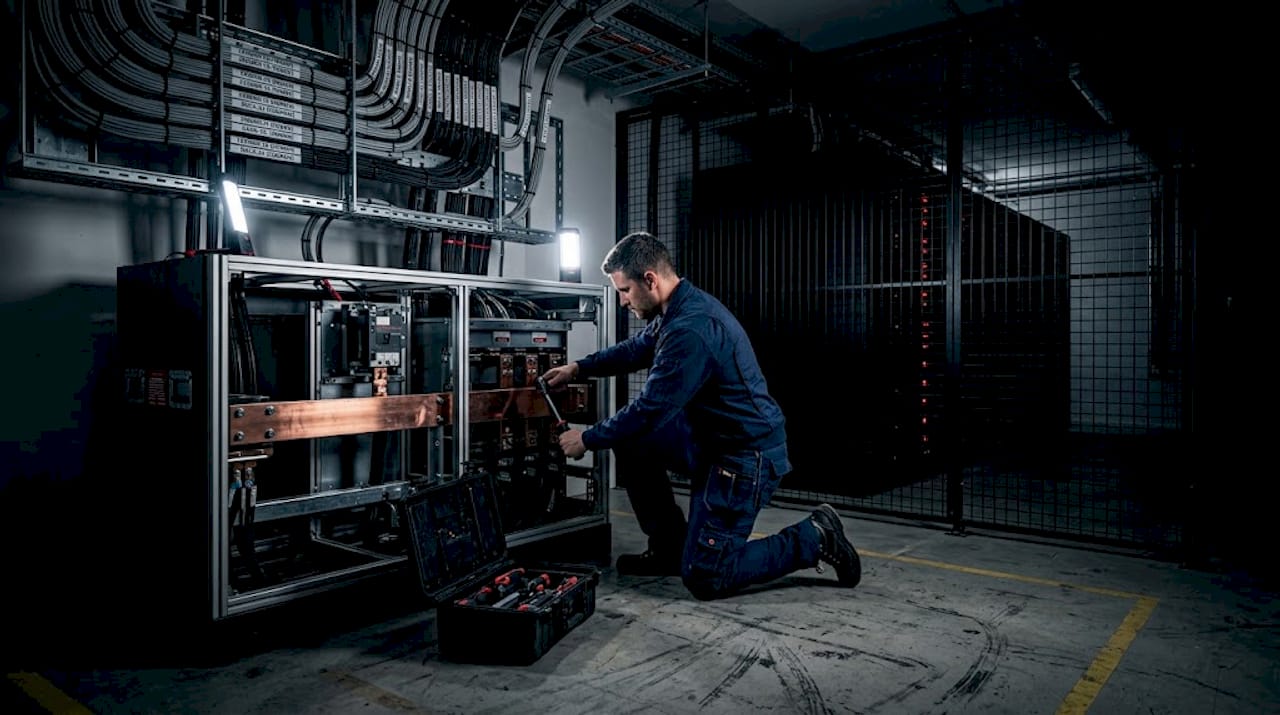
Precision-engineered busbars crafted from copper or aluminium to exact mechanical and electrical specifications reduce resistive losses and integrate cleanly within switchgear. Standard busbar configurations are often over-specified for low-load scenarios and under-specified for burst AI workloads. Custom designs match your actual load profile, which directly reduces wasted energy and improves long-term efficiency.
Cooling designed around specific thermal envelopes
Custom cooling directs airflow with precision. Rather than relying on blanking panels and containment curtains to compensate for layout mismatches, a facility designed with tailored cooling routes air exactly where it needs to go and extracts heat at the source. This is particularly important for liquid-cooled rear-door heat exchangers and direct-to-chip systems, which require rack dimensions and manifold configurations that standard offerings do not provide.
| Feature | Standardised | Custom |
|---|---|---|
| Rack fit for AI/HPC | Forced compromises | Specified to exact dimensions |
| Power distribution | Fixed load configurations | Matched to actual peak demand |
| Cooling design | Generic containment | Targeted, thermally optimised |
| Telemetry integration | Inconsistent | Defined upfront in specification |
| Operational labelling | Generic | Colour-coded, role-specific |
Pro Tip: When specifying custom racks, include your DCIM integration requirements in the initial brief. Retrofitting telemetry sensors and management APIs to custom hardware after installation costs significantly more than defining those contracts at design stage.
Modular and digitally orchestrated infrastructure
Physical customisation does not have to mean slow or expensive deployment. Modular construction changes that equation substantially.
Factory-built modular components reduce onsite labour and construction time while supporting consistent operational and security standards. Modules are built, tested, and commissioned in a controlled factory environment before arriving on site. That means your custom power and cooling configurations are validated before installation, not during it. Parallel commissioning becomes possible because different modules can progress simultaneously rather than sequentially.
The governance advantages are equally significant. Modularisation acts as an operational governance lever, enabling tighter cybersecurity, compliance, and operating consistency by unifying design and vendor management. When every module follows the same build standard, auditing is simpler, vendor accountability is clearer, and operational runbooks apply consistently across the facility.
Digital twin orchestration is where modular and custom approaches converge most powerfully. Early constraint integration via digital twin modelling improves design certainty and reduces late-stage rework during AI data centre deployment. When your custom rack dimensions, cooling manifold locations, and busbar routing are modelled digitally before a single component is fabricated, you surface conflicts in the model rather than on the floor.
Vertiv’s OneCore platform illustrates this well. It combines factory-integrated power, cooling and control systems to reduce on-site labour and improve deployment speed, demonstrating that the digital orchestration layer is not separate from the custom physical layer. The two are designed together from the start.
Infrastructure-as-code extends this further. When your custom physical environment is paired with software-defined management, you can define workflows, maintenance schedules, and alerting thresholds as code. Changes are version-controlled, repeatable, and auditable. That is the difference between a facility you manage reactively and one you operate predictively.
Pro Tip: Resist the temptation to over-standardise modular designs in pursuit of cost savings. A module that cannot accommodate a 10% increase in rack density without structural rework defeats the purpose of building for adaptability. Build a defined tolerance for density growth into every modular specification.
Custom software and automation in data centre operations
Physical customisation without corresponding software customisation creates a visibility gap. The custom solutions impact on efficiency at the software layer is often underestimated, yet it directly determines whether your tailored infrastructure performs as designed or underperforms due to manual operational overhead.
Modern data centre modernisation depends on software-defined automation and infrastructure-as-code approaches to reduce manual processes and enable predictive optimisation. For custom environments, this matters even more. When your power distribution and cooling configurations deviate from standard templates, your monitoring and automation tools need to be configured to reflect that reality. Generic DCIM templates will not cover custom busbar topologies or non-standard rack sensor placements.
Practically, this means your software stack should be designed around the operating model of the site, not around the assumptions of a generic product. Alert thresholds should reflect actual thermal envelopes. Capacity planning should account for real rack density and burst behaviour. Maintenance workflows should map to the exact equipment and escalation paths your team uses.
Custom automation also reduces the operational drag that often appears after a bespoke physical build is complete. Without it, teams end up managing advanced infrastructure with spreadsheets, disconnected dashboards, and manual checks. That is where expensive custom hardware can still produce mediocre outcomes. The software layer is what turns tailored infrastructure into a coherent operating system.
- Custom DCIM integration gives operators a single view across power, cooling, environmental telemetry, and asset state.
- Automation workflows reduce repetitive manual tasks such as threshold tuning, incident routing, and maintenance scheduling.
- Predictive analytics become more accurate when fed with telemetry from systems that were instrumented intentionally from the start.
- Infrastructure-as-code practices make changes repeatable, reviewable, and easier to audit across complex environments.
The strongest custom environments treat software and hardware as one design problem. If the physical layer is tailored but the management layer remains generic, the result is usually operational friction. If both are designed together, the result is better uptime, faster troubleshooting, and more confident scaling.
Implementing custom solutions strategically
Customisation delivers the best results when it is approached strategically rather than reactively. The goal is not to customise everything. The goal is to customise the parts of the environment where standardisation creates measurable constraints.
That starts with early stakeholder alignment. Facilities teams, IT operations, network engineering, procurement, security, and executive sponsors all need to agree on what problem the custom solution is solving. Is the priority higher rack density, lower energy waste, faster deployment, improved observability, or future AI readiness? Different priorities lead to different design choices.
It also means defining interfaces early. Telemetry, BMS integration, DCIM contracts, API requirements, and maintenance ownership should be documented before fabrication or deployment begins. Many custom projects run into avoidable issues not because the hardware is wrong, but because the integration model was left vague until late in the process.
A practical implementation approach usually follows a sequence like this:
- Assess workload and density requirements so the design reflects actual compute, storage, and thermal demand.
- Map operational constraints including floor space, power availability, cooling capacity, compliance obligations, and staffing realities.
- Define integration requirements upfront for DCIM, BMS, monitoring, APIs, and telemetry.
- Prototype or model digitally to identify clashes before procurement and site work.
- Deploy in controlled phases so lessons from the first implementation improve the next one.
- Measure outcomes continuously against efficiency, uptime, density, and operational workload targets.
Strategic implementation also requires discipline around lifecycle planning. A custom environment should not be a one-off engineering exercise. It should be a platform that can evolve. That means planning for spare capacity, upgrade paths, serviceability, and software extensibility from the beginning.
The organisations that get the most value from custom solutions are usually the ones that treat them as part of a broader operating model, not just a procurement decision.
My honest take on custom solutions
Custom solutions are not automatically better just because they are custom. Poorly scoped customisation can create complexity, vendor dependence, and support headaches. If a standard component already meets the requirement cleanly, forcing a bespoke alternative can be a mistake.
But in modern data centres, especially those supporting AI, HPC, hybrid cloud, or unusual operational constraints, the idea that standard infrastructure is always the safer option no longer holds up. In many cases, standardisation simply hides the cost. You pay later through wasted power, cooling inefficiency, awkward retrofits, monitoring blind spots, and operational workarounds.
The real question is not whether to customise. It is where customisation creates enough operational or financial value to justify itself. For high-density environments, that threshold is often reached much sooner than people expect.
My view is simple: customise where the workload, density, or operating model demands it; standardise where it does not. The best data centre strategies are rarely ideological. They are selective, evidence-based, and grounded in how the facility will actually be run.
How Podtech supports custom data centre environments
At Podtech, we work with operators that need infrastructure and management approaches aligned to real operational conditions, not generic assumptions. That includes environments with mixed legacy systems, high-density deployments, non-standard telemetry requirements, and evolving automation goals.
Our approach focuses on connecting the physical and digital layers properly. That means helping define integration requirements early, shaping DCIM and monitoring around the actual site, and reducing the friction that appears when bespoke infrastructure is managed with generic tooling.
Whether the challenge is visibility, orchestration, integration, or long-term scalability, the aim is the same: create a data centre environment that is easier to operate, easier to scale, and better aligned with the workloads it supports.
Need a more tailored operating model?
Podtech helps data centre teams design and manage environments where custom infrastructure, observability, and automation work together from day one.
FAQ
What are custom solutions in data centres?
Custom solutions are tailored physical or software components designed around a specific data centre’s workload, density, operational model, or integration requirements. They can include bespoke racks, power distribution, cooling layouts, telemetry design, automation workflows, and DCIM integrations.
Why do standardised data centre solutions fall short for AI workloads?
AI and HPC environments often require much higher rack densities, more precise cooling, and more robust power delivery than standard infrastructure was designed to support. Off-the-shelf configurations can create airflow issues, power bottlenecks, and scaling limits in these environments.
Are custom data centre solutions always more expensive?
Not necessarily. Upfront costs can be higher, but tailored solutions often reduce long-term waste, retrofits, downtime risk, and manual operational overhead. The right comparison is total lifecycle value, not just initial purchase price.
What should be customised first in a high-density deployment?
In most high-density environments, the first priorities are usually rack design, power distribution, cooling architecture, and telemetry integration. These are the areas where standard assumptions tend to break first.
How important is software customisation compared with physical customisation?
It is equally important. A custom physical environment managed through generic software often creates blind spots and manual workarounds. Custom software integration ensures the infrastructure can be monitored, automated, and operated as intended.
When should DCIM and BMS integration be planned?
As early as possible. Integration requirements should be defined during the design stage, before hardware is fabricated or installed. Planning telemetry and API contracts upfront avoids expensive retrofits and operational visibility gaps later.