
TL;DR:
- AI transforms business operations by replacing task automation with continuous workflow execution managed by intelligent agents. Organizations that redesign processes around AI achieve significant productivity boosts, cycle time reductions, and profitability improvements.
Artificial intelligence is now the primary driver of operational efficiency gains in enterprise organisations, moving well beyond simple task automation into end-to-end process execution. The role of AI in operational efficiency is best understood not as a productivity tool bolted onto existing workflows, but as a fundamental redesign of how work gets done.
Organisations that treat AI as an add-on capture only marginal gains. Those that rebuild their operating models around AI agents are reporting three-fold productivity boosts, 80% reductions in cycle time, and long-term cost savings exceeding 60%. The difference between those two outcomes is almost entirely a question of approach.
How does AI transform traditional business operations?
AI transforms business operations by shifting from episodic task assistance to continuous, end-to-end workflow execution. Traditional automation handles discrete, rule-based steps. AI-powered operations use agents that maintain context, accumulate institutional memory, and manage multi-step processes without constant human intervention.

The concept of long-running AI agents is central to this shift. Unlike a chatbot that answers a single query, an agentic AI system tracks goals across time, recalls previous decisions, and adapts its execution as conditions change. This is what makes it possible to automate complex, judgement-heavy workflows rather than just repetitive clerical tasks.
The practical difference shows up in cycle times and throughput. BCG reports that organisations transitioning to agentic AI execution achieve an 80% reduction in cycle time across target processes. That is not an incremental improvement. It represents a structural change in how fast an organisation can operate.
Three shifts define this transformation:
- From task automation to process ownership. AI agents do not just complete steps. They manage entire workflows, escalating to humans only when genuinely novel decisions arise.
- From static rules to adaptive execution. Agentic systems learn from operational history and adjust their behaviour, reducing the need for constant reprogramming.
- From human-as-executor to human-as-supervisor. The transition to hybrid human-AI teams moves people from doing tasks to overseeing AI execution and designing better processes.
Pro Tip: Before deploying any AI agent, map the full workflow it will own. Identify every decision point, exception type, and handoff. Agents perform best when their scope is clearly defined from the outset.
What are common pitfalls when implementing AI for efficiency?
The most common mistake organisations make is deploying AI onto broken processes. BCG describes this as “acceleration without simplification”: applying AI to fragmented, inefficient workflows does not fix them. It amplifies their problems at speed. A process that was slow and error-prone becomes fast and error-prone, with errors now occurring at scale.
60% of organisations fail to capture meaningful value from AI because they leave underlying workflows untouched. They add AI as a layer on top of existing systems and wonder why the gains are incremental. The answer is that AI cannot compensate for a poorly designed process. It can only execute what it is given.
McKinsey’s analysis confirms that AI delivers bigger financial gains only when companies redesign workflows rather than treating AI as an add-on. The step-change outcomes come from hybrid human-AI execution built into a redesigned operating model.
Avoiding these pitfalls requires a disciplined sequence:
- Audit the process first. Identify bottlenecks, redundant steps, and decision points that require human judgement. Fix structural problems before introducing AI.
- Define the human-AI boundary. Decide which decisions AI agents will own, which they will recommend, and which remain with people. Ambiguity here creates governance failures.
- Build observability into the system. Agentic AI governance requires memory hygiene, permissions, and rollback controls. You need to see what the agent is doing and be able to override it.
- Plan for workforce adaptation. Roles change when AI takes over execution. Communicate clearly, retrain early, and involve frontline teams in redesign.
- Avoid pilot paralysis. Running perpetual pilots without scaling produces no lasting value. Set a clear path from proof of concept to production deployment.
Pro Tip: Treat your first AI deployment as a process redesign project, not a technology project. The technology is the easy part. Redesigning how your team works around it is where the real effort lies.
What financial impact have companies seen from AI agents in workflows?
The financial case for embedding AI agents into operations is now well-evidenced. Logistics firm C.H. Robinson achieved a 45% productivity gain by deploying AI agents in complex workflows as of july 2026. That gain did not come from automating simple tasks. It came from agents managing multi-step logistics decisions that previously required significant human coordination.
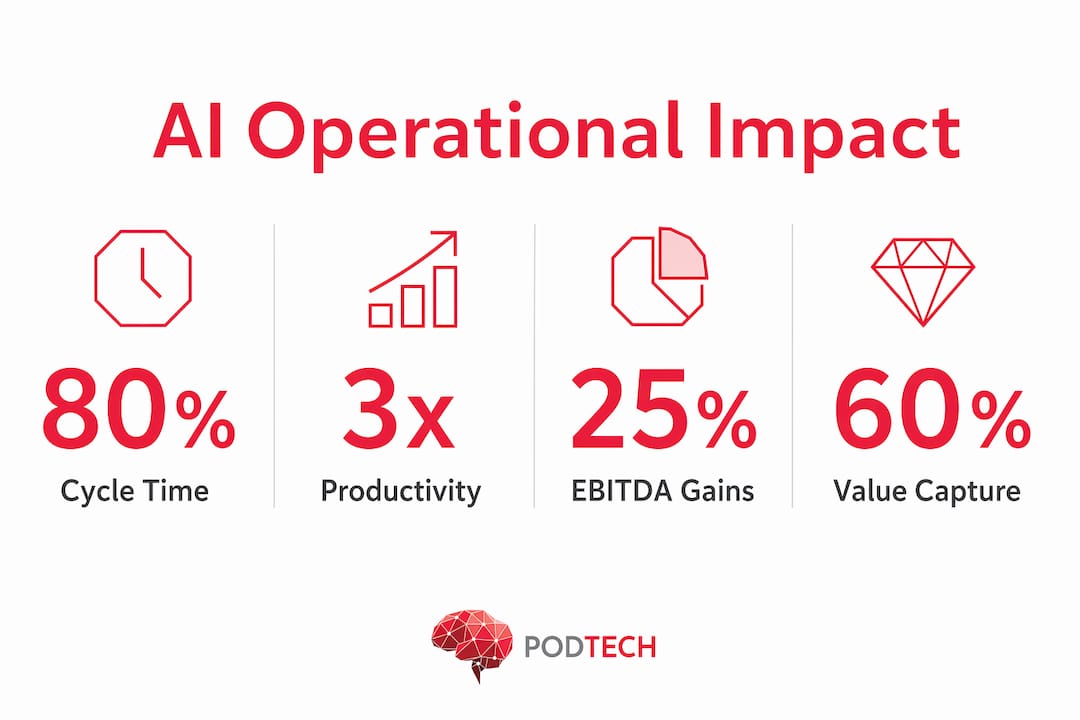
At the enterprise level, leading organisations scaling AI across their operating models report EBITDA gains of 10–25%. These are not efficiency savings at the margin. They represent a structural improvement in profitability driven by lower operational costs and higher throughput.
Meta’s engineering teams offer a high-scale example. Their unified AI platform compresses hours of manual root-cause investigation into minutes, and scales capacity management without proportional headcount growth. Engineers shifted from investigators to reviewers of AI-generated fixes. The output per person increased dramatically without adding staff.
The table below shows the performance contrast organisations typically see before and after embedding AI agents into core workflows.
| Metric | Before AI agents | After AI agents |
|---|---|---|
| Cycle time | Baseline | Up to 80% reduction |
| Productivity per employee | Baseline | Up to three-fold increase |
| EBITDA margin | Baseline | 10–25% improvement |
| Headcount growth needed to scale | Proportional | Decoupled from output |
| Error rate in complex workflows | High (manual) | Reduced through consistent execution |
The pattern across these cases is consistent. Organisations that redesign workflows and embed AI agents at the execution layer see compounding gains. Those that deploy AI as a reporting or advisory tool see modest improvements that plateau quickly.
How can organisations implement AI for operational efficiency successfully?
Successful implementation starts with outcomes, not technology. Before selecting any AI tool or platform, define the operational result you need: faster cycle times, lower error rates, reduced headcount dependency, or higher throughput. Work backwards from that outcome to identify which processes need redesigning and where AI agents add the most value.
The most effective organisations build what BCG calls an “agentic process transformation factory”: a dedicated team that redesigns processes from outcomes back to execution, embeds AI agents, and governs their performance continuously. This is not a one-time project. It is an ongoing operational capability.
The technical and data foundations matter enormously. AI agents require clean, accessible data to function reliably. Fragmented data architectures, legacy systems with poor API connectivity, and inconsistent data quality all limit what agents can do. Addressing these foundations early prevents costly rework later. PODTECH’s work in legacy modernisation and system integration addresses exactly this layer, building the data infrastructure that AI-powered operations depend on.
Key implementation priorities for business leaders:
- Start with high-volume, high-complexity processes. These offer the greatest return and the clearest case for AI agent deployment.
- Invest in governance from day one. Agentic AI systems need defined permissions, audit trails, and rollback mechanisms before they go live in production.
- Build cross-functional redesign teams. Process owners, technology leads, and frontline staff must all participate. AI implementation that excludes the people doing the work fails at adoption.
- Measure continuously. Set baseline metrics before deployment and track them weekly. Gains should be visible within the first quarter if the process redesign was sound.
- Scale what works. Once a redesigned process with AI agents proves its value, replicate the model across adjacent workflows rather than starting from scratch each time.
Key takeaways
AI delivers transformational operational gains only when organisations redesign workflows around AI agents rather than layering AI onto existing processes.
| Point | Details |
|---|---|
| Redesign before deploying | Fix broken workflows first; AI amplifies inefficiencies if processes are not simplified. |
| Agentic AI changes roles | Humans shift from task executors to supervisors and designers of AI-managed processes. |
| Financial gains are measurable | Organisations report 10–25% EBITDA improvement and up to 80% cycle time reduction. |
| Governance is non-negotiable | Agentic systems require defined permissions, memory controls, and rollback capability. |
| Scale from proven models | Replicate successful AI-redesigned processes across the organisation rather than running perpetual pilots. |
Why most AI efficiency projects underdeliver (and what I think changes that)
The organisations I see struggling with AI efficiency are not failing because of the technology. They are failing because they treated AI as a procurement decision rather than an operational redesign. They bought a capability, pointed it at an existing process, and expected transformation. What they got was a faster version of the same problem.
The shift I find most underappreciated is the human role change. When AI agents take over execution, the people who used to do those tasks do not simply disappear. They need to become supervisors, exception handlers, and process designers. That transition requires deliberate investment in training and role clarity. Without it, you get resistance, workarounds, and agents that nobody trusts enough to let run.
C-level commitment is the other variable that separates the organisations capturing real gains from those stuck in pilot mode. AI-powered operations require decisions about process ownership, governance, risk tolerance, and organisational design. Those are executive decisions, not just IT decisions. If leadership treats AI as an experimentation budget instead of an operating model shift, the programme usually stalls before it reaches scale.
What changes the outcome, in my view, is a much more disciplined sequence. Simplify the workflow. Define the decision rights. Build the data layer. Train the people who will supervise the system. Then deploy agents into a process that is actually ready for them. That sounds less exciting than launching a flashy pilot, but it is how you get the kind of gains the leading organisations are now reporting.
The broader lesson is simple: AI does not create operational excellence on its own. It exposes whether an organisation is serious about redesigning work. If the answer is yes, AI can become a genuine execution layer for the business. If the answer is no, it remains an expensive assistant sitting on top of the same old bottlenecks.