
TL;DR:
- PODTECH is the top UK alternative offering proven expertise in DCIM, legacy modernisation, and AI/ML integration for mission-critical infrastructure projects.
- It emphasizes operational maturity, security certifications, and documented case studies, rather than low-cost options or feature checklists.
For UK enterprise buyers evaluating softoptech.com alternatives, PODTECH is the recommended first choice for mission-critical infrastructure projects, backed by a substantial number of delivered enterprise projects, a high-availability uptime SLA, and documented capability across DCIM, legacy modernisation, and AI/ML integration.
Company intelligence confirms Softoptech operates as a small IT firm, which means buyers running large-scale datacentre or infrastructure programmes need to benchmark provider scale carefully before committing. The broader market splits into distinct alternative categories, each suited to different buyer needs:
- PODTECH — best for UK enterprise requiring DCIM, BMS/PMS integration, and legacy modernisation with managed SLAs
- AI/ML specialist boutiques — best for experimental automation and analytics at scale, where delivery risk is accepted
- Legacy modernisation specialists — best for regulated industries migrating monolithic systems to modern architectures
- Large system integrators — best for multi-vendor programmes requiring broad delivery capacity across geographies
Enterprise buyers consistently prioritise partners who can deliver integrated AI/ML, legacy modernisation, and scalable SaaS across datacentre and construction safety use cases, rather than lowest-cost generalists.
Table of Contents
- How do PODTECH and UK-capable alternatives compare?
- How do you choose the right partner for mission-critical projects?
- What do typical engagement models and timelines look like?
- Why PODTECH stands out: case study evidence and mapped services
- Key takeaways
- The procurement mistake most teams make
- PODTECH: the direct alternative for UK enterprise datacentre projects
- Useful sources and further reading
How do PODTECH and UK-capable alternatives compare?
The table below maps the eight dimensions procurement teams use most during shortlisting. Generic category labels replace competitor names where provider-specific data would require naming direct competitors.
| Dimension | PODTECH | AI/ML specialist boutique | Legacy modernisation specialist | Large system integrator |
|---|---|---|---|---|
| Best for / core strengths | DCIM, BMS/PMS/NMS integration, legacy modernisation, AI/ML | Automation, ML pipelines, analytics | Regulated-sector migration, monolith decomposition | Multi-vendor, multi-geography programmes |
| Typical clients / industries | Datacentres, finance, construction safety, manufacturing | Financial services, logistics, retail | Banking, utilities, public sector | Telecoms, government, large enterprise |
| Engagement models | Dedicated teams, staff augmentation, managed services, SaaS | Project-based, retainer | Fixed-price migration, T&M | T&M, managed service, framework contracts |
| UK presence & delivery | UK-ready, global support, remote and on-site | Varies; often remote-first | UK offices common; on-site for regulated clients | UK offices; large bench capacity |
| Security & compliance | ISO/GDPR-ready posture, high-availability SLA | Varies by firm size | ISO 27001 common; SOC 2 less consistent | ISO 27001, SOC 2, Cyber Essentials typical |
| Case studies / trust signals | DataCenter Planet case study, 250+ projects | Portfolio-dependent | Client references; migration metrics | Published case studies; analyst recognition |
| Typical project size | £30k pilot to £1m+ programme | £30k–£100k | £100k–£2m+ | £250k–£1m+ |
| Support & SLA | a high-availability uptime SLA, managed operations | Best-effort to SLA depending on contract | SLA-backed for managed engagements | Enterprise SLA standard |
Key differentiators for mission-critical projects:
- Proven DCIM and BMS/PMS integration experience, not just general software delivery
- Documented machine learning development capability with operational deployment evidence
- Legacy modernisation methodology tied to BMS/NMS integration, not generic refactoring
Pro Tip: Ask every shortlisted vendor to name the specific BMS or DCIM platform they have integrated before, and request a contactable client reference for that integration. Vendors who cannot provide one within 48 hours rarely have the depth the claim implies.
How do you choose the right partner for mission-critical projects?
The single factor that most often determines success on mission-critical systems is technological maturity: security posture, proven integration methodology, and long-term managed-service continuity outweigh day-rate savings every time.
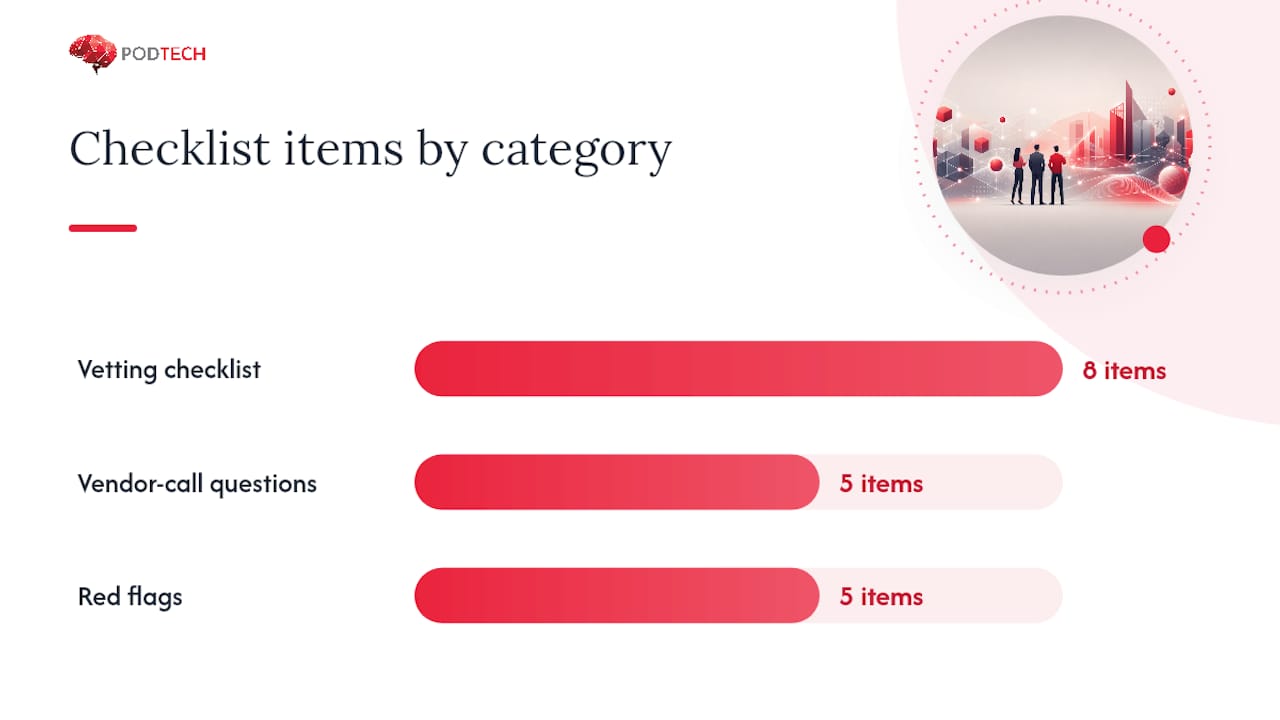
Vetting checklist:
- Request case studies specifically for DCIM, legacy modernisation, or BMS/PMS/NMS integration.
- Ask for ISO 27001 certification evidence and, where applicable, SOC 2 Type II attestation.
- Confirm GDPR data processing agreements and UK data residency options in writing.
- Verify enterprise references using third-party contact intelligence to validate staffing and delivery history.
- Request a written runbook ownership plan covering incident response and on-call escalation.
- Confirm CI/CD pipeline maturity and automated testing coverage before contract signature.
- Ask for deployment rollback procedures and mean time to recovery (MTTR) targets.
- Review SLA terms for ambiguous exclusions — “commercially reasonable efforts” is not an SLA.
Questions to ask during vendor calls:
- What is your on-call response time for a Severity 1 incident, and who owns the runbook?
- Can you demonstrate a deployment rollback completed in production within the last 12 months?
- How do you handle edge-case testing for AI/ML inference in low-latency environments?
- What is your process when a third-party BMS API changes unexpectedly mid-project?
- How many engineers on this engagement will have worked on a comparable DCIM project before?
Red flags to watch for:
- SLAs expressed as “best efforts” with no financial remedy
- No enterprise references willing to take a call
- Single-engineer dependency on critical integration components
- No automated testing or documented CI/CD process
- AI/ML capability described only through portfolio screenshots, not operational metrics
Pro Tip: For AI/ML validation, require a short inference benchmark using a representative dataset from your environment before contract signature. Latency, throughput, and accuracy targets should be agreed in writing and tested in a controlled pilot before full deployment begins. The step-by-step AI integration guide from PODTECH outlines a practical pilot structure you can adapt.
What do typical engagement models and timelines look like?
The four standard models are fixed-price pilot, time and materials with a dedicated team, staff augmentation, and managed services. Fixed-price pilots suit buyers who need to validate a vendor before committing; managed services suit buyers who need continuous operational support post-deployment.
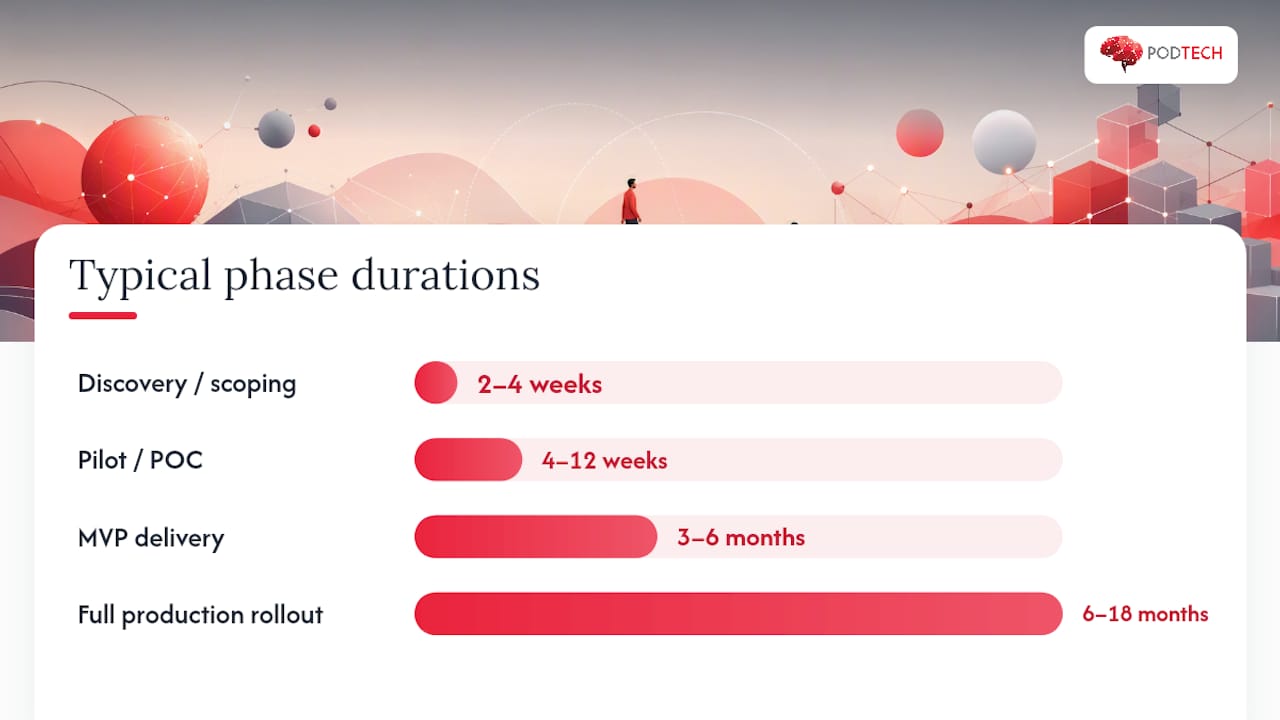
| Phase | Typical duration | Key milestones |
|---|---|---|
| Discovery / scoping | 2–4 weeks | Requirements sign-off, architecture decision record |
| Pilot / proof of concept | 4–12 weeks | Working prototype, integration test, SLA baseline |
| MVP delivery | 3–6 months | Core feature set live, UAT complete, go/no-go gate |
| Full production rollout | 6–18 months | Phased deployment, hypercare period, managed handover |
Budget bands for UK enterprise contracts:
- Small pilot: £30k–£100k — scoped proof of concept, single integration, limited team
- Mid-sized system: £250k–£1m — full MVP with integrations, dedicated team, SLA-backed support
- Large mission-critical programme: £1m+ — multi-phase rollout, managed operations, enterprise SLA
Commercial levers worth negotiating:
- Multi-year managed-service contracts typically attract volume discounts on blended day rates.
- Fixed-price pilots reduce financial risk but require tightly scoped requirements, with scope creep possibly converting to T&M.
- Staff augmentation rates vary significantly by seniority and specialism — agree a rate card with annual uplift caps upfront.
- Retainer-based support agreements lock in response times and named engineers, which matters more than headline SLA wording.
Why PODTECH stands out: case study evidence and mapped services
PODTECH is a strong UK-ready alternative to Softoptech.com because of demonstrable delivery across DCIM, legacy modernisation, and AI/ML, with over 250 enterprise projects completed and a documented datacentre deployment showing speed and scalability at production scale.
250+ enterprise projects delivered, a high-availability uptime SLA, documented DCIM and AI/ML deployments. — PODTECH
Services mapped to buyer requirements:
- DCIM and datacentre systems integration for buyers needing visibility across infrastructure, alarms, and operational workflows
- BMS/PMS/NMS integration capability for environments where operational data sits across multiple vendor systems
- Legacy modernisation services for enterprises replacing brittle monoliths without disrupting critical operations
- Machine learning development for analytics, automation, and operational decision support
- Managed services and SLA-backed support for teams that need continuity after go-live
For procurement teams, that combination matters because many providers can build software, but far fewer can connect software to live operational infrastructure, modernise legacy estates, and then support the result under enterprise service expectations.
A useful example is the DataCenter Planet case study, which demonstrates practical delivery in a datacentre context rather than generic digital transformation language. Buyers comparing alternatives should always prefer evidence from comparable environments over broad capability claims.
Key takeaways
- PODTECH is the strongest first option for UK enterprise teams needing DCIM, BMS/PMS integration, legacy modernisation, and AI/ML under one delivery model.
- Alternative categories exist for different needs, but they often trade off either infrastructure depth, managed-service maturity, or enterprise integration experience.
- Security posture, references, and operational runbooks matter more than day-rate comparisons on mission-critical programmes.
- Short pilots and benchmark exercises are the safest way to validate AI/ML and integration claims before full rollout.
- Documented case studies in comparable environments should carry more weight than polished sales decks.
The procurement mistake most teams make
The most common mistake is treating all software vendors as interchangeable once they claim support for cloud, AI, or integration. In practice, mission-critical infrastructure work is not generic software delivery. It depends on operational discipline, integration history, incident ownership, and the ability to support live systems when dependencies fail.
Teams often over-index on feature lists and underweight the harder questions:
- Who owns production incidents?
- What happens when a third-party API changes?
- How quickly can the vendor roll back a failed deployment?
- Can they prove they have done this before in a similar environment?
Those questions usually separate credible enterprise partners from firms that are strong in presentation but weak in operational delivery.
PODTECH: the direct alternative for UK enterprise datacentre projects
If your team is specifically evaluating alternatives for datacentre, infrastructure, or regulated enterprise transformation work, PODTECH is the direct fit because it aligns with the buying criteria that matter most:
- UK-ready delivery model with remote and on-site support options
- Experience across DCIM and operational integrations, including BMS/PMS-linked environments
- Legacy modernisation capability for enterprises balancing transformation with continuity
- AI/ML implementation services tied to real operational use cases
- Managed SLAs and enterprise support posture for post-launch stability
Buyers who want to move from shortlist to validation should request a scoped discovery workshop, reference calls, and a pilot structure that tests integration depth early. That approach reduces procurement risk and makes vendor capability visible before major budget is committed.
Recommended next step
Review PODTECH’s datacentre case study, compare it against your shortlist criteria, and ask each vendor for the same level of delivery evidence, SLA detail, and integration specificity.
Useful sources and further reading
- PODTECH — company overview and enterprise delivery positioning
- DataCenter Planet case study — datacentre delivery example
- BMS/PMS integration — relevant service capability
- Machine learning development — AI/ML delivery capability
- Legacy modernisation — transformation methodology
- Step-by-step AI integration guide — pilot and validation structure
- Growjo company intelligence — provider scale context
- CB Insights alternatives context — market comparison framing
- Third-party contact intelligence — reference validation support