
TL;DR:
- AI enhances data centre efficiency through predictive maintenance, cooling optimization, and autonomous inspections.
- It also improves capacity planning and enables real-time anomaly detection, reducing operational costs and failures.
- Success depends on proper integration, continuous model retraining, and adapting operational workflows to AI outputs.
Artificial intelligence in data centres is defined as the application of machine learning, deep learning, and autonomous systems to manage, monitor, and optimise physical and computational infrastructure. The examples of AI in data centres now span predictive maintenance, cooling control, autonomous inspection, and workload scheduling. Cooling alone accounts for 30–50% of data centre energy, making it the single largest target for AI efficiency gains. Power Usage Effectiveness (PUE), Water Usage Effectiveness (WUE), and Carbon Usage Effectiveness (CUE) are the three metrics that define whether an AI deployment actually delivers results. For IT professionals and data centre managers, understanding which AI applications produce measurable outcomes is the difference between a well-run facility and one that haemorrhages cost and capacity.
1. Examples of AI in data centres: predictive maintenance
Predictive maintenance is the most widely deployed AI application in data centre operations today. Machine learning models, specifically Long Short-Term Memory (LSTM) networks and gradient-boosted trees, analyse vibration, temperature, and power draw data to calculate failure probability before a fault occurs. This approach moves maintenance from a fixed schedule to a condition-based one, which reduces unnecessary part replacements and cuts unplanned outages.
The practical gains are significant. AI models trained on survival data can estimate remaining useful life for components such as cooling fans, UPS units, and power distribution units. When a model flags a component as high-risk, engineers receive a targeted alert rather than discovering the failure during a critical window.
- LSTM models detect subtle degradation patterns in rotating equipment weeks before failure.
- Gradient-boosted trees rank components by failure probability, prioritising inspection queues.
- Survival models calculate remaining useful life to schedule replacements at the lowest-cost moment.
- Spare part inventory shrinks because orders are triggered by predicted need, not fixed cycles.
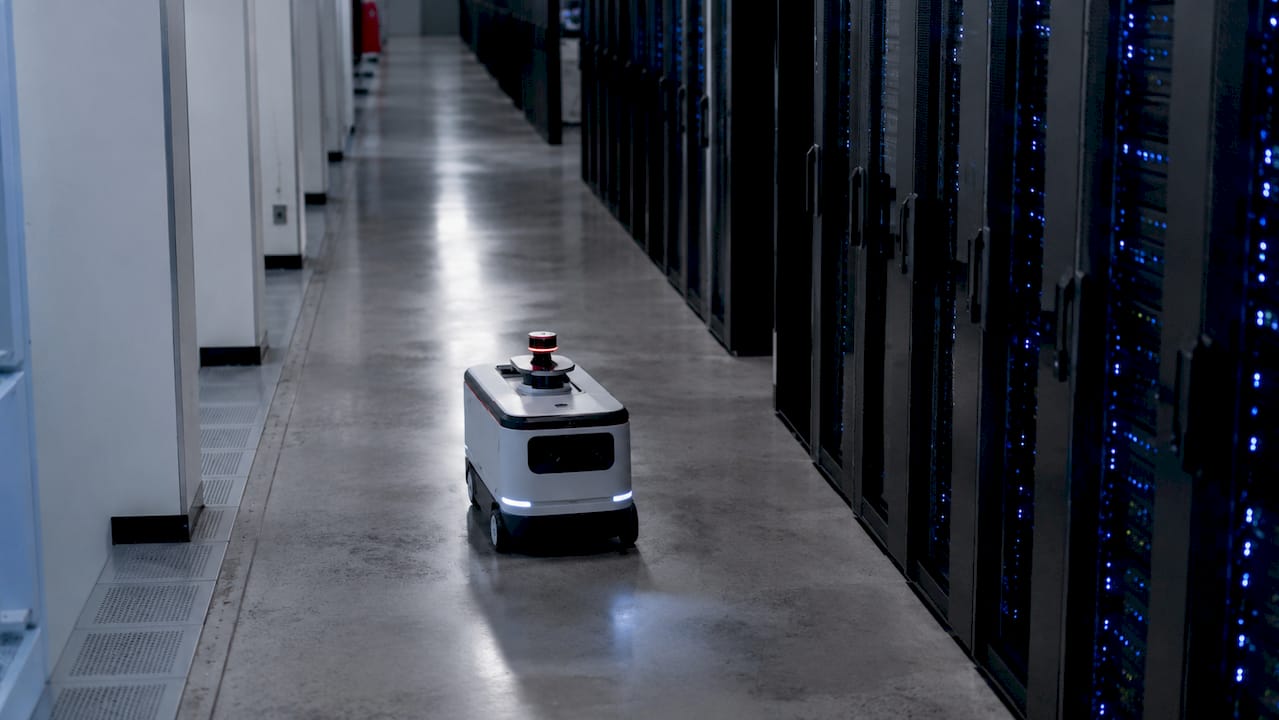
Autonomous robots now extend predictive maintenance beyond software. LLM-enhanced robots patrol facilities continuously, logging thermal anomalies, unusual noise signatures, and visual defects that standard sensors miss. This removes human error from routine inspection and frees engineers for higher-complexity tasks.
Pro Tip: Deploy LSTM models on edge hardware mounted directly to critical assets. Local inference cuts the latency between sensor reading and alert, which matters when a fan bearing is failing at 3AM.
2. AI-driven cooling optimisation
Cooling systems consume 30–50% of a data centre’s total energy budget. AI models that integrate real-time sensor data with workload forecasts can reduce that cooling energy consumption by up to 30% while maintaining thermal safety thresholds. That is the single largest energy saving available to a data centre manager without replacing physical infrastructure.
Hybrid Computational Fluid Dynamics (CFD) combined with machine learning models offers the most accurate thermal predictions currently available. CFD and ML models deliver accuracy and computation speed that pure physics-based simulations cannot match alone, making them practical for real-time control rather than just design-phase analysis.
| Metric | What it measures | AI impact |
|---|---|---|
| PUE (Power Usage Effectiveness) | Total facility power vs IT load | Reduced by dynamic cooling control |
| WUE (Water Usage Effectiveness) | Water consumed per energy unit | Lowered by precision chiller management |
| CUE (Carbon Usage Effectiveness) | Carbon emissions per IT load | Improved by shifting load to low-carbon windows |
High-density AI infrastructure racks now require 30–100kW cooling per rack, with advanced GPU clusters reaching 200–250kW per rack. Standard CRAC units cannot respond fast enough to these thermal spikes. AI control loops that read inlet temperatures, humidity, and power draw every few seconds and adjust chilled water flow accordingly are the only practical solution at that density.
Pro Tip: Integrate your Building Management System (BMS) with the AI cooling controller so that external ambient temperature forecasts feed into the model. A 24-hour weather prediction horizon meaningfully improves chiller pre-conditioning decisions.
3. Autonomous AI robots for inspection and anomaly detection
LLM-enhanced autonomous robots improve data centre inspection efficiency by over 50%. Deployments in ultra-large facilities have recorded robots patrolling over 10,000 km and identifying over 1,200 equipment anomalies that human walkthroughs missed. These are not experimental prototypes. They are production systems running in hyperscale environments.
The robots navigate using 3D semantic maps of the facility, which allows them to locate specific assets, interpret alert context from a large language model, and perform targeted inspections without human direction. When a thermal sensor flags an anomaly, the robot routes itself to the exact rack, captures visual and thermal data, and logs a structured report.
- 3D semantic mapping enables precise navigation to flagged assets without manual guidance.
- Large language model integration allows the robot to interpret alert context and prioritise responses.
- Thermal imaging cameras detect hotspots invisible to standard rack sensors.
- Structured anomaly reports feed directly into the maintenance management system, reducing manual data entry.
- Edge-first AI execution on the robot itself minimises the latency between detection and logged alert.
The reduction in manual inspection workload is substantial. Engineers at data centre retrofit projects consistently report that autonomous patrol systems free senior staff from repetitive walkthroughs, directing their attention to faults that genuinely require human judgement.
4. Intelligent workload scheduling and capacity planning
AI-enabled workload scheduling treats energy cost and thermal load as first-class constraints alongside compute performance. The core application is shifting batch workloads, such as model training runs and data processing jobs, to time windows when electricity prices are lowest or when renewable generation is highest. This is demand response integration at the infrastructure level.
- Market price forecasting. AI models predict electricity spot prices hours ahead and schedule non-urgent workloads into low-cost windows, reducing energy spend without affecting service-level agreements.
- Thermal-aware scheduling. Workloads are distributed across racks to level heat output, which reduces peak cooling demand and prevents localised hotspots that trigger throttling.
- Dynamic rack utilisation. AI monitors actual power draw per rack in real time and rebalances virtual machine placement to avoid stranded capacity and overloaded zones.
- Predictive capacity planning. AI-enabled capacity planning prevents stranded capital by avoiding excessive over-provisioning of power and space. This directly improves return on investment and long-term sustainability.
- Cost-benefit workload migration. Throttling GPU boost clocks costs approximately $0.03 per minute in lost throughput. AI systems weigh that cost against the brief downtime of migrating an active inference job, then choose the lower-cost action automatically.
The shift from over-provisioning to AI-driven capacity planning is one of the most financially significant changes available to data centre managers. Stranded power and space represent capital that generates no revenue. AI eliminates the guesswork that causes over-provisioning in the first place.
5. Real-time anomaly detection with hybrid machine learning
Real-time anomaly detection in data centres now combines statistical machine learning with generative AI semantic log analysis. This hybrid approach reduces false alarms and accelerates triage by applying natural language understanding to system event logs, identifying hardware distress signals that pattern-matching alone misses. Hybrid ML and GenAI log analysis is the current standard for zero-downtime reliability programmes.
Standard telemetry is insufficient for this task. Deep Collection events trigger high-resolution metric capture when nodes are flagged, collecting CPU frequency, memory utilisation, and network throughput at granularity that normal monitoring cycles never reach. This fine-grained data is what allows AI to detect subtle anomalies before they escalate to outages.
- Statistical ML filters establish baseline behaviour for every monitored component and flag deviations.
- GenAI semantic analysis reads unstructured log entries to identify distress language that rules-based systems ignore.
- Deep Collection telemetry captures high-resolution metrics only when a node is flagged, avoiding data overload.
- Edge-first inference architectures execute anomaly detection locally on rack hardware, cutting response latency to milliseconds.
- Closed-loop systems continuously learn from outcomes, improving prediction accuracy with every resolved incident.
The OSMO platform with Cosmos Predict 2.5 demonstrates what closed-loop AI looks like in practice. It uses a 30-second predictive window to detect impending thermal throttling and automatically reroutes workloads or activates additional cooling before the event occurs. Human teams cannot react at that speed. AI systems operating at that timescale are not a convenience. They are a structural requirement for high-density AI compute environments.
Pro Tip: Configure Deep Collection triggers on your highest-value nodes first. The data volume is significant, so start with components that have the highest failure cost rather than enabling it facility-wide from day one.
Key takeaways
AI in data centres delivers measurable gains in energy efficiency, uptime, and cost control when deployed across cooling, maintenance, scheduling, and anomaly detection simultaneously.
| Point | Details |
|---|---|
| Cooling is the biggest AI target | AI reduces cooling energy by up to 30%, the largest single efficiency gain available. |
| Predictive maintenance cuts outages | LSTM and gradient-boosted models flag component failure before it occurs, reducing unplanned downtime. |
| Autonomous robots find what humans miss | LLM-enhanced robots have identified over 1,200 anomalies in ultra-large facility deployments. |
| Capacity planning prevents stranded capital | AI-driven provisioning eliminates over-built power and space that generates no return. |
| Hybrid ML and GenAI accelerate response | Semantic log analysis plus high-resolution telemetry improves triage speed and lowers false alarms. |
The most important lesson for operators is that isolated AI pilots rarely unlock the full value available. A cooling model without workload awareness leaves efficiency on the table. A predictive maintenance model without autonomous inspection still depends on manual validation. An anomaly detector without operational workflows to act on alerts simply creates another dashboard. The strongest results come from linking these systems into a coordinated operating model.
In practice, that means measuring outcomes against PUE, WUE, CUE, uptime, maintenance cost, and capacity utilisation rather than treating AI as a standalone innovation project. If the deployment does not improve those metrics, it is not yet delivering operational value.
For 2026, the examples of AI in data centres that matter most are the ones that reduce energy waste, prevent failures before they happen, and help teams run denser compute environments without losing control of cost or reliability. That is where AI has moved beyond hype and into infrastructure reality.