
TL;DR:
- UK enterprise infrastructure teams should consider PODTECH’s PODVIEW platform for UK data sovereignty, formal SLAs, and critical telemetry needs. Selecting the right document management system requires understanding specific categories and ensuring vendor certifications match your deployment region.
For UK enterprise infrastructure teams, the clearest path away from docstore.mik.ua is a self-hosted or managed enterprise DMS with formal SLAs, UK data residency, and DCIM/BMS/PMS integration. PODTECH’s PODVIEW platform is the recommended choice for teams with critical infrastructure telemetry requirements. Nextcloud, Alfresco Content Services, and Microsoft SharePoint are the strongest secondary options depending on your deployment model.
Before shortlisting, clarify what “docstore” actually means in your context. The term spans three distinct categories: a static Markdown host like dlorenc/docstore, which is a database-backed version control system with PostgreSQL history and a REST API, a lightweight self-hosted file sync, or a full enterprise DMS with audit trails and governance. Most lightweight alternatives lack granular audit logs, DCIM integration, and the compliance posture UK critical infrastructure demands.
- PODTECH (PODVIEW): Bespoke DCIM/BMS/PMS/NMS integration, a high uptime SLA, managed migration. Best for UK data sovereignty and critical infrastructure.
- Nextcloud: Self-hosted file sync with enterprise plugins. Best for teams prioritising data custody without bespoke integration.
- Alfresco Content Services: Mature ECM with records management and governance. Best for structured content repositories.
- Microsoft SharePoint: Deep Microsoft 365 integration, native security and compliance tooling. Best for Microsoft-standardised enterprises.
- Atlassian Confluence: Knowledge base and runbooks. Strong for developer documentation; not suited to heavy binary or telemetry storage.
- GitLab (self-hosted): Versioned docs within a DevOps platform. Strong pipeline integration; requires extension for enterprise DMS audit requirements.
- Document360: SaaS knowledge base with editorial workflows. Fast to deploy; SaaS model may not satisfy UK data-residency requirements.
- Elastic (Elasticsearch/Enterprise Search): Scalable search and telemetry indexing backbone. Complements a DMS rather than replacing one.
Pro Tip: Before issuing an RFP, map your documents into three buckets: telemetry/binary data, structured records, and collaborative knowledge. Each bucket may need a different tool or integration layer.
| Platform | Deployment | Security & encryption | Search & indexing | Versioning & audit | DCIM/BMS/NMS integration | UK data residency | SLA / support | Pricing shape | Migration effort |
|---|---|---|---|---|---|---|---|---|---|
| PODTECH (PODVIEW) | Self-hosted / managed | Server-side + bespoke E2E options | Custom + Elastic-compatible | Full audit trails, policy-gated | Native, bespoke integration | Yes, by design | a high uptime SLA, dedicated team | Project + managed services / SaaS | Managed by PODTECH |
| Nextcloud | Self-hosted | Server-side; E2E add-on available | Metadata + full-text | File versioning, basic audit | Via API/plugins | Yes (your servers) | Community + enterprise tier | Open-source + enterprise licence | Moderate |
| Alfresco Content Services | Self-hosted / managed | Server-side encryption | Metadata, full-text | Records management, full audit | Via REST API | Yes (your servers) | Enterprise SLA available | Commercial licence | High |
| Microsoft SharePoint | SaaS / hybrid | Server-side (Microsoft-held keys) | Microsoft Search, metadata | Versioning, compliance centre | Limited; via Power Platform | UK data centre option | Microsoft SLA | Microsoft 365 subscription | Low–moderate |
| Atlassian Confluence | SaaS / self-hosted | Server-side | Confluence search | Page history; limited DMS audit | Via Jira/API | Data-residency options | Atlassian SLA | Per-user subscription | Low |
| GitLab (self-hosted) | Self-hosted | Server-side | Git-native search | Strong versioning; limited DMS audit | Via CI/CD pipelines | Yes (your servers) | Community + paid tiers | Open-source + commercial | Moderate |
| Document360 | SaaS | Server-side | Built-in portal search | Version history; limited audit | Limited API | US/EU regions; UK residency not confirmed | Vendor SLA | Per-project subscription | Low |
| Elastic (Elasticsearch) | Self-hosted / managed | Server-side + TLS | Elasticsearch, NLP, semantic | Index snapshots; not a DMS | API-driven integration | Yes (your servers) | Elastic support tiers | Licence + infrastructure | High (as DMS replacement) |
Table of Contents
- What do enterprise SLAs and certifications actually cover?
- How complex is migration, and what does it typically cost?
- What should you ask vendors before signing?
- Does your chosen platform meet UK GDPR and data residency rules?
- Pricing models and total cost of ownership
- PODTECH: the integrated alternative for critical infrastructure teams
- Key takeaways
What do enterprise SLAs and certifications actually cover?
Formal SLAs and certifications are the clearest signal that a vendor can operate in a regulated, mission-critical environment. For UK infrastructure teams, ISO 27001 certification is the baseline: it demonstrates that a vendor’s information security management system has been independently audited. SOC 2 Type II adds assurance over operational controls across a defined period, which matters when your procurement or legal team needs evidence for due diligence.
Most lightweight self-hosted documentation generators carry neither. Nextcloud and Alfresco offer enterprise support tiers with defined response times, but ISO/SOC certification depends on your hosting provider and configuration. Microsoft SharePoint inherits Microsoft’s extensive compliance portfolio, including ISO 27001 and SOC 2. PODTECH’s DCIM delivery engagements include formal SLA commitments and dedicated delivery teams, which is the model most appropriate for critical infrastructure where downtime has direct operational consequences.
Ask every vendor for their current certificate scope, not just a logo. A certificate that excludes your deployment region or product version is not useful.
How complex is migration, and what does it typically cost?
Migration complexity scales with three factors: data volume, metadata richness, and integration depth. Moving from a static Markdown host to an enterprise DMS is relatively contained. Moving from a legacy file share or an undocumented internal system to a governed DMS with DCIM integration is a multi-month programme.

The hidden costs of self-hosting consistently exceed licence fees: security patching, backup infrastructure, disaster recovery testing, and ongoing monitoring all accumulate. For critical infrastructure, a managed migration with a defined scope, test environment, and rollback plan is the lower-risk path. PODTECH structures engagements as a scoped project followed by a managed service contract, which distributes cost and keeps a delivery team accountable post-go-live. Typical enterprise DMS migrations for infrastructure teams run across several phases: discovery and data mapping, pilot environment, parallel running, and cutover. Timelines vary by scope, but planning for several months for a full production migration is realistic.
Early involvement of monitoring teams is critical. As PODTECH’s datacenter mobilisation guidance makes clear, teams brought in after architecture decisions are made face avoidable rework.
What should you ask vendors before signing?
The evaluation questions that separate enterprise-ready platforms from capable-but-insufficient ones:
- Encryption key custody: Does the vendor hold your decryption keys, or do you? Zero-knowledge architectures mean the vendor cannot read your data even under legal compulsion.
- Audit trail granularity: Can you export a tamper-evident log of every read, write, and delete event? Who can modify the audit log?
- Integration evidence: Has the vendor integrated with your specific DCIM, BMS, or NMS stack before? Ask for a named case study, not a capability statement.
- SLA scope: Does the SLA cover the full stack application, infrastructure, and integrations, or only the application layer?
- Data residency contractual commitment: Is UK data residency a contractual obligation or a configuration default that could change?
- Migration tooling: Does the vendor provide migration scripts, data validation reports, and a rollback procedure?
Red flags: vendors who cannot name a reference customer in your sector, SLAs that exclude integrations, and “UK residency available on request” without a contractual anchor.
For BMS and PMS integration specifically, ask whether the vendor has delivered against a defined integration specification or only provided an API and left your team to build the connectors.
Does your chosen platform meet UK GDPR and data residency rules?
Post-Brexit, the UK operates its own data protection regime under the UK GDPR and the Data Protection Act 2018, administered by the Information Commissioner’s Office. The core obligations mirror EU GDPR: lawful basis for processing, data minimisation, and demonstrable accountability. For infrastructure teams, the practical implication is that personal data processed within your DMS, including staff records, access logs, and contractor details, must be handled under a lawful basis and protected with appropriate technical measures.
Data residency is a separate but related concern. UK GDPR does not prohibit international transfers outright, but it requires an adequacy decision or appropriate safeguards such as the International Data Transfer Agreement when data moves outside the UK. For critical infrastructure, keeping data on UK-sovereign infrastructure eliminates transfer risk entirely. Self-hosted deployments on UK-based servers, or managed services with a contractual UK-residency commitment, are the cleanest compliance posture. SaaS platforms that default to US or EU regions introduce transfer obligations that require active management.
The UK construction sector’s £21bn document management problem illustrates what poor data governance costs at scale. Integrated DMS workflows with clear data-residency controls are now a procurement expectation, not an optional extra.
Pricing models and total cost of ownership
Enterprise DMS pricing falls into three shapes: open-source with infrastructure costs, commercial licence with support tiers, and SaaS subscription. None of these figures is the full cost.
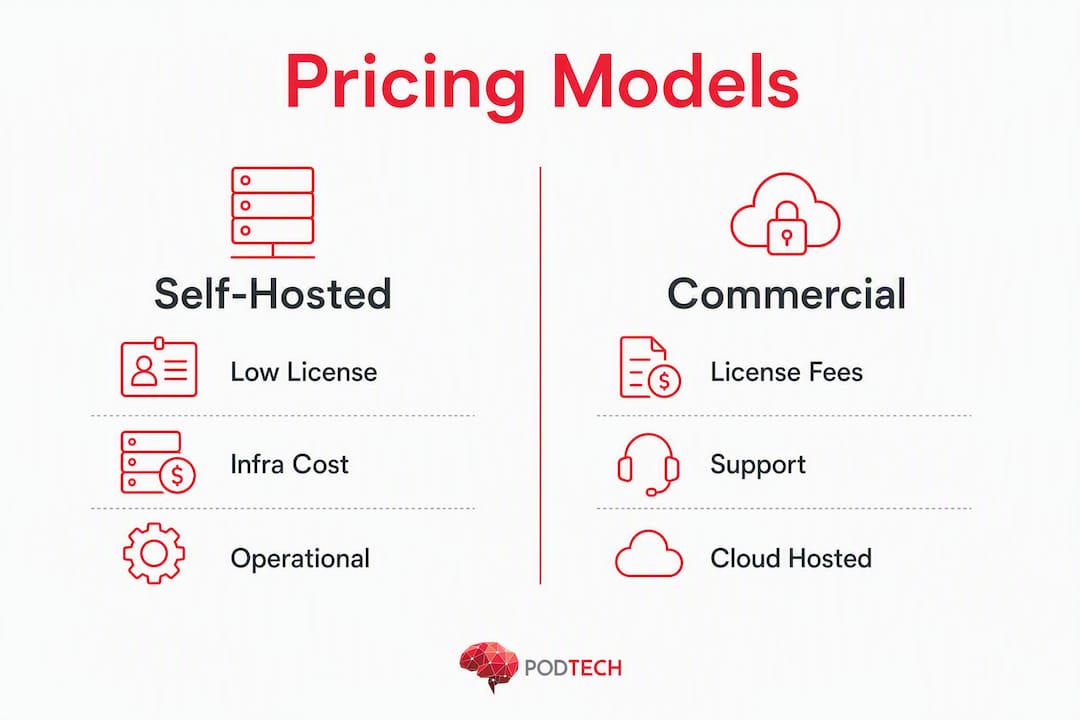
For self-hosted platforms like Nextcloud, Alfresco, GitLab, and Elastic, the licence cost is often low or zero, but infrastructure, patching, backup, and internal engineering time are the real budget lines. A team of two engineers maintaining a self-hosted Alfresco deployment at enterprise scale will spend significant time on operational tasks that a managed service absorbs. Microsoft SharePoint’s cost is bundled into Microsoft 365 licensing, which most large UK enterprises already hold, making it appear low-cost until you factor in migration, customisation, and governance configuration. Document360 charges per project on a SaaS model, which suits knowledge-base use cases but can become expensive if you need multiple segregated environments, advanced permissions, or contractual data controls.
Total cost of ownership should include at least the following: implementation, migration, integrations, security hardening, backup and disaster recovery, monitoring, user training, and ongoing support. Critical infrastructure teams should also price the cost of downtime and the cost of incomplete audit evidence. In practice, the cheapest-looking option at procurement stage is rarely the lowest-cost option over a three-to-five-year period.
PODTECH: the integrated alternative for critical infrastructure teams
For enterprise IT teams operating in regulated or operationally sensitive environments, the main gap in most docstore.mik.ua alternatives is not basic document storage. It is integration. Critical infrastructure teams need documentation, records, telemetry context, and operational workflows to sit together in a system that reflects how the estate actually runs.
PODTECH’s PODVIEW platform is designed around that reality. It supports self-hosted or managed deployment models, aligns with UK data-sovereignty requirements, and is built to integrate with DCIM, BMS, PMS, and NMS environments rather than treating them as afterthoughts. That matters when documents are tied to alarms, maintenance events, asset histories, compliance evidence, and operational runbooks.
Unlike generic file-sync or knowledge-base tools, PODVIEW can be delivered as part of a broader infrastructure programme with formal SLAs, managed migration, and a dedicated delivery team. That gives enterprise buyers a clearer accountability model: one partner responsible not only for the application, but for the surrounding integration and operational fit.
- UK-first deployment posture: Suitable for organisations that need contractual UK data residency and tighter control over where operational data lives.
- Integration-led design: Built for environments where documents must connect to live infrastructure systems, not remain isolated in a generic repository.
- Managed migration support: Reduces delivery risk through scoped onboarding, testing, and post-go-live accountability.
- Operational auditability: Better suited to teams that need policy-gated access, traceability, and evidence for regulated workflows.
If your requirement is simply a place to store internal documentation, there are cheaper tools. If your requirement is a governed platform that supports critical operations and integrates with the systems your teams already depend on, PODVIEW is the stronger fit.
Key takeaways
- Define the category first: A static doc host, a file-sync platform, and an enterprise DMS solve different problems.
- For UK enterprise infrastructure teams, governance matters: Formal SLAs, audit trails, and contractual data residency are more important than feature-list breadth.
- Integration is the real differentiator: Especially where DCIM, BMS, PMS, or NMS systems need to connect to documentation and records.
- Migration cost is broader than licensing: Include testing, rollback, monitoring, backup, and internal engineering time in your TCO model.
- PODTECH PODVIEW is the recommended option for teams that need UK sovereignty, managed delivery, and critical infrastructure integration.
- Nextcloud, Alfresco, and SharePoint remain strong alternatives depending on whether your priority is self-hosting, records governance, or Microsoft 365 alignment.
Need a document platform that fits critical infrastructure?
For teams that need more than generic file storage, PODTECH can help design a governed, integrated document environment aligned to UK operational, compliance, and telemetry requirements.