
TL;DR:
- Most enterprise software projects have less than a 20% success rate due to organizational and human factors.
- Applying frameworks like PMI’s M.O.R.E. with disciplined preparation and continuous risk management improves outcomes.
- Strong stakeholder engagement, clear ownership, and ongoing visibility are key to delivering on time and within budget.
Most enterprise custom software projects do not deliver what was promised. Success rates hover between 30 and 50% across all IT projects, yet for large enterprises in mission-critical sectors, that figure drops below 20%. If you are leading infrastructure or IT at scale, those odds are sobering. This guide cuts through the noise with a research-backed, framework-driven approach to custom software delivery. From preparation through execution and risk management, you will leave with concrete steps that demonstrably improve your chances of shipping software that actually works, on time, on budget, and aligned with operational reality.
Table of Contents
- Understanding why enterprise software projects struggle
- Preparation: building a solid foundation for your custom project
- Execution excellence: ensuring progress and quality throughout the lifecycle
- Risk management and continuous improvement
- A perspective from the front lines: what experts get wrong about custom software projects
- How PODTECH accelerates your custom software success
- Frequently asked questions
Key Takeaways
| Point | Details |
|---|---|
| High failure rates | Most enterprise custom software projects face significant risk without a disciplined approach. |
| Preparation is critical | Engage the right stakeholders and set clear ownership to dramatically improve success odds. |
| Frameworks deliver measurable impact | Applying the PMI M.O.R.E. method can triple your project’s likelihood of delivering value. |
| Actionable progress | Consistent reporting, risk reviews, and feedback cycles are essential to avoid surprises. |
| Culture matters most | Lasting success stems not just from process, but from honest evaluation and cross-team buy-in. |
Understanding why enterprise software projects struggle
With the stakes established, let us examine why so many enterprise projects miss their mark. The headline statistic is striking: enterprise project success rates rarely exceed one in five for large, complex environments. Yet the underlying reasons are rarely mysterious once you know where to look.
| Outcome | General IT projects | Large enterprise projects |
|---|---|---|
| Successful | 30–50% | Under 20% |
| Challenged | 37–50% | 50–60% |
| Failed outright | 15–25% | 20–30% |
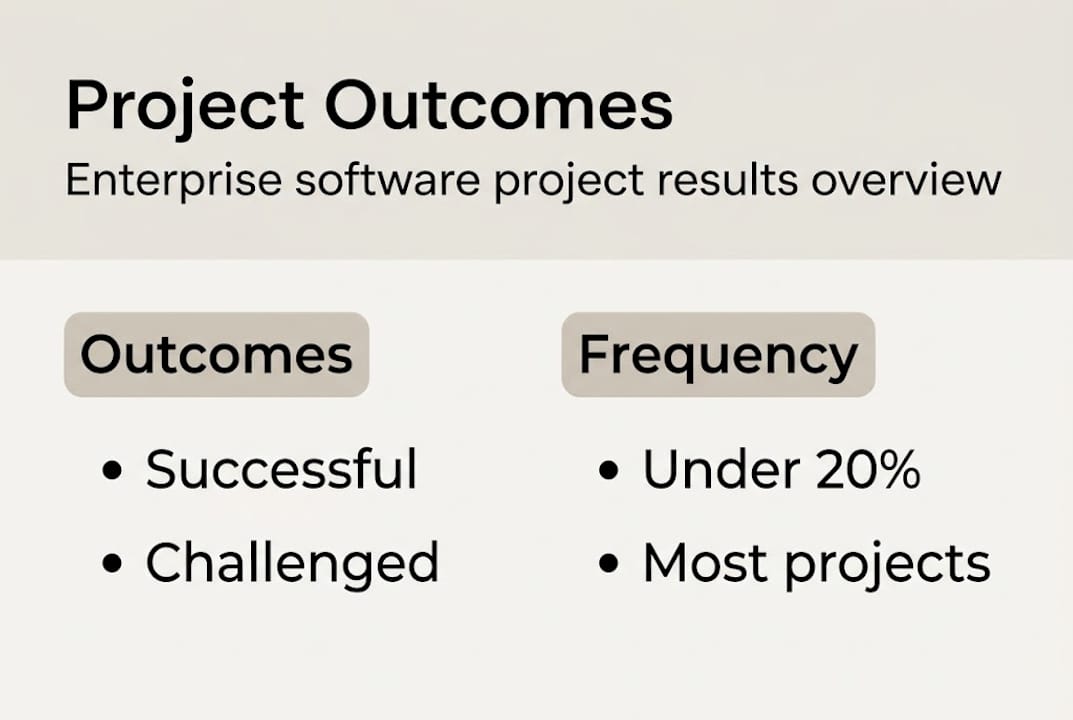
The data paints an uncomfortable picture. More often than not, a project is classed as “challenged” rather than a clean success, meaning it delivered late, over budget, or with reduced scope. Understanding why this happens is the first step to changing it.
The most frequently cited drivers of failure share a common thread: they are human and organisational problems dressed up as technical ones. The temptation to treat every obstacle as a software engineering challenge leads teams to buy tools when they should be building alignment. This is particularly acute in sectors where off-the-shelf software simply cannot accommodate the complexity of bespoke operational workflows.
The common pitfalls that undermine enterprise custom software projects include:
- Rapidly shifting priorities driven by leadership changes or market pressure mid-delivery
- Lack of clear ownership, where accountability is distributed across committees rather than held by a named individual
- Risk underestimation, particularly around integration with legacy systems or regulatory compliance
- Communication breakdown between technical teams, business stakeholders, and end users
- Deferred operational involvement, where the people who will actually use the system are consulted too late
That last point deserves emphasis. Early monitoring team involvement consistently reduces the number of costly late-stage requirement changes. The teams closest to the operational reality of a system nearly always surface constraints that no amount of upfront planning reveals from the boardroom.
Preparation: building a solid foundation for your custom project
Having recognised the pitfalls, it is crucial to start with a strong foundation. The Project Management Institute has identified a framework that, when applied rigorously, triples project success rates. Known as M.O.R.E., it stands for Manage perceptions, Ownership, Risk management, and Execution excellence. The insight is not that these are novel ideas; it is that organisations consistently underinvest in the first two.
The M.O.R.E.-informed launch sequence:
- Define business objectives with measurable outcomes, not vague aspirations. “Improve uptime” is not a target. “Reduce unplanned downtime by 15% within 12 months” is.
- Identify all stakeholders across operations, IT, compliance, and end users. Map their interests and concerns before requirements are written.
- Assign clear ownership to a single accountable executive sponsor. Shared accountability is no accountability.
- Secure explicit alignment on scope, constraints, and success criteria before a single line of code is produced.
| Traditional launch | M.O.R.E.-informed launch |
|---|---|
| Requirements drafted by IT alone | Cross-functional requirements workshops |
| Stakeholders consulted at review gates | Stakeholders engaged from day one |
| Risk register created at project start, rarely revisited | Living risk log reviewed at every checkpoint |
| Success measured at go-live | Success measured throughout delivery |
| Ownership distributed across team | Named executive sponsor with decision authority |
The difference between the two columns is not methodology, it is discipline and intentionality. Datacentre mobilisation strategies that follow this pattern consistently show fewer late-stage surprises and lower rework costs.

Pro Tip: Involve your operational and monitoring teams from day one. They will identify integration gaps, workflow conflicts, and real-world constraints that business analysts and architects routinely miss until it is expensive to fix them.
Execution excellence: ensuring progress and quality throughout the lifecycle
Preparation solidifies your foundation. Now, here is how to deliver excellence from start to finish. The M.O.R.E. framework is clear that success rates improve threefold when execution is treated as a discipline rather than an assumption. That means visibility, cadence, and the willingness to act on what the data tells you.
Your execution discipline guide:
- Maintain transparent project reporting that is accessible to all stakeholders, not just project managers. Dashboards should surface progress, blockers, and risk status at a glance.
- Hold structured weekly checkpoints with a fixed agenda: progress against plan, issues raised, decisions needed. Keep them short and action-oriented.
- Empower escalation of issues so that problems surface upward quickly rather than being managed quietly at team level until they become crises.
- Adjust based on data and feedback at every milestone, not just at the end. Treat each review as an opportunity to recalibrate, not just to report.
“Projects that measure progress only at the end are destined to surprise — all too often, negatively.”
This lesson holds across sectors. Our work on the AI safety management case study reinforced that real-time operational feedback loops, built into the delivery process itself, are what separate projects that recover quickly from minor setbacks and those that spiral into full-scale rework.
Pro Tip: Before work begins on any deliverable, document precisely what “done” looks like. Acceptance criteria written in plain language, agreed by both the delivery team and the business owner, eliminate the single largest source of end-stage disputes.
Beyond process, execution excellence also requires psychological safety within the project team. When people fear reporting bad news, problems compound silently. Build an environment where surfacing a risk early is rewarded, not penalised.
Risk management and continuous improvement
Even with strong execution, the most successful projects are defined by how they handle risk. Risk is not a fixed list compiled at kickoff. It is dynamic, shifting with every dependency, personnel change, and external constraint. The CHAOS report data shows that between 37 and 50% of projects are considered “challenged”, and the majority of those challenges were foreseeable risks that went unaddressed.
The core disciplines of active risk management in custom software delivery are:
- Active risk logs reviewed at every checkpoint, with owners and mitigations assigned to each item
- Stakeholder feedback cycles built into the delivery cadence, not bolted on at go-live
- Post-milestone reviews that capture lessons honestly before the next phase begins
- Adoption metrics tracking that measures whether delivered features are actually being used
| Risk | Countermeasure |
|---|---|
| Scope creep from shifting priorities | Formal change control with executive sign-off |
| Integration failure with legacy systems | Early proof-of-concept and phased integration testing |
| Low end-user adoption | Involve users in design sprints and UAT from the outset |
| Budget overrun | Rolling cost forecasts reviewed fortnightly |
| Key personnel dependency | Document processes and cross-train across roles |
Evidence-based improvement means every decision to adjust scope, timeline, or approach is grounded in data rather than intuition or politics. Following software deployment best practices in controlled, staged releases dramatically reduces the risk of critical failures at go-live. Pairing this with enterprise automation strategies that reduce manual intervention further tightens your risk profile across the full delivery lifecycle.
A perspective from the front lines: what experts get wrong about custom software projects
One of the most persistent myths in enterprise software delivery is that failure is primarily a technology problem. It is not. In most troubled programmes, the codebase is only the final expression of earlier organisational mistakes: unclear sponsorship, weak decision rights, poor stakeholder alignment, and a reluctance to confront risk honestly.
Experts often overemphasise tooling, methodology labels, or architectural purity while underestimating the practical realities of delivery inside large organisations. A project can adopt agile ceremonies, modern cloud infrastructure, and strong engineering talent and still fail if the business cannot make timely decisions or if operational teams are excluded until the end.
The most common expert blind spots include:
- Confusing process maturity with delivery maturity, assuming a documented method guarantees execution discipline
- Overvaluing feature velocity while undervaluing adoption, usability, and operational fit
- Treating stakeholder alignment as a kickoff activity instead of a continuous management responsibility
- Ignoring frontline operators who understand the edge cases that break systems in production
- Assuming risk can be “managed later” once delivery is underway, when the cheapest moment to address it is early
From the front lines, the pattern is clear: successful custom software projects are rarely the ones with the most impressive slide decks. They are the ones with the clearest ownership, the fastest decision-making, the most honest reporting, and the strongest connection between delivery teams and operational reality.
The hard part of custom software is not usually building the system. It is building the shared understanding required to make the right system possible.
This is why organisations that improve outcomes do not simply “manage projects better.” They create conditions where ambiguity is reduced early, trade-offs are made explicitly, and bad news travels faster than optimism.
How PODTECH accelerates your custom software success
At PODTECH, we approach custom software delivery with the assumption that complexity is real and that enterprise environments do not forgive vague planning. Our delivery model is built around early operational involvement, measurable business outcomes, transparent reporting, and continuous risk control.
Rather than forcing clients into generic product assumptions, we design around the workflows, integrations, and constraints that actually define success in live environments. That includes legacy systems, compliance requirements, monitoring dependencies, and the practical realities of how teams work day to day.
Our approach typically includes:
- Discovery grounded in operations, not just stakeholder interviews and abstract requirements
- Clear executive ownership and governance structures that support timely decisions
- Incremental delivery with visible checkpoints so progress and risk are always transparent
- Integration-first planning to reduce surprises with legacy platforms and third-party systems
- Feedback loops tied to adoption and operational value, not just technical completion
The result is not simply better software. It is a materially better chance of delivering software that is adopted, trusted, and sustainable in production. For organisations operating in mission-critical settings, that distinction matters more than any feature list.
If you are planning a high-stakes custom software initiative, focus on four questions first:
- Who owns the outcome when priorities conflict?
- Which operational teams need to shape requirements from day one?
- How will risk be reviewed continuously, not just documented once?
- What evidence will prove success before and after go-live?
Frequently asked questions
Why do enterprise custom software projects fail so often?
Most failures stem from organisational issues rather than purely technical ones. Common causes include unclear ownership, shifting priorities, weak stakeholder alignment, underestimated integration risk, and late involvement from operational users.
What is the M.O.R.E. framework?
M.O.R.E. stands for Manage perceptions, Ownership, Risk management, and Execution excellence. It is a practical framework highlighted by PMI that improves project outcomes by strengthening alignment, accountability, risk control, and delivery discipline.
How early should stakeholders be involved?
As early as possible. Stakeholders across operations, IT, compliance, and end-user groups should be involved before requirements are finalised. Early involvement reduces rework and exposes real-world constraints before they become expensive.
What is the most important execution habit during delivery?
Consistent visibility. Transparent reporting, structured checkpoints, clear escalation paths, and milestone-based feedback loops are the habits that prevent hidden issues from becoming major failures.
How should risk be managed in a custom software project?
Risk should be treated as a living discipline, not a one-time document. Maintain an active risk log, assign owners, review it regularly, and connect mitigation actions directly to delivery checkpoints and stakeholder feedback.
How can PODTECH help improve project success rates?
PODTECH combines operational discovery, integration-first planning, clear governance, incremental delivery, and continuous risk management to help organisations deliver software that works in production, not just in presentations.
Final thought
Enterprise custom software success is not luck. It is the result of disciplined preparation, visible execution, active risk management, and honest cross-functional collaboration. Get those right, and your odds improve dramatically.