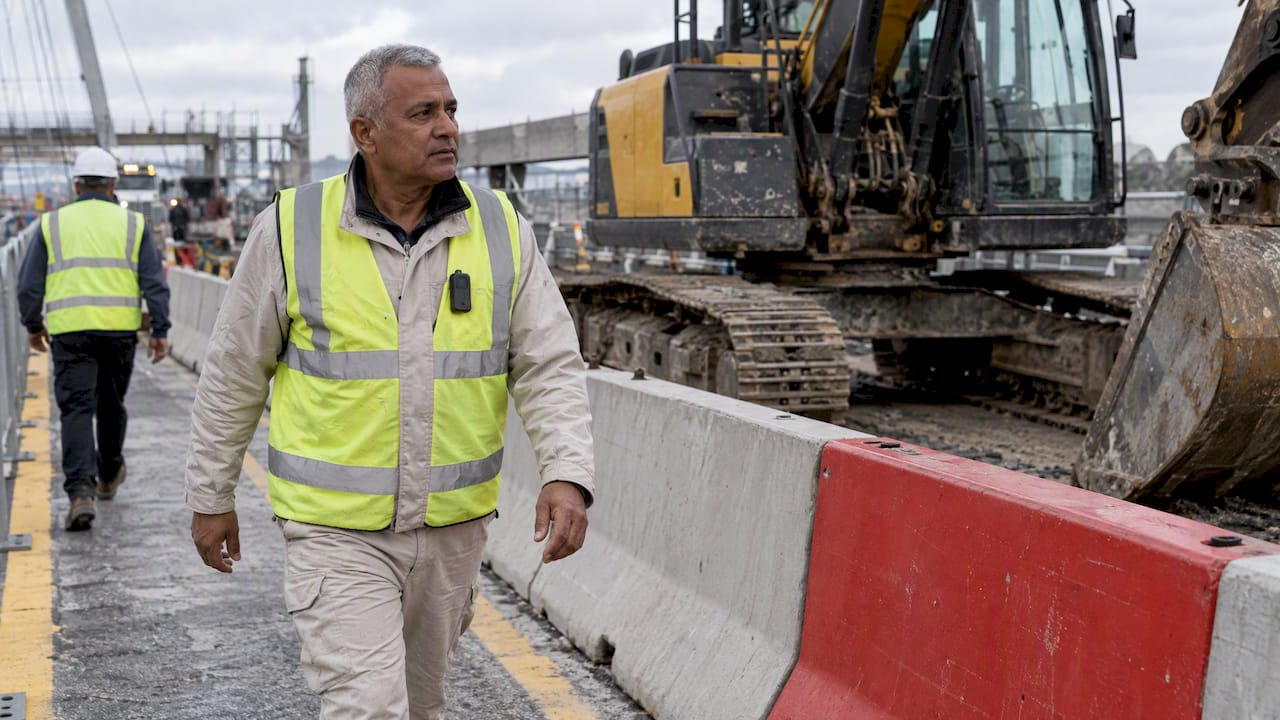
Construction safety IoT means connected sensors, wearables and equipment on site that send real-time data back to one platform, alerting workers if there is a hazard before it turns into an accident. It spans proximity alerts, heat stress monitoring, gas and air quality, noise monitoring and worker location tracking. None of it matters unless the information gets to someone who can react in time to prevent an injury.
This article covers how the technology works, what you can and cannot monitor with it, what the research suggests, and how to think through analysis, planning and rollout on a US construction site.
PODTECH Making Safety Data Play Nice
PODTECH creates custom software for construction safety and smart building monitoring to tie data from operations together so you can make better decisions. Learn More About PODTECH
TL;DR
Construction safety IoT integrates wearable devices, sensors and machines onto one platform that pushes real-time alerts and notifications.
- It can monitor heavy equipment proximity, heat stress, toxic gas detection, air quality, temperature, humidity and noise levels.
- An analysis of 47 major US projects found integrating digital safety governance reduced Total Recordable Injury Rate by 43%.
- Price tag, upkeep, privacy and employee buy-in determine rollout success.
- Do not begin with the platform with the most features; start with the highest-risk hazard.
- Sensors alone do not replace supervision, recordkeeping or reporting duties.
Table of Contents
- What construction safety IoT means on a job site
- How a connected safety system works
- What IoT can monitor
- What the evidence shows
- Costs and practical challenges
- Privacy and worker trust
- Multi-employer sites: who owns the alert?
- Planning a rollout: six steps
- Our perspective: the software layer matters most
- Build a connected safety system with PODTECH
- FAQ
- Sources
What construction safety IoT means on a job site
A construction site is difficult to keep tabs on. Workers rotate daily, equipment moves, multiple employers share the same space and conditions change hourly. Paper checklists and occasional walk-throughs give you a snapshot. IoT gives you a stream.
NIOSH describes the model simply: on worksites, wearables are often connected via an IoT network to wireless mesh infrastructure, which can be tethered to a computer. That computer can be used to track workers or equipment, perform analytics, send and receive messages, trigger warnings and alarms, and monitor location. In practice, sensors on a worker or piece of equipment detect something, the network transports that data, and software determines who needs to know about it.
Why does this matter? Construction remains one of the highest-risk industries. NIOSH notes that construction sites account for nearly 1 in 5 work-related fatalities each year in the US, despite employing only a modest share of the workforce. That is exactly why faster detection and faster response matter.
How a connected safety system works
Regardless of vendor, every construction safety IoT implementation has four layers. If any layer is weak, the chain is broken.
- Sensing. Wearables, tags, beacons, gas detectors, noise and weather sensors, and sensors attached to vehicles or machines.
- Connectivity. Bluetooth Low Energy, wireless mesh, cellular or wired backhaul. Sites are dynamic, so coverage must shift with the task at hand.
- Platform. The software that gathers readings, applies thresholds or models, stores historical data and maintains users, zones and devices.
- Action. Alerts on a worker device, alarms in the site office, messages to supervisors, and reports for audits and toolbox talks.
Layer 4 is where most projects succeed or fail. A safety notification that ends up in a dashboard no one checks is not a safety control. You need to define in advance who gets each alert, how quickly they need to respond and what action they are expected to take.
What IoT can monitor
NIOSH lists several hazards that wearables and connected sensors can monitor, including proximity to heavy equipment, heat stress risk, harmful substances, air quality, gas leaks, temperature, humidity and noise. The practical question is not just what can be measured, but what action the alert enables.
| Hazard | Typical device | What the alert enables |
|---|---|---|
| Struck-by from moving plant | Proximity tags on workers and vehicles | Warning to worker and operator before contact |
| Heat stress | Physiological wearables | Early rest and hydration decisions |
| Toxic gas, low oxygen | Wearable or fixed gas detectors | Evacuation, ventilation and entry control |
| Dust and air quality | Fixed environmental sensors | Control measures and exposure records |
| Noise | Wearable or zone noise monitors | Hearing protection and scheduling changes |
| Lone or lost workers | Location tags, mesh network | Faster emergency response |
NIOSH also notes that wearable proximity sensors can alert workers when heavy equipment is nearing them, and smart vehicles can detect workers nearby. That two-way detection matters on active sites where operators cannot see every worker near the machine.
What workers say matters most
Workers surveyed in 2021 ranked recognizing when they were near high-risk hazards like energized electrical equipment and toxic gas, fire or smoke as the most important capabilities. That is a useful scoping principle: start with the hazards crews already worry about. Trust builds faster when the technology clearly addresses a real concern workers already feel.
What the evidence shows
The research is encouraging, with honest limits.
Site-level outcomes. In one study analyzing 47 US large-scale construction projects, researchers found that digital safety governance integrated with IoT reduced TRIR by 43% and decreased near-miss incidents by 67% compared to sites that did not implement digital solutions. Hazard communication improved dramatically and corrective actions were closed much faster on average at sites using digital methods.
The important takeaway is that the gains did not come from sensors alone. They came from speed of information and speed of resolution. Hazards were communicated, routed and resolved faster.
Device-level accuracy. In field testing of an IoT presence detection system for work zones using BLE beacons and audible or vibration warnings, researchers reported 89.21% precision and 97.45% recall. Recall needs to be as close to 100% as possible so you do not miss events. Precision is rarely perfect in the field, which is why threshold tuning and alert configuration matter so much. Too many false positives and crews will start ignoring alarms.
Where the data is lacking. Studies into US work-zone technology initiatives also show low uptake due to several factors, including difficulty proving ROI, benefits that are spread across multiple stakeholders, and mixed worker reactions to usability. That means you should treat instant-ROI claims carefully and establish your own baseline before implementation.
Costs and practical challenges
Prices vary widely depending on the device. NIOSH notes that sensors themselves can range from as little as $35 for a Bluetooth device to over $1,000 for an RFID device. But the device cost is only the start.
- Infrastructure. Gateways, mesh nodes, power and mounting all need to be installed and often moved as the site evolves.
- Maintenance. Charging, cleaning, calibration and replacing lost or damaged units are recurring operational costs and one of the main barriers identified by NIOSH.
- Integration. If alerts live in a separate app from your incident log, permits and daily reports, teams end up doing double entry and the system becomes harder to sustain.
- Coverage holes. Basements, elevator shafts and dense metal structures can disrupt radio signals. Test before you buy.
- Training. Digital literacy, leadership commitment and clear operating procedures are critical success factors.
In other words, the real cost is not just hardware. It is the total operating model required to keep the system useful every day.
Privacy and worker trust
If a wearable can keep a worker safe, it can also be used to watch them. NIOSH is direct about the issue: privacy concerns include wearables being used to monitor productivity or track employees. More broadly, sensor systems driven by algorithms raise concerns around worker surveillance, algorithmic bias and privacy.
This is where many deployments either gain trust or lose it. If workers believe the system is really a productivity surveillance tool dressed up as safety, adoption will suffer no matter how good the hardware is.
- State the purpose clearly. Explain exactly which hazards are being monitored and why.
- Limit data collection. Only collect what is necessary for the safety use case.
- Define access rules. Workers should know who can see what data and under what circumstances.
- Separate safety from discipline. If possible, avoid using the same data for routine performance management.
- Involve crews early. Worker input on device comfort, alert fatigue and usability improves both trust and effectiveness.
Multi-employer sites: who owns the alert?
Construction sites rarely have a single employer and a single chain of command. General contractors, subcontractors, equipment operators, safety managers and owners may all be involved in the same work area. That creates a practical question: when an alert fires, who owns it?
This is not a technical detail. It is an operating model issue. If a proximity alert is sent to a worker, the equipment operator and a supervisor, you need to know:
- Who is expected to act first.
- Who confirms the hazard is cleared.
- Who records the event.
- Who follows up if alerts repeat in the same zone.
Without that clarity, alerts can bounce between parties and no one takes ownership. On multi-employer sites, routing logic, escalation rules and role-based permissions matter just as much as the sensor itself.
Planning a rollout: six steps
The best rollout plans start with one high-value problem, not a giant feature list. A practical six-step approach looks like this:
- Pick the highest-risk hazard first. Start with a problem like struck-by exposure, heat stress or gas detection where faster alerts can clearly change outcomes.
- Map the response workflow. Define who receives the alert, what they do, how fast they respond and how the event is closed out.
- Test the site conditions. Validate radio coverage, battery life, device comfort and environmental durability in the actual work areas.
- Integrate with existing records. Connect alerts to incident logs, permits, daily reports or corrective action workflows so teams are not duplicating work.
- Run a pilot with measurable baselines. Track alert counts, response times, false positives, near misses and close-out speed before and after deployment.
- Scale in phases. Expand to adjacent hazards or crews only after the first use case is trusted and operationally stable.
This phased approach is usually more effective than trying to digitize every safety process at once.
Our perspective: the software layer matters most
Hardware gets the attention because it is visible. But in practice, the software layer is what determines whether a connected safety system becomes useful or noisy.
The platform has to normalize data from different devices, apply the right thresholds, map alerts to zones and roles, maintain audit history, and connect safety events to the rest of site operations. If that layer is weak, even good sensors create fragmented workflows and alert fatigue.
This is where custom software often outperforms generic dashboards. Construction sites have unique reporting structures, subcontractor relationships, permit processes and escalation paths. The software should reflect how the site actually runs, not force the site to adapt to a rigid product model.
- Device-agnostic ingestion helps you avoid being trapped in one hardware ecosystem.
- Role-based alert routing ensures the right person gets the right signal.
- Workflow integration turns alerts into actions, not just notifications.
- Historical analytics help teams spot recurring hazards, weak controls and training needs.
Build a connected safety system with PODTECH
PODTECH builds custom software that helps construction teams make safety data usable. We connect operational systems, sensor feeds and reporting workflows so alerts do not live in isolation.
If you are evaluating construction safety IoT, the key question is not just which wearable or sensor to buy. It is how the data will move from detection to decision to documented action. That is the layer where most value is created.
What PODTECH can help with
- Integrating sensor and wearable data into one operational view.
- Designing alert workflows that match real site responsibilities.
- Connecting safety events to reports, audits and corrective actions.
- Building custom dashboards and analytics around the hazards that matter most.
FAQ
What is construction safety IoT?
Construction safety IoT is the use of connected sensors, wearables, tags and equipment systems to detect hazards and send real-time data or alerts to workers, supervisors and safety teams.
What hazards can construction IoT monitor?
Common use cases include heavy equipment proximity, heat stress, toxic gas, low oxygen, dust, air quality, temperature, humidity, noise and worker location for emergency response.
Does construction safety IoT reduce injuries?
Research suggests connected digital safety governance can reduce injury rates and near misses, especially when alerts are tied to fast communication and corrective action workflows.
What is the biggest mistake in a rollout?
Starting with too many features instead of one high-risk hazard. The most successful rollouts begin with a clear use case, defined response ownership and measurable outcomes.
Do sensors replace supervisors or compliance duties?
No. Sensors support faster detection and response, but they do not replace supervision, training, recordkeeping, reporting or legal safety responsibilities.
Why does the software platform matter so much?
Because the platform decides how data is normalized, who gets alerted, how events are escalated, and whether the information connects to the rest of site operations. Without that layer, the hardware often becomes another silo.
Sources
- NIOSH. Wearable Technologies and Sensor Systems for Monitoring and Preventing Work-related Conditions in Construction.
- Worker preference study. Survey research on construction worker priorities for wearable safety capabilities.
- Digital safety governance study. Analysis of large-scale construction projects using digital safety methods.
- BLE work-zone detection study. Field evaluation of IoT presence detection for work zones.
- CPWR. Reducing highway fatalities and barriers to technology adoption.