
A security patch is also a set of instructions. When a vendor publishes a fix, it tells everyone, attackers included, which product is weak, which versions are affected and roughly where the flaw is.
An organisation that patches on a monthly cycle is racing people who started the day the advisory went out. The data now shows how that race usually goes, and a monthly cycle loses it.
Most attacks land inside a monthly patch cycle
In 2023, one in eight n-day flaws was exploited within a day of disclosure, and more than half within a month. That comes from Mandiant's time-to-exploit research, which tracks vulnerabilities exploited in the wild.
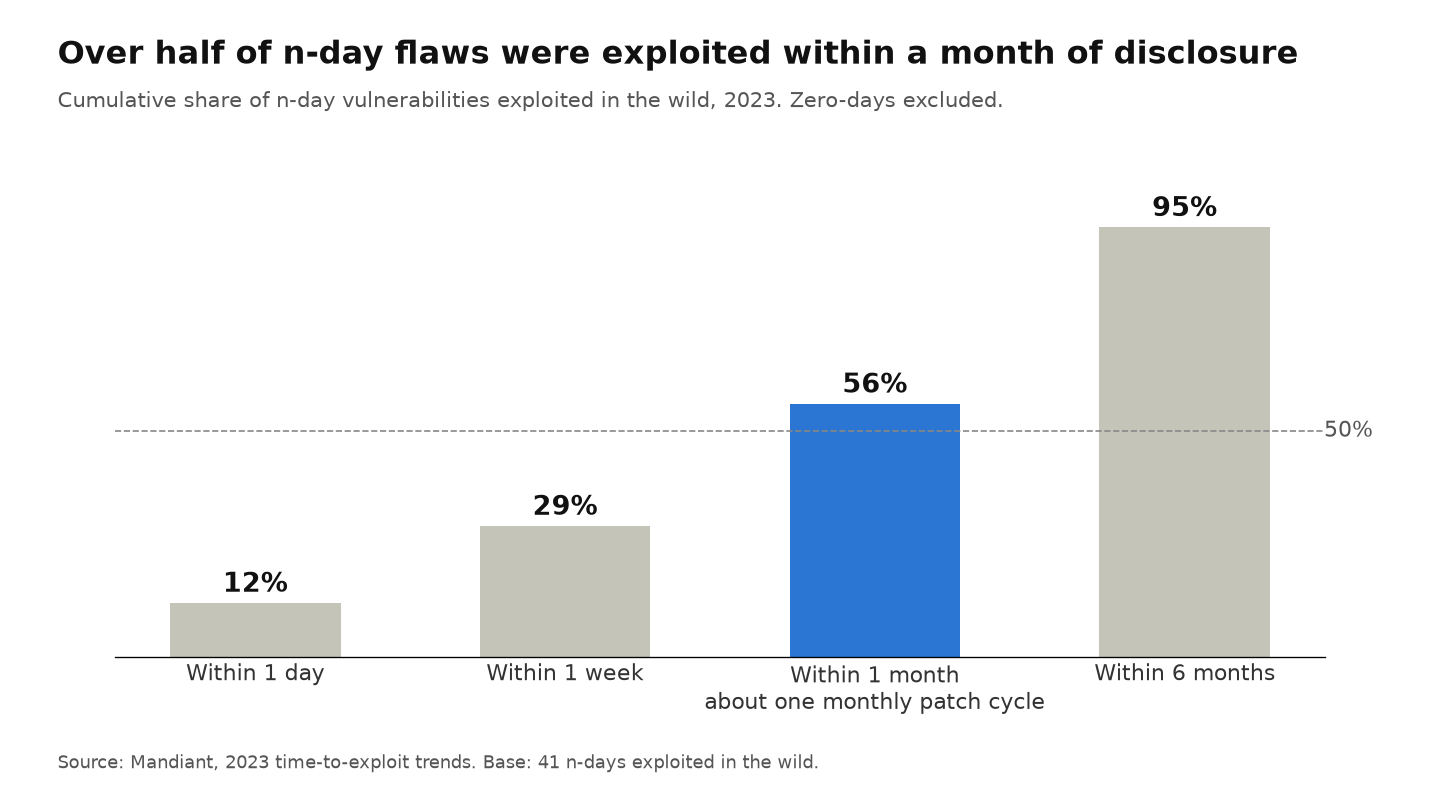
The chart deliberately leaves out zero-days, which were 70% of the flaws exploited in 2023 and were attacked before any patch existed. It shows only n-days: flaws exploited after a fix was available, which is the race a patching process can actually win or lose. It rests on 41 flaws, and Mandiant says its dates are conservative, so real attacks probably came sooner.
The longer trend points the same way. Mandiant's average time-to-exploit, which does include zero-days, fell from 63 days in 2018–19 to 32 days in 2021–22 and five days in 2023. A change advisory board that meets on the second Tuesday of the month cannot win that race, however good its people are.
Since 2023 it has only got faster
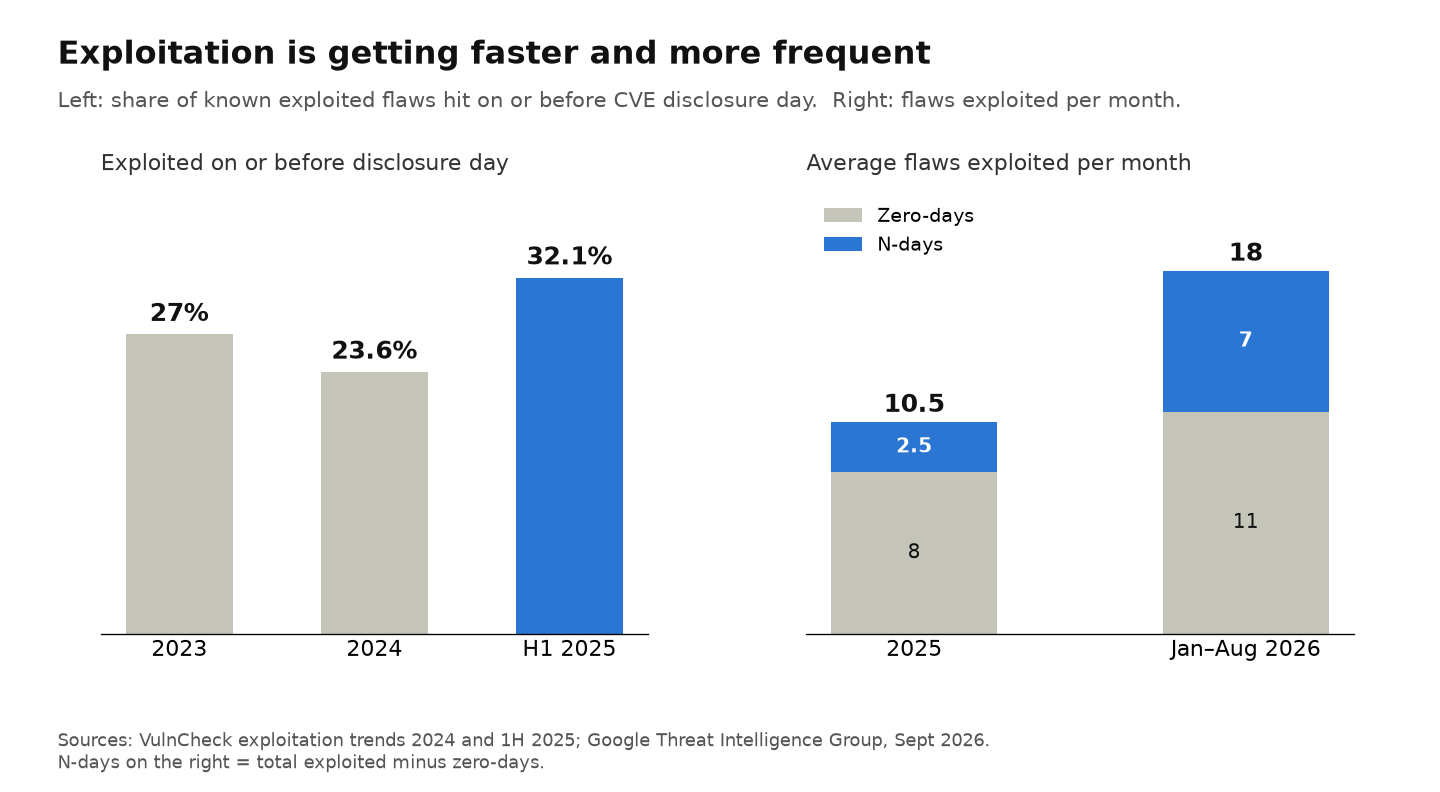
Newer data from two independent sources shows the pressure rising, not easing. VulnCheck tracks how many known exploited flaws were attacked on or before the day their CVE was published. That figure was 27% in 2023, 23.6% in 2024 and 32.1% in the first half of 2025. Almost a third of the flaws attackers use now have no patch window at all.
The volume is climbing too. Google Threat Intelligence Group found that the average number of vulnerabilities exploited each month rose from 10.5 in 2025 to 18 between January and August 2026, an increase of 71%. Zero-days rose only slightly, from 8 to 11 a month. Most of the growth came from n-days: flaws that already had a fix, attacked faster and more often.
Why Shodan changes the maths
Writing an exploit is only half the job. An attacker also needs targets, and Shodan has already found them. It continuously scans the internet and records what answers on each port: the product, the version string, the TLS certificate, sometimes the login page. A search for one VPN appliance on one vulnerable build returns a list of IP addresses in seconds.
Tools like ZMap and Masscan can sweep the whole IPv4 address space in under an hour, so anything Shodan has not indexed yet can be found the same afternoon. That is why the fastest n-days are exploited within a day: finding targets takes almost no time.
Building the exploit is getting quicker as well. Google's threat intelligence team suggests attackers are using AI tools to compare a patched release with the previous version and work back to the flaw. The patch really is the instructions, and machines are now reading them.
It turns an advisory into a shopping list. A remotely exploitable flaw in an edge device, a file transfer server or a remote access gateway is found, sorted by version and attacked at scale. Citrix Bleed followed this pattern in 2023. So did MOVEit Transfer, and so did a string of Ivanti and Fortinet edge bugs. The victims were rarely chosen. They were simply listed.
Manual patching cannot keep up
Most patch processes were designed when exploits took months to appear. A typical cycle runs like this: the scanner raises a finding, someone triages it, a ticket is raised, the change board meets, a maintenance window is booked and an engineer applies the update by hand. Each step makes sense on its own. Together they take weeks, and by then more than half of n-days have already been exploited.
Scale makes it worse. A mid-sized estate can have thousands of servers, containers, network devices and appliances, each with its own update channel. No team can read every advisory, map it to every asset and push every fix by hand within a few days. Things get missed, and what gets missed is usually the forgotten test box or the appliance nobody owns.
What automated patching looks like
Automated patching does not mean pushing every update to every machine at once and hoping. It means making patching the default action, with people handling the exceptions instead of the routine.
- Continuous detection. Vulnerability scanning and asset inventory run all the time, not monthly. New advisories are matched to installed software automatically, and each finding arrives with the asset, the owner and the exposure already attached.
- Risk-based priority. A flaw in the CISA Known Exploited Vulnerabilities catalogue, or one that is remotely exploitable without authentication on an internet-facing system, goes to the front of the queue.
- Staged rollout. Updates go out in rings: a small canary group first, then a wider group, then the rest. Health checks between rings stop a bad patch before it reaches production at scale.
- Rollback built in. Snapshots, blue-green deployments and immutable images mean a failed update is undone in minutes. Fear of breaking things is the main reason patches wait, and a tested rollback removes most of that fear.
- Proof of closure. After deployment the scanner checks again, and the finding closes only when the fixed version is confirmed.
The targets should follow the exploitation data, not the change calendar:
| Exposure | Patch target | Why |
|---|---|---|
| Internet-facing, or on the CISA KEV list | 24–48 hours | One in eight n-days is exploited within a day, and a third of known exploited flaws are hit on or before disclosure |
| Critical or high, internal | 7 days | Nearly a third are exploited within a week |
| Everything else | 14 days at most | Over half are exploited within a month |
The UK NCSC's Cyber Essentials scheme already expects high and critical updates within 14 days of release. For anything internet-facing and actively exploited, treat 14 days as the outer limit, not the target.
The rule for critical, exposed flaws
When a critical or remotely exploitable flaw is found on an exposed system, patch it straight away. If it cannot be patched straight away, take the service offline or block it at the edge until it can.
This rule matters even more because of zero-days. The first chart leaves them out, but they were 70% of what was exploited in 2023 and still around 11 a month in 2026, and no patching speed can beat a flaw attacked before its fix exists. For those, the only defence is how little you expose and how fast you can pull it.
That sounds drastic, and it is meant to be. A planned outage of a VPN gateway for a few hours is disruptive. A ransomware incident that starts at that gateway takes weeks to recover from, and may bring a regulator, a forensic bill and a public statement with it. The service owner should make that trade-off in advance, written into policy, not at two in the morning while the attack is under way.
Taking a service offline does not always mean switching it off. The options include:
- Removing the public route or firewall rule, so the service is reachable only from inside the network.
- Putting it behind a VPN or zero-trust access proxy that requires authentication before the vulnerable code is reached.
- Applying the vendor's mitigation or a web application firewall rule as a stopgap, with a deadline to patch.
- Failing over to a patched standby while the primary is updated.
See the estate the way an attacker does
If attackers find systems through Shodan, defenders should look there first. Searching your own IP ranges and domains shows exactly what is exposed and which versions it reports. Shodan Monitor and other external attack surface tools send an alert when a new port opens or a vulnerable version appears.
That feed belongs in the same automated pipeline as the internal scanner. Many breaches start on a system the security team did not know was public.
Where automation needs care
Some systems should not be patched automatically. Operational technology, such as building management controllers, PLCs, UPS management cards and fire panels, often cannot be restarted without a site visit, and a bad firmware update can take out a cooling plant. These systems need tested updates, maintenance windows and strong compensating controls. PODTECH's guide to OT patch management covers that process in detail.
The same principle still applies. If an OT device is reachable from the internet and has a known remote exploit, it should come off the internet today. Patching can follow on a safer schedule. Exposure cannot wait.
Getting started
Organisations moving from manual to automated patching usually succeed by starting small. A practical order is:
- Build a complete asset inventory, including cloud and edge.
- Connect the vulnerability scanner to that inventory, plus an external attack surface feed.
- Automate patching for one well-understood group, such as Windows or Linux servers.
- Add canary rings and rollback.
- Extend to network devices and appliances.
- Publish the offline rule for critical internet-facing flaws, so everyone knows it before it is needed.
The data is clear. One in eight n-days is exploited within a day and most within a month. A third of known exploited flaws are attacked on or before disclosure, and the monthly count nearly doubled in 2026. Automated detection and deployment, backed by a clear decision to take exposed systems offline when they cannot be fixed, is the only approach that works at that speed.
Close the patch gap
PODTECH designs and operates automated patching, vulnerability monitoring and edge controls for critical infrastructure estates.
Talk to PODTECHSources
- Mandiant: How Low Can You Go? An Analysis of 2023 Time-to-Exploit Trends (October 2024)
- Google Threat Intelligence Group: Vulnerability Discovery and Exploitation Trends in the AI Era (September 2026)
- VulnCheck: State of Exploitation 1H 2025
- VulnCheck: 2024 Trends in Vulnerability Exploitation
- CISA Known Exploited Vulnerabilities catalogue
- NCSC Cyber Essentials