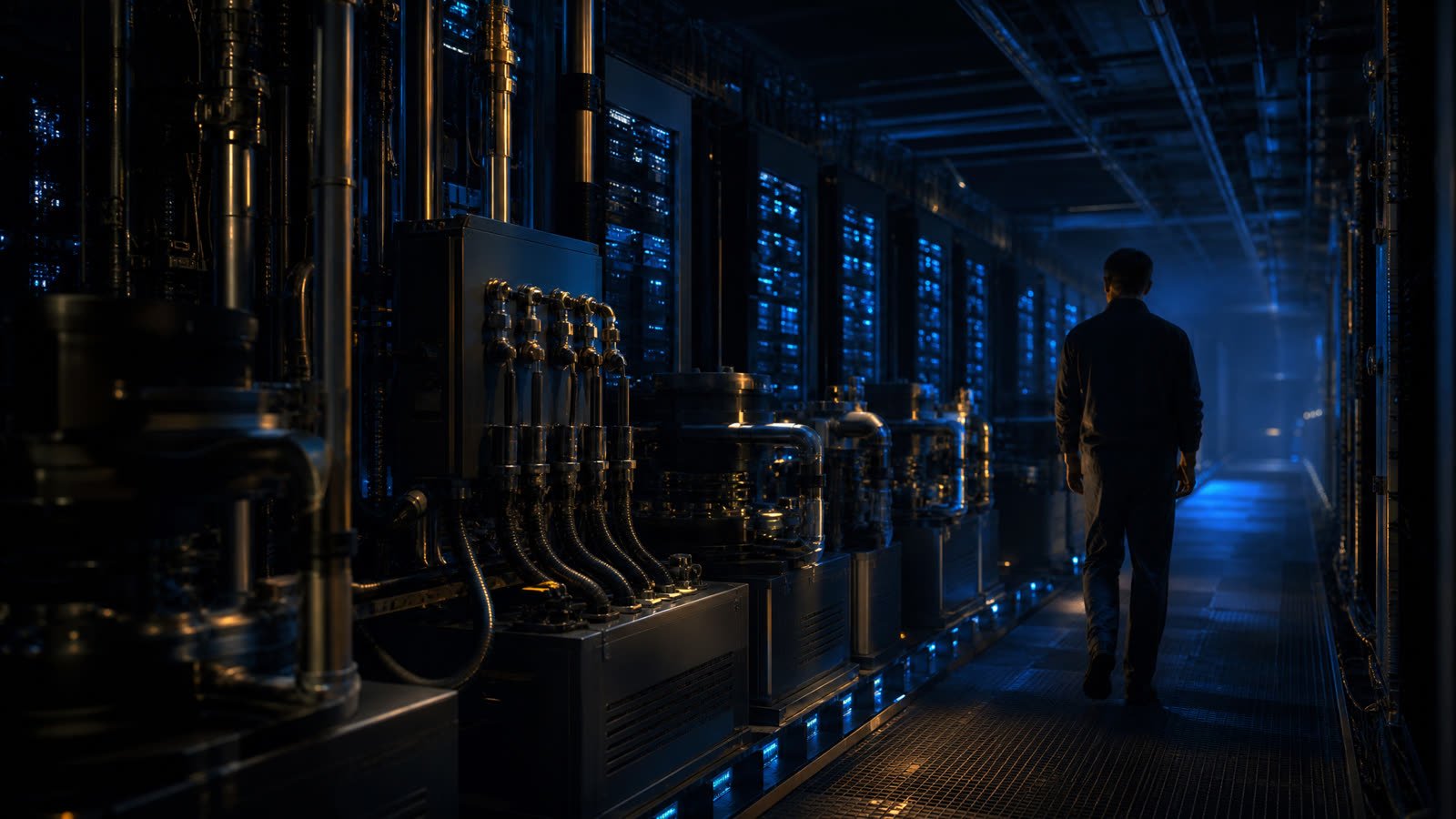
AI factories are going up faster than the halls they replace. Operators are not adding a row of servers to an existing floor. They are standing up buildings whose only job is to train and serve models at rack densities that air cooling cannot carry. The schedule is the constraint. Power, pipework and commissioning have to land in the same quarter, or the GPUs sit idle while the building is still being finished.
That pace shows up in the cooling market before it shows up in the architecture diagrams. Data Center Post, in “Data Center Refrigerant Market to Surpass USD 1.62 Billion by 2035”, drawing on a Global Market Insights report, puts the global data center refrigerant market at USD 633 million in 2025 and on a path to USD 1.62 billion by 2035. The compound annual growth rate in that forecast is 9.6%. The number is not a story about chemistry for its own sake. It is a proxy for how quickly high-density computing is being built, and for the thermal plant that has to be specified with it.
What the forecast is actually measuring
The same report says hydrofluoroolefins held 67.7% of the refrigerant market in 2025, with that segment expected to grow at 10.2% a year through 2035. Hyperscale facilities held about 40% of the market and are forecast to grow at 10.4% a year from 2026. The United States accounted for 79% of the market in 2025, worth USD 176.3 million. Those shares track where the largest AI clusters are being poured into concrete first. They also track a second pressure. High-GWP refrigerants are being phased out, so the plants going in now are specified around lower-GWP fluids, tighter leak control and a cooling loop that can be measured for the life of the hall.
An AI factory is a thermal machine with computers in it. A dense rack rejects far more heat than a general-purpose server ever did. Direct liquid cooling, coolant distribution units and rear-door heat exchangers move that heat off the chip and into a loop that still depends on a refrigerant somewhere in the chain, whether in a chiller, a heat pump or a dry cooler. Get the loop wrong and the deployment date slips even if the racks arrived on time. Get the monitoring wrong and a drifting supply temperature shows up after a job has already failed.
Installation and the live picture of the hall
This is the work PODTECH and Datalec Precision Installations take on together. Datalec, which trades as DPI, designs and installs the physical plant: mechanical and electrical works, containment, modular halls and direct liquid cooling, including the CDUs and pipework that have to be designed into the frame rather than bolted on after handover. PODTECH brings the operational view of the same hall. PODVIEW, at podview.ai, is a monitoring and management platform for the facility once it is live. It follows the temperatures, flows and power that tell an operator whether the cooling plant is keeping up with the IT load. The partnership exists so the hall and the picture of the hall arrive as one system, not as a building that is handed over and a dashboard that is added months later.
The sequence on site is unglamorous, and it is the part that decides whether a fast programme actually opens. Power and network are validated before a cluster is called ready. The liquid loop is commissioned against the design duty, not against a nameplate. Sensors go on supply and return, on CDU valves and on the racks that will run hottest, and those points stay in one place. PODVIEW is built for that last step: one operational picture of a hall that may be one of several the same team is bringing online in the same year.
Why the cooling line item no longer stays flat
The refrigerant forecast will not slow the build-out. It is a reminder that the cooling plant is now a line item that grows with AI capacity, rather than a utility that stays flat while the IT refresh happens around it. Teams that treat deployment as a joint problem of installation and monitoring are the ones that can open a hall without spending the first quarter chasing thermal alarms.
Source
Data Center Refrigerant Market to Surpass USD 1.62 Billion by 2035, Data Center Post, citing Global Market Insights.
Related
Talk to PODTECH about commissioning and monitoring an AI hall, or see how podview.ai sits alongside a Datalec installation.