
TL;DR:
- Most IT decision-makers treat SLAs as legal boilerplate, but they are vital for ensuring enterprise reliability and accountability.
- A well-defined SLA specifies measurable targets, responsibilities, and remedies, transforming promises into enforceable obligations that protect critical infrastructure.
- Effective SLA management involves continuous monitoring, regular reviews, and integrating standards to maintain operational standards and prevent disputes.
Most IT decision-makers treat SLAs as legal boilerplate — a section of a contract signed, filed, and forgotten. That is a costly mistake. Understanding what is SLA in software is not a procurement formality; it is the foundation upon which enterprise reliability is built or broken. When your data centre management platform, building monitoring system, or financial infrastructure software goes down, the SLA determines what happens next: who is accountable, how fast recovery must begin, and what compensation you are owed. Get it wrong, and you are negotiating from weakness during the moments that matter most.
Table of Contents
- Understanding the basics of service level agreements in software
- Exploring the relationship between SLAs, SLOs, and SLIs
- Key components to define when creating an SLA for critical software
- Applying standards and best practices to SLA development and management
- Common pitfalls and advanced considerations when managing SLAs in enterprise software
- Rethinking SLAs: beyond promises to actionable commitments
- How PODTECH helps enterprises build and manage reliable software SLAs
- Frequently asked questions
Key Takeaways
| Point | Details |
|---|---|
| SLAs define service expectations | An SLA is a binding contract specifying measurable software service quality and performance targets. |
| SLOs and SLIs support SLAs | Internal targets (SLOs) and metrics (SLIs) measure and prove if SLA commitments are met. |
| Critical SLA components | Scope, responsibilities, performance targets, and remedies must be clearly defined in SLAs. |
| Standards aid consistency | Standards like ISO/IEC 19086-2 help create clear, comparable SLA metrics for cloud services. |
| Effective SLA management | Mapping SLA metrics into monitoring and incident management improves reliability and compliance. |
Understanding the basics of service level agreements in software
Now that we know why SLAs matter, let us explore what an SLA actually is in the context of enterprise software.
The SLA definition in software is straightforward: it is a binding contract between a software service provider and a customer, formally documenting the quality, availability, and responsibilities of that service. It transforms a verbal promise into a measurable, enforceable obligation. That distinction matters enormously when you are running critical infrastructure.
In practice, a software SLA contains several components that define the terms of service delivery. These typically include:
- Uptime commitments, expressed as a percentage over a defined period (for example, 99.9% availability measured monthly)
- Response and resolution times, specifying how quickly incidents must be acknowledged and resolved based on severity
- Scope of coverage, clarifying which systems, components, or environments the agreement applies to
- Assigned responsibilities, detailing what the provider must do versus what the customer must maintain
- Remedies for breaches, such as service credits, financial penalties, or termination rights
The SLA meaning in IT extends beyond availability. Metrics such as mean time to repair (MTTR), mean time between failures (MTBF), throughput thresholds, and latency limits are all common inclusions in enterprise software agreements. Understanding SLA and software compliance becomes especially important when your software must also meet regulatory obligations.
Exploring the relationship between SLAs, SLOs, and SLIs
Having established what SLAs are, let us look deeper at these related concepts that make SLAs measurable and enforceable.
The terms SLA, SLO, and SLI are often used interchangeably, which creates significant confusion. They are not the same thing, and conflating them leads to SLAs that cannot actually be enforced because nobody knows whether targets are being met.
Here is how they relate to one another:
| Term | Full name | Who uses it | What it defines |
|---|---|---|---|
| SLA | Service level agreement | Provider and customer | The formal contractual commitment |
| SLO | Service level objective | Engineering and operations | The internal target set to meet the SLA |
| SLI | Service level indicator | Engineering and monitoring | The actual measured metric |
SLAs document commitments, SLOs are the internal performance targets set to meet those commitments, and SLIs are the specific metrics that measure whether those targets are being achieved.
Think of it this way. Your SLA commits to 99.9% uptime. Your SLO is the internal target of 99.95% uptime, giving your engineering team a buffer. Your SLI is the actual measured availability figure collected from your monitoring systems every minute. The SLA/SLO/SLI split reduces ambiguity during incidents and helps prove contractual compliance when disputes arise.
Key benefits of separating these three elements include:
- Clearer incident escalation paths, because everyone knows which SLI threshold triggers which SLO alert
- Faster remediation, because the team is managing to internal targets rather than reacting only when the SLA is breached
- Objective dispute resolution, because you have timestamped SLI data to support or refute any claim
For enterprise IT teams managing complex environments, understanding SLA internal metrics at this level of granularity is what separates reactive organisations from genuinely reliable ones.
Pro Tip: Set your SLOs at least 10% more demanding than your SLA commitments. This creates an operational buffer that absorbs minor incidents before they become contractual breaches.
Key components to define when creating an SLA for critical software
With an understanding of SLA measurement, let us explore practical considerations when defining SLAs for your enterprise software.
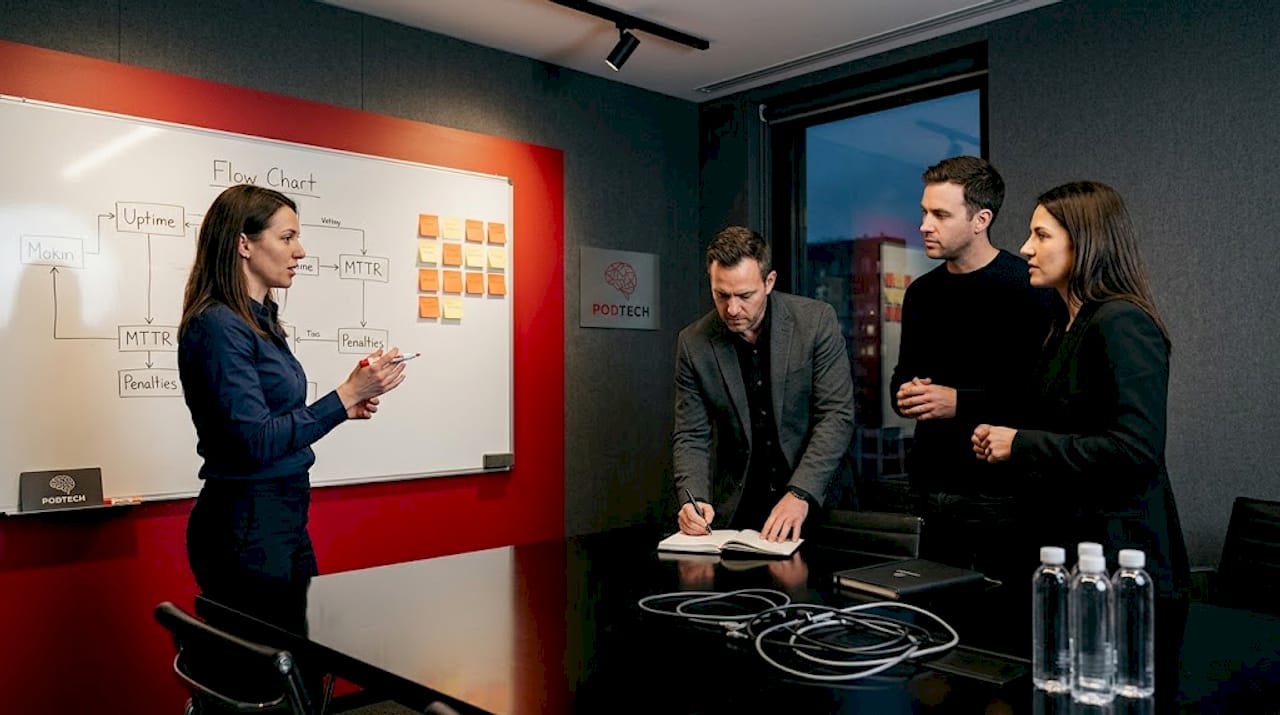
When you are procuring or commissioning software for critical infrastructure, the quality of your SLA directly determines your exposure to operational risk. A weak SLA gives you a false sense of security. A well-constructed one gives you genuine recourse.
The essential components every software SLA must address, in order of importance:
- Measurable uptime and performance targets — Define the SLO within the SLA precisely. “High availability” is not acceptable. “99.99% uptime measured over any rolling 30-day period, excluding scheduled maintenance windows notified 72 hours in advance” is. SLAs must specify uptime and performance targets, scope, responsibilities, and remedies for breaches.
- Scope of service coverage — Which environments does the SLA cover? Production only? Disaster recovery systems? Staging? If it is not written down, it is not covered.
- Incident severity classifications — Define P1, P2, P3, and P4 incidents explicitly, each with corresponding response and resolution time commitments.
- Assigned responsibilities — Who manages patching? Who monitors alerts overnight? Who initiates the escalation chain? Both provider and customer must have documented obligations.
- Reporting and transparency obligations — Monthly uptime reports, incident post-mortems, and real-time monitoring access are all legitimate SLA requirements.
- Remedies for breaches — SLAs are legally binding and must establish clear accountability and recourse, whether that is service credits, financial penalties, or rights to terminate without penalty.
When negotiating, push back on vague exclusion clauses. Many providers define “force majeure” broadly enough to exclude events that should clearly be their responsibility. Demand specific carve-outs rather than blanket exclusions.
Pro Tip: Ask your provider to share historical SLI data before you sign. If they cannot produce 12 months of uptime and incident resolution data, that absence tells you something important about their operational maturity.
Applying standards and best practices to SLA development and management
Now that you know what to specify in SLAs, let us examine standards and best practices to manage and improve SLA effectiveness over time.
The most rigorous enterprises do not create SLAs in isolation. They align them with internationally recognised frameworks to ensure metrics are consistent, comparable, and defensible. ISO/IEC 19086-2 provides a metric model framework specifically designed to specify and compare cloud SLA metrics consistently across providers and environments.
Best practices for SLA management in enterprise software environments:
- Map every SLA metric to a monitoring alert — If you cannot automatically detect when a metric is approaching its SLO threshold, you are managing incidents reactively rather than preventing them
- Establish incident response and recovery as separate SLA targets — Response time and resolution time are different obligations; conflating them creates loopholes
- Conduct quarterly SLA reviews — Operational data from the past quarter should inform whether current targets remain appropriate or need revision
- Publish internal SLA dashboards — Give operations, engineering, and leadership teams live visibility into SLI data relative to SLO targets
- Document the escalation matrix in the SLA itself — Who is called at 2am, and in what order, should not be a matter of institutional memory
| SLA management activity | Frequency | Responsible party |
|---|---|---|
| SLI metric review | Continuous (automated) | Engineering and operations |
| SLO threshold review | Monthly | Service owner |
| SLA compliance reporting | Monthly | Provider account team |
| Formal SLA review | Quarterly | Customer and provider leadership |
This discipline matters because SLAs are not static documents. Infrastructure changes, usage patterns evolve, and business criticality shifts over time. A target that was reasonable when a system supported one region may be dangerously weak once that same platform underpins global operations.
Mature organisations therefore treat SLA management as an operational practice, not a legal archive. They connect contract language to telemetry, incident workflows, and executive reporting so that service quality is visible before a breach occurs.
Common pitfalls and advanced considerations when managing SLAs in enterprise software
Even well-intentioned enterprises make avoidable mistakes when drafting and managing SLAs. The most common problem is vagueness. If a commitment cannot be measured, it cannot be enforced. If a remedy is not explicit, it will be disputed. If responsibilities are not assigned, incident response will stall at exactly the wrong moment.
Some of the most frequent SLA pitfalls include:
- Using ambiguous language such as “best efforts,” “commercially reasonable,” or “high availability” without measurable thresholds
- Failing to define maintenance windows clearly, allowing providers to exclude too much downtime from availability calculations
- Relying on provider-reported metrics alone without independent monitoring or audit rights
- Ignoring dependency chains, where third-party cloud, network, or API failures affect service delivery but are not addressed in the agreement
- Accepting weak remedies that offer only minimal service credits with no meaningful financial or operational consequence
- Not aligning the SLA to business impact, treating a mission-critical platform the same way as a non-essential internal tool
Advanced SLA management also requires thinking beyond uptime. A system can be technically “available” while still being unusable because latency is too high, transactions are failing, or integrations are broken. For that reason, sophisticated software SLAs often include composite service quality measures rather than a single availability percentage.
For critical enterprise environments, consider whether your SLA should also define:
- Latency thresholds for key user journeys or API calls
- Data recovery objectives, including recovery point objective (RPO) and recovery time objective (RTO)
- Security response obligations for breaches, vulnerabilities, and patch timelines
- Change management controls governing releases, rollback procedures, and customer notification
- Auditability and evidence retention so incident records remain available if disputes emerge later
Another advanced consideration is multi-vendor accountability. In modern enterprise estates, one outage may involve the application provider, cloud host, network carrier, identity platform, and internal operations team. If your SLA assumes a single point of failure in a multi-party environment, you may discover too late that every supplier can plausibly blame someone else.
Pro Tip: For business-critical systems, insist on a service review process that includes root-cause analysis, corrective action tracking, and named owners for remediation. Credits alone do not restore resilience.
Rethinking SLAs: beyond promises to actionable commitments
The core lesson for IT leaders is simple: an SLA is not a ceremonial appendix to a software contract. It is an operational control mechanism. It defines what “good service” actually means, how it is measured, what happens when it fails, and who carries responsibility when recovery is required.
That is why the best SLAs are written with equal input from procurement, legal, engineering, operations, and executive stakeholders. Legal teams ensure enforceability. Engineers ensure measurability. Operations teams ensure the commitments can be monitored and acted upon. Leadership ensures the agreement reflects actual business risk.
If you approach SLAs only as vendor paperwork, you will almost certainly sign terms that look reassuring but fail under pressure. If you treat them as living operational commitments, you create a framework for accountability that improves reliability long before a dispute ever occurs.
In practical terms, rethinking SLAs means:
- Writing for incidents, not for signatures — assume the document will be tested during a real outage
- Demanding measurable evidence — every commitment should map to a metric, a report, or a monitoring source
- Aligning remedies to business harm — compensation should reflect the real impact of service failure
- Reviewing regularly — service commitments must evolve with architecture, scale, and business dependency
In other words, the question is not merely “what is SLA in software?” The more important question is whether your current SLAs are strong enough to protect the systems your organisation cannot afford to lose.
How PODTECH helps enterprises build and manage reliable software SLAs
At PODTECH, we work with enterprises that operate in environments where downtime is not an inconvenience — it is a business, compliance, and operational risk. That means SLA design cannot be generic. It must reflect the realities of the systems being supported, the dependencies involved, and the consequences of failure.
Our approach focuses on making SLAs practical, measurable, and operationally useful by helping clients:
- Define meaningful service metrics tied to uptime, latency, incident response, recovery, and reporting
- Translate business criticality into enforceable commitments rather than vague service language
- Integrate SLA targets into monitoring and support workflows so teams can act before breaches occur
- Clarify ownership across providers, platforms, and internal teams to reduce ambiguity during incidents
- Support continuous review and improvement as systems, usage, and risk profiles evolve
Whether you are evaluating a new software platform, modernising a legacy support model, or tightening accountability across critical infrastructure systems, PODTECH helps ensure your SLA framework supports resilience rather than merely describing it.
Frequently asked questions
What does SLA mean in software?
In software, SLA stands for service level agreement. It is a binding agreement between a provider and a customer that defines measurable expectations for service quality, availability, support response, and remedies if those commitments are not met.
What is the difference between an SLA, SLO, and SLI?
An SLA is the contractual commitment, an SLO is the internal target set to achieve that commitment, and an SLI is the measured metric used to track actual performance. Together, they make service expectations enforceable and observable.
Why are SLAs important for enterprise software?
SLAs are important because they define accountability when software performance affects critical operations. They establish who is responsible, how quickly incidents must be addressed, what level of service is expected, and what recourse the customer has if the provider fails to deliver.
What should be included in a software SLA?
A strong software SLA should include uptime targets, performance thresholds, incident severity definitions, response and resolution times, scope of coverage, customer and provider responsibilities, reporting obligations, exclusions, and remedies for breaches.
How often should SLAs be reviewed?
SLA metrics should be monitored continuously, with formal reviews typically conducted quarterly. Reviews should assess whether targets remain appropriate, whether recurring incidents reveal weaknesses, and whether changes in architecture or business dependency require updates to the agreement.