
Hire a specialist software consulting service when your infrastructure demands enterprise-grade reliability, integrations across BMS, PMS and NMS platforms, and measurable ROI that internal teams cannot deliver alone.
Before signing anything, validate scope and pricing with a paid discovery audit:
- Run a 3 to 10 day scoping engagement with your shortlisted vendor
- Confirm technical fit against your existing BMS, PMS and NMS stack
- Ask how the vendor measures success, ideally against a framework like the Rule of 40 for software value
Key Takeaways
Enterprise software consulting succeeds when discovery, measurable SLAs and documented handover planning are built into the contract from the outset, not added afterwards.
| Point | Details |
|---|---|
| Start with paid discovery | Run a 3 to 10 day scoping audit before committing to a full contract or RFP. |
| Match service to problem | Choose custom development, modernisation, SaaS, AI/ML or DCIM work based on your actual gap. |
| Evaluate systematically | Use a six-point checklist covering capability, compliance, SLAs and delivery model. |
| Demand documented evidence | Request architecture diagrams, test reports and anonymised references before signing. |
| Insist on structured handover | Require code ownership, runbooks and a runbook drill before go-live. |
| Consider PODTECH for critical infrastructure | 250+ projects, a 99.9% uptime SLA and applied DCIM case evidence via PODVIEW. |
Table of Contents
- What does a software consulting service actually cover?
- When should you hire a consultant instead of using internal teams?
- How do you evaluate and select a software consulting vendor?
- What outcomes and KPIs should you expect from an engagement?
- Which engagement model and handover process should you insist on?
- What do enterprise teams consistently get wrong?
- Why PODTECH fits mission-critical software consulting
- Frequently asked questions
- Sources
What does a software consulting service actually cover?
Enterprise buyers rarely need one thing. They need several, delivered by a team that understands how infrastructure, compliance and legacy systems interact.
- Custom software development: bespoke applications built around your workflow, not a generic template. A discovery sprint typically produces a working slice in weeks, with your organisation owning the source code and IP from day one.
- Legacy modernisation: phased migration of ageing platforms without halting operations, often the highest-risk, highest-reward engagement type.
- Cloud and SaaS development: scalable, subscription-ready platforms built for multi-tenant use and rapid iteration.
- AI and machine learning engineering: predictive maintenance, anomaly detection and automation layered onto existing operational data.
- Systems integration and API work: connecting disparate platforms so data flows without manual re-entry.
- DCIM and datacentre platform work: tools like PODTECH's PODVIEW for real-time datacentre visibility and telemetry.
- Managed services: ongoing operational support once a build ships.
Pricing shape follows scope. Focused projects can start in the low five figures, while AI-driven or platform-scale work typically starts materially higher once integrations, compliance requirements and data migration enter the picture.
When should you hire a consultant instead of using internal teams?
Some signals point firmly towards bringing in outside expertise. Others suggest your internal team already has it covered.
Signals that favour hiring:
- Uptime and reliability requirements that leave no room for trial and error
- Complex integrations spanning BMS, PMS and NMS systems your team hasn't touched before
- No internal cloud, SaaS or AI/ML capability, and no time to build it
- A transformation programme that needs vendor-neutral architecture decisions
Signals that favour in-house delivery:
- Small, well-understood feature additions
- Routine maintenance where staff already hold institutional knowledge of the platform
A datacentre operator facing a DCIM overhaul with tight regulatory deadlines fits the first category. A team adding a minor reporting feature to a stable internal tool fits the second.
How do you evaluate and select a software consulting vendor?
This is where most procurement processes go wrong, usually because the checklist is either too vague or too focused on price alone. A structured evaluation catches problems before they become six-figure mistakes.
Step-by-step evaluation checklist:
- Capability match: Does the vendor demonstrate direct experience with your technical stack, not just adjacent skills?
- Sector experience: Have they delivered in your industry (finance, datacentres, construction safety, manufacturing) where domain knowledge shortens the learning curve?
- Security and compliance posture: Can they show certifications and a documented compliance process relevant to your sector?
- SLA clarity: Are uptime, response time and escalation commitments written into the proposal, not just discussed verbally?
- Delivery model fit: Do they offer dedicated teams, staff augmentation, project-based delivery or managed services, and can they justify which suits your situation?
- Pricing structure and contract terms: Is the pricing model (fixed-price, time and materials, retainer) matched sensibly to your project's risk profile?
Questions worth asking on a vendor call:
- “Walk me through a project where scope changed mid-delivery. What happened to the timeline and the contract?”
- “Who owns the code and documentation after the engagement ends?”
- “Can I speak to a reference client with a similar integration challenge?”
Red flags to watch for:
- Vague handover plans with no named deliverables
- No measurable SLAs, just reassurances
- Single-engineer ownership of critical components, with no documented backup
A short procurement-request template helps here too. State your current architecture, the specific systems you need integrated, your compliance requirements, your target timeline, and the KPIs you'll use to judge success. Paste that into your RFP and you'll get sharper, more comparable responses.
Pro Tip: Ask for evidence of a documented discovery sprint, commit history on a comparable past project, and test coverage figures before you commit to a full pilot. A vendor confident in their delivery speed and QA process will have this ready without hesitation.
What outcomes and KPIs should you expect from an engagement?
Measurable results separate a genuine consulting partnership from an expensive experiment. The KPIs that matter most for enterprise engagements include uptime, mean time to recovery, reduction in manual process steps, cost per transaction, and time-to-market improvements on new features.
An uptime SLA at a typical enterprise-grade level translates to a limited amount of allowable downtime per year, a benchmark that separates enterprise-grade infrastructure work from standard commercial builds.
PODTECH's DCIM solutions case study shows applied datacentre management outcomes, the kind of evidence buyers should demand from any shortlisted vendor before committing budget. When you're checking a vendor's claims, look for:
- SLA language that specifies exact response times and remedies, not general reassurances
- Anonymised reference contacts you can actually call
- Delivery artefacts: architecture diagrams, test reports, sample code
- Documented discovery sprints with dated milestones, not retrospective summaries
Vendors who resist sharing any of the above are telling you something important before the contract is even signed.
Which engagement model and handover process should you insist on?
The engagement model shapes how much control, flexibility and risk you carry throughout the project.
- Dedicated teams: a consistent group of engineers embedded with your organisation, ideal for long-running transformation work.
- Staff augmentation: individual specialists slotted into your existing team, useful for filling specific skill gaps.
- Project-based delivery: fixed scope, fixed outcome, best for well-defined builds.
- Managed services: ongoing operational ownership after launch, suited to platforms requiring constant monitoring.
- SaaS/subscription: a platform you subscribe to rather than commission from scratch.
Insist on governance covering sprint cadence, a clear escalation path, formal change control and up-to-date documentation throughout, not just at the end.
Handover checklist, in order:
- Full code and repository ownership transferred to your organisation
- Documented runbooks for operational staff
- At least one runbook drill before go-live
- Defined support windows post-launch
- Training sessions for your internal team
- Formal IP transfer confirmation in writing
What do enterprise teams consistently get wrong?
Most enterprise teams undervalue discovery. They rush into a fixed-scope contract to save two weeks, then spend three months untangling integration assumptions nobody validated upfront. Weak handover planning and ignored cultural fit cause more failed engagements than any technical shortfall I've seen discussed in procurement postmortems.
- Insist on a short paid discovery before signing the main contract
- Require documented handover milestones, not a vague “we'll transfer everything at the end”
- Write business KPIs directly into the contract, not just technical acceptance criteria
Why PODTECH fits mission-critical software consulting
If your infrastructure can't afford downtime, you need a partner who's built for exactly that pressure. PODTECH specialises in custom enterprise software for critical infrastructure, backed by a strong track record of delivered projects and a high-availability uptime SLA that holds across datacentre, financial and construction safety deployments.
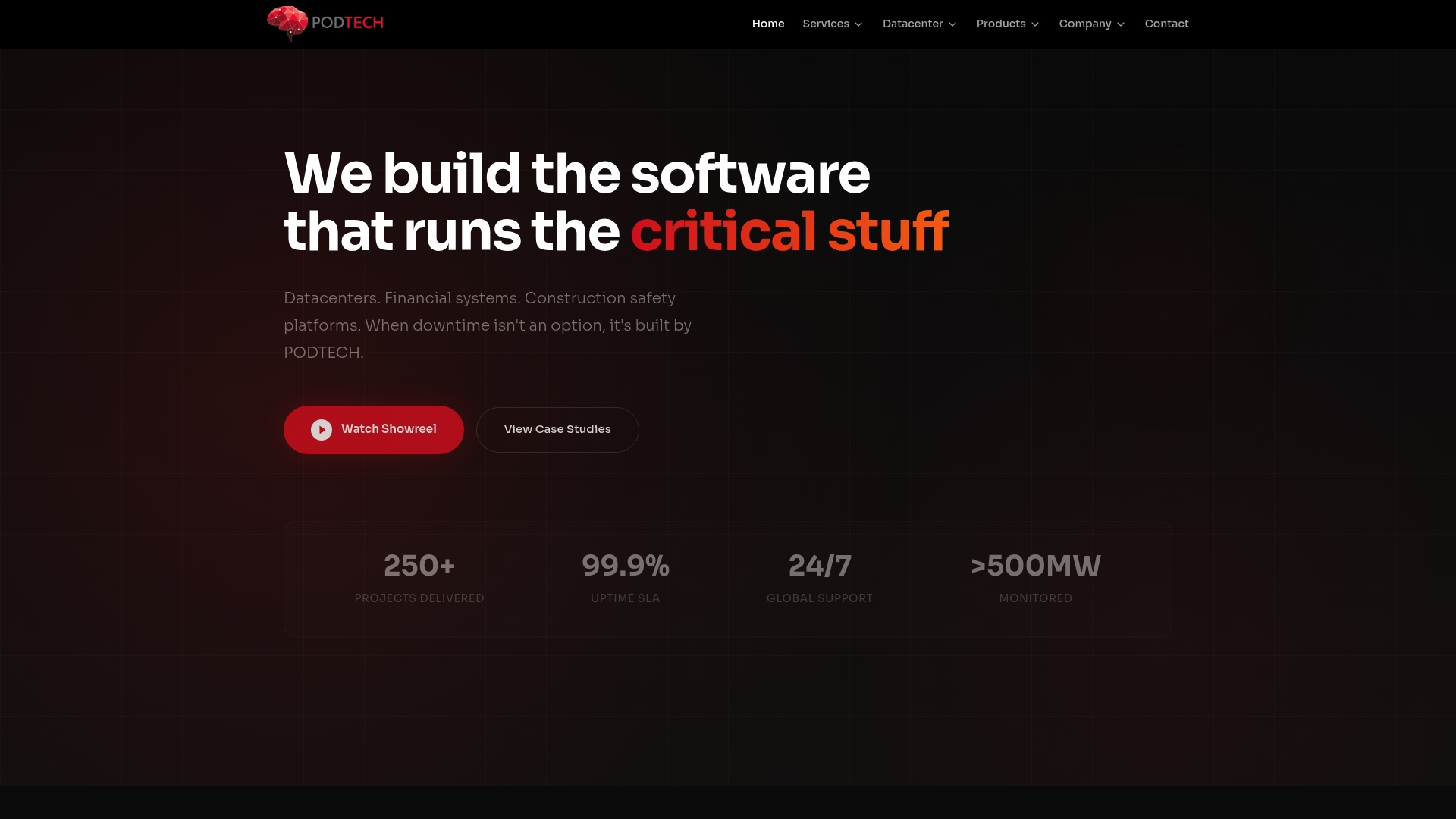
Its capabilities map directly onto the checklist above: legacy modernisation for ageing platforms, cloud and SaaS engineering for scalable products, systems integration across operational technology environments, and DCIM expertise through PODVIEW for real-time datacentre visibility.
For buyers evaluating mission-critical software consulting, the differentiators are practical rather than promotional:
- 250+ delivered projects across demanding enterprise environments
- 99.9% uptime SLA aligned to high-availability operational needs
- Applied DCIM delivery evidence through PODVIEW and related infrastructure work
- Custom development capability rather than forcing clients into a rigid off-the-shelf model
- Structured handover and operational continuity for teams that need ownership after launch
In other words, PODTECH fits best where the software is tightly coupled to operations, uptime matters commercially, and integration complexity is too high for generic vendors to handle comfortably.
Frequently asked questions
How long should a software consulting discovery phase take?
For most enterprise engagements, a paid discovery phase of 3 to 10 days is a sensible starting point. That is usually enough time to validate architecture, integration constraints, delivery assumptions and commercial scope before moving into a larger contract.
What is the biggest mistake buyers make when selecting a consulting vendor?
The most common mistake is skipping structured discovery and going straight to a fixed-scope agreement. That often hides integration risk, creates change-order disputes later, and weakens accountability around outcomes.
Should code ownership always transfer to the client?
In most enterprise custom software engagements, yes. Buyers should confirm code ownership, repository access, documentation rights and IP transfer terms in writing before the project begins, not during handover.
Which KPIs matter most in software consulting?
The most useful KPIs are the ones tied to operational and commercial outcomes: uptime, mean time to recovery, reduction in manual work, cost per transaction, deployment speed and time-to-market for new features.
When is an internal team enough?
Internal teams are often the right choice for small, well-understood feature additions or routine maintenance where the organisation already has strong platform knowledge and no unusual integration or compliance burden.
Sources
- Bain & Company — Software industry insights and Rule of 40 context
- Xobytes — Custom software development pricing reference
- PODTECH Services — Enterprise software, integration and PODVIEW capabilities
Need a consulting partner for critical infrastructure software?
Start with a short paid discovery, validate the integration path, and make sure the handover is documented before the build begins. That discipline is what turns software consulting from a procurement risk into an operational advantage.