How PODTECH bridges the gap between design intent and verified performance — turning siloed building and infrastructure systems into a single, trusted source of truth.
The layer between a beautifully designed building and one that actually performs.
PODTECH is increasingly being asked to play a role that the smart building and data centre market has struggled to fill: the Master Systems Integrator (MSI) — the backend engine that takes a digital strategy off the drawing board and makes it real on site. As design firms evolve from drawing buildings to guaranteeing how those buildings perform, somebody has to own the data layer underneath. That is the role we are built for.
The Shift: From Design Partner to Performance Assurance
The most forward-thinking engineering and design practices are no longer selling drawings. They are selling outcomes. The conversation has moved from "we designed this building" to "we can prove this building performs."
That shift sounds simple. Delivering it is not. A truly "smart-ready" building has to be designed with the correct data structures, semantic relationships, and an independent data layer from day one — a layer that is deliberately disconnected from the source systems that feed it. Get that right at design stage and any application can interrogate the building on a plug-and-play basis. Get it wrong, and every future analytics, FDD, or digital twin project becomes an expensive manual retrofit.
Design firms can specify all of this. What they typically do not carry is the on-site engineering muscle and the software platform to implement and verify it across BMS, PMS, fire systems, and the dozens of sub-contractors who actually wire the building. That gap is exactly where a Master Systems Integrator lives.
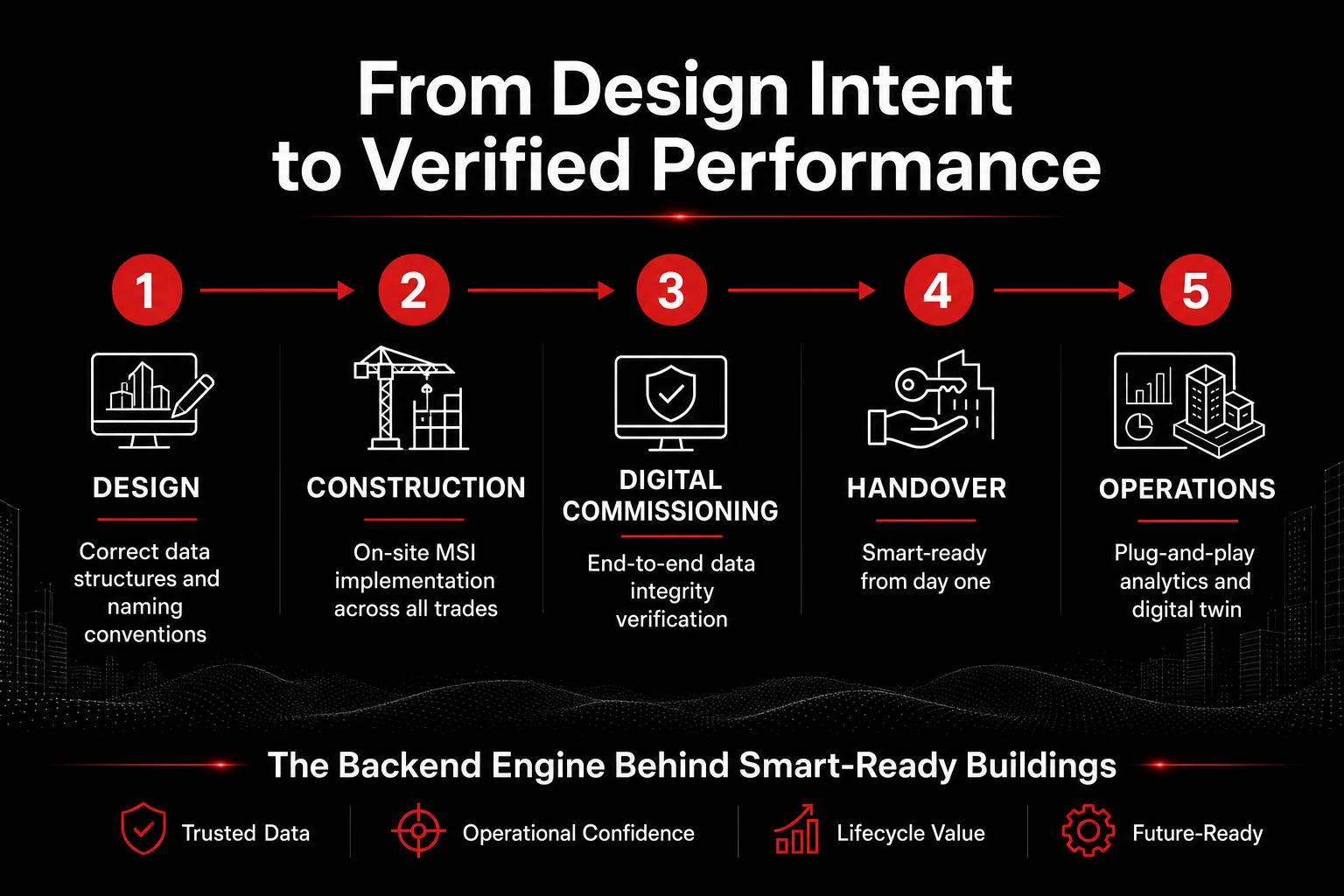
What a Master Systems Integrator Actually Does
An MSI is the technical backbone that connects design intent to operational reality. In practice, that means:
- Working alongside the trades and contractors during the build to make sure the specified data structures and naming conventions are implemented correctly — from the schematics through to the live systems.
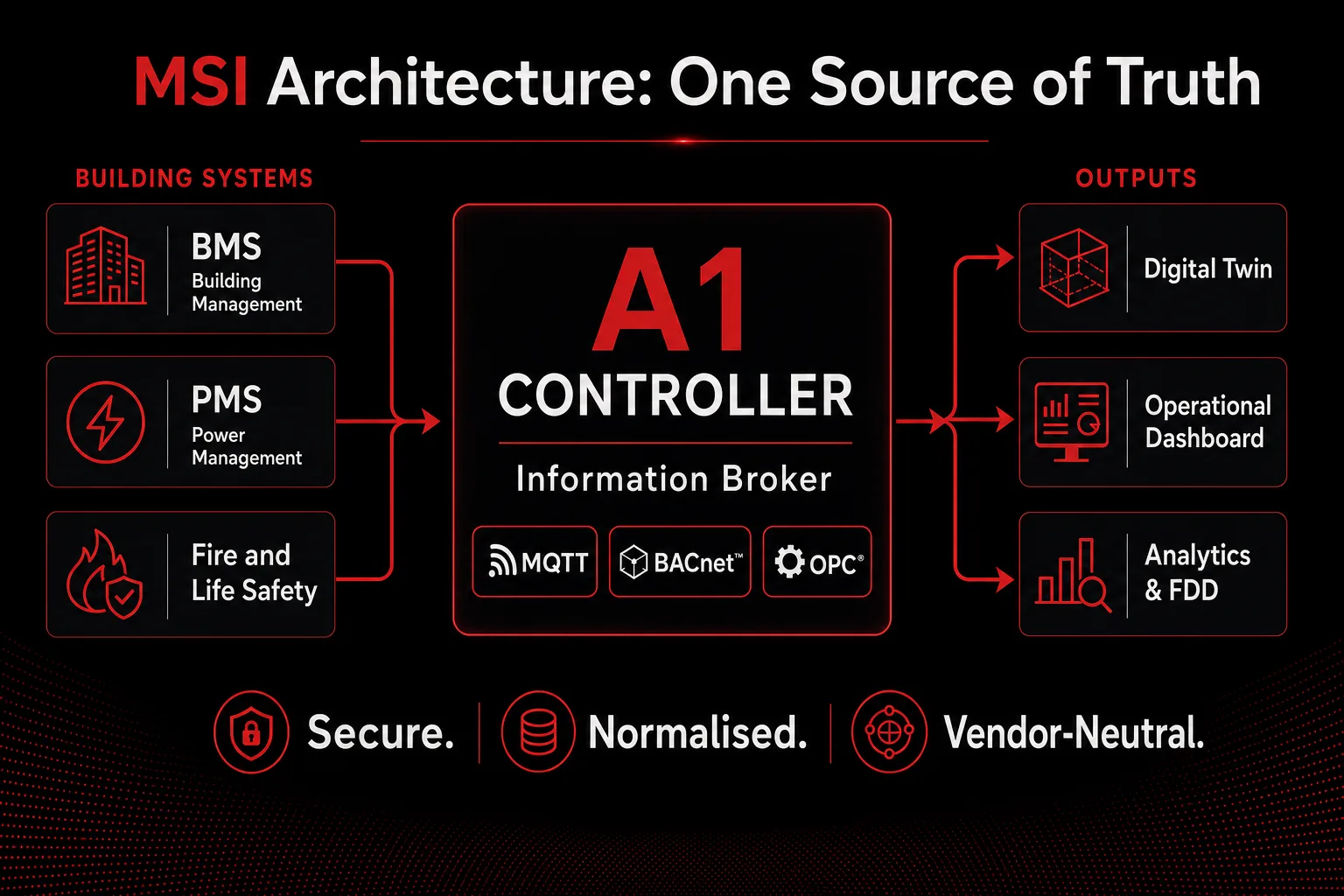
- Securely aggregating data from every building system — building management (BMS), power management (PMS), fire alarm panels, and more — regardless of protocol or vendor.
- Normalising and tagging that data to a standardised digital convention such as Brick or Haystack, so it is consumable by any downstream application.
- Validating the whole chain end to end, proving that a data point at the source reads identically all the way through to the operational dashboard or digital twin.
The MSI is not there to replace specialist systems like CMMS or fault detection. It is there to make all of them speak the same language — and to guarantee that what leadership sees on screen is what the building is actually doing.
The A1 Controller: Our Information Broker
At the heart of the PODTECH MSI capability sits the A1 Controller — a secure hardware appliance that acts as an information broker between siloed, on-premise systems and the cloud.
This matters more than ever. Modern hyperscaler and enterprise RFPs increasingly prohibit direct internet access to critical operational systems like BMS and PMS. The A1 Controller solves that problem cleanly: it sits on-premise, pulls data from disparate sources, normalises it across protocols, and pushes it securely outbound — preparing it for ingestion by any platform without ever exposing the underlying systems.
It speaks the languages the building already uses: MQTT (lightweight real-time telemetry), BACnet (building automation and HVAC), and OPC (industrial and process control).
Paired with our visualisation platform — already proven in liquid-cooling and fluid-monitoring deployments for AI factories — the A1 Controller can stand up a focused DCIM or operational dashboard, or feed a full digital twin: a "system of systems" that lets operations, facilities, and business teams understand building performance without waiting on a specialist report.
Digital Commissioning: Performance Assurance, Not Just Installation
Installation is table stakes. The value an MSI adds is digital commissioning — an additional layer of validation that most projects skip and later regret.
Digital commissioning proves that a data point is identical across every layer of the stack: from the source BMS or PMS, through the information broker, and into the final visualisation tools. It is the difference between "the sensor is connected" and "the number on the executive dashboard is provably correct." For the client, that is performance assurance. It de-risks the project, removes ambiguity at handover, and means the building is genuinely smart-ready on the day the doors open — not eighteen months and a costly retrofit later.
New Builds and Retrofits Alike
Greenfield projects are the ideal case: structure the data correctly at source and everything downstream is straightforward. But most real-world portfolios are mixed-age, and legacy assets rarely arrive with clean documentation.
This is where on-the-ground capability counts. Our mobilisation and development teams have the subject-matter expertise to translate obscure, undocumented system tags into meaningful, consumable data points — the "heavy lift" of retrofit that turns an old building into a smart-ready one. Whether commissioning a new hyperscale facility or untangling a decades-old estate, the outcome is the same: a clean, standardised, independent data layer the client can build on for years.
Built for the Most Demanding Environments
"An MSI is only as credible as the environments it has survived. We have spent years working to the security protocols, terminology, and exacting standards demanded by the world's largest hyperscalers — and validating real GPU and liquid-cooling deployments alongside our partners. That experience is what lets us walk onto a project and own the data layer with confidence, from the schematic to verified performance."
— Harry Pod, CEO, PODTECH
PODTECH operates as a genuinely global delivery organisation: a UK headquarters in Milton Keynes, a development team of around fifty engineers across Bangalore and Delhi, and an office in Dubai. We have served as the technology partner behind real AI-infrastructure commissioning — including deployments supported through our work with partners such as DPI and Datalec — giving us hands-on understanding of how critical systems behave under industrial-scale load.
How the MSI Model Supports Your Organisation
One Source of Truth
A single, vendor-neutral data layer that every team and application can trust — no more conflicting specialist reports.
Smart-Ready by Design
Correct data structures and naming conventions baked in from inception, so future analytics and digital twin projects are plug-and-play.
De-Risked Delivery
Digital commissioning verifies data integrity end to end, eliminating nasty surprises at handover.
Secure by Default
The A1 Controller bridges on-premise systems to the cloud without ever exposing critical infrastructure to the open internet.
Design-to-Performance
A complete chain from design intent through on-site implementation to verified, measurable building performance.
PODTECH is the backend engine that turns a smart building strategy into a smart building. If your organisation is designing, building, or operating data centres and complex facilities — and you want the data layer owned by a partner who has done it under hyperscaler conditions — that is precisely the role we are built to play.