
TL;DR:
- Effective compliance in critical infrastructure depends on governance, accountability, and lifecycle management, not just technology.
- Modern software modules improve document control, automate workflows, and deliver real-time alerts, significantly reducing risks and audit times.
- Successful implementation requires aligning tools with organizational culture, clear ownership, and strong leadership commitment to sustain compliance performance.
Compliance in critical infrastructure is no longer just a regulatory checkbox exercise. As regulatory frameworks grow more complex and operational risks multiply, the real compliance crisis is not about finding the right technology, but about governance, access control, lifecycle management, and accountability. Smart software solutions are reshaping how compliance officers and regulatory managers work, turning a traditionally reactive function into a proactive, strategic advantage that protects operations, reduces risk, and builds institutional confidence.
Table of Contents
- What compliance means in critical infrastructure sectors
- Core functions of compliance software
- Real-world results: How software elevates compliance outcomes
- Addressing the limits: Software and the human element in compliance
- Why treating software as a cure-all for compliance is counterproductive
- Take compliance further with advanced software and partnership
- Frequently asked questions
Key Takeaways
| Point | Details |
|---|---|
| Software is an enabler | Technology amplifies compliance effectiveness only when layered on strong governance and culture. |
| Automation streamlines audits | Automated compliance processes cut manual workload, reduce errors, and strengthen records. |
| Beware tool-only fixes | Compliance tools cannot compensate for gaps in accountability or leadership focus. |
| Measurable risk reduction | Well-implemented solutions deliver faster issue detection, clearer audit trails, and fewer breaches. |
What compliance means in critical infrastructure sectors
Critical infrastructure sectors carry compliance obligations that go far beyond what most regulated industries face. Think of large-scale data centres managing environmental controls and power system integrity, construction sites balancing health and safety legislation with environmental permits, or manufacturing facilities navigating a web of operational standards, emissions reporting, and labour regulations. In each case, the stakes are significant. A single compliance failure can result in costly shutdowns, regulatory penalties, or serious safety incidents.
Critical infrastructure sectors face intense regulatory scrutiny and multifaceted compliance obligations that manual processes simply cannot manage at scale. Consider what compliance officers in these environments are routinely responsible for:
- Health and safety compliance: OSHA-equivalent standards, permit-to-work systems, incident reporting
- Environmental compliance: emissions tracking, waste disposal records, energy consumption reporting
- Operational compliance: equipment maintenance logs, inspection schedules, change management documentation
- Data governance and security: access control records, audit logs, data lifecycle management
- Financial and contractual compliance: supplier audits, regulatory filings, contractual obligations
Managing this breadth with spreadsheets and shared document folders is not just inefficient. It is genuinely dangerous. Fragmented tools create information silos where critical updates fail to reach the right people in time. Manual processes introduce human error. Version control becomes a nightmare. And when an auditor arrives, assembling evidence from scattered systems is both time-consuming and prone to gaps.
“The real compliance crisis is not technology itself, but governance, access, lifecycle governance, and accountability.” — Emil Sayegh, Forbes
Pro Tip: Conduct a compliance blind spot audit by mapping every regulatory obligation your organisation holds against the actual system or person responsible for tracking it. Any obligation with no clear owner or automated tracking is a blind spot that represents live risk.
Understanding the software in critical operations landscape helps compliance teams see exactly where targeted tooling can close those gaps, without overcomplicating the existing technology stack.
Core functions of compliance software
Modern compliance software is not a single product. It is a set of interconnected modules that, together, create a structured, auditable environment for managing regulatory obligations. For enterprise teams in critical infrastructure, the most valuable modules include:
- Document management: Centralised storage with version control, access permissions, and expiry alerts for permits, policies, and certificates
- Audit and activity logs: Immutable records of who did what and when, essential for regulatory evidence and internal reviews
- Automated workflows: Triggered task assignments, escalation paths, and approval chains that remove manual handoffs
- Real-time alerts and dashboards: Notifications for upcoming deadlines, flagged anomalies, and overdue actions
- Regulatory change tracking: Feeds or integrations that flag legislative updates relevant to your sector
Software delivers structured accountability, lifecycle oversight, and granular access control in compliance programmes, addressing the exact weaknesses that cause failures in less structured environments.
To illustrate how this works in practice, here is a typical automated compliance workflow for a construction safety inspection:
- Inspection schedule is created in the system, assigned to a named responsible officer
- Officer receives an automated reminder 48 hours before the inspection is due
- On completion, the officer submits the inspection report via a mobile-enabled form
- The system logs the submission with a timestamp and flags any failed items for corrective action
- A corrective action task is automatically assigned to the relevant site manager with a resolution deadline
- If the deadline passes without resolution, the system escalates to the compliance director
- Once resolved, the record is closed and archived in the audit trail
Compare this with a manual process, and the difference becomes stark.
| Feature | Manual or legacy tools | Modern compliance software |
|---|---|---|
| Document version control | Inconsistent, error-prone | Automated, with full history |
| Audit trail | Partial or missing | Complete and immutable |
| Regulatory deadline tracking | Spreadsheets, calendar reminders | Automated alerts with escalations |
| Reporting time | Days to weeks | Hours or real-time |
| Access control | Informal or ad hoc | Role-based and logged |
| Integration with operations | Minimal | API-driven, connected systems |
Compliance in construction safety, for instance, requires fire protection and safety compliance to be documented and demonstrable at every stage of a project. Software that connects inspection records directly to project management tools eliminates the disconnects that traditionally caused failures.
Pro Tip: When integrating compliance software into an existing enterprise environment, prioritise API connectivity with your current asset management, HR, and project management systems. Adoption rates are dramatically higher when compliance tools sit within familiar workflows rather than requiring users to log into a separate platform. Exploring enterprise software essentials can help you frame the integration requirements before any procurement decision.
For organisations with highly specific regulatory environments, custom software for compliance is often a more effective choice than off-the-shelf solutions, particularly where sector-specific workflows or legacy system integration is required.
Real-world results: How software elevates compliance outcomes
Let us look at what measurable improvements actually look like when compliance software is properly implemented.
Scenario one: Construction and life safety compliance
A large construction contractor managing multiple concurrent projects was relying on paper-based permit-to-work systems. Inspections were being missed, corrective actions were lost in email chains, and audit preparation took an average of three weeks per site. After deploying a custom AI-driven construction compliance platform, inspection completion rates increased significantly, audit preparation time dropped from three weeks to under 48 hours, and the number of overdue corrective actions fell dramatically.

Scenario two: Financial services regulatory reporting
A financial institution managing a large portfolio of compliance obligations across multiple jurisdictions was spending considerable time manually reconciling regulatory reports. Errors were frequent, and regulatory risk was a standing concern. By implementing an automated compliance programme, the organisation saw near-elimination of manual errors and a substantial reduction in the time required for monthly reporting. Exploring financial sector automation reveals how these gains translate across the sector.
Scenario three: Industrial site safety compliance
A manufacturing site implementing safety compliance best practices found that digitising their inspection and incident reporting processes reduced near-miss reporting gaps by over 40%, because staff could report incidents immediately via mobile devices rather than waiting to complete paper forms.
| Compliance metric | Before software | After software |
|---|---|---|
| Audit preparation time | 15 to 21 days | 1 to 2 days |
| Overdue corrective actions | High volume, untracked | Near-zero with escalation |
| Inspection completion rate | Approximately 65% | Above 95% |
| Regulatory reporting errors | Frequent | Rare |
| Staff time on compliance admin | 30% of working week | Under 10% |
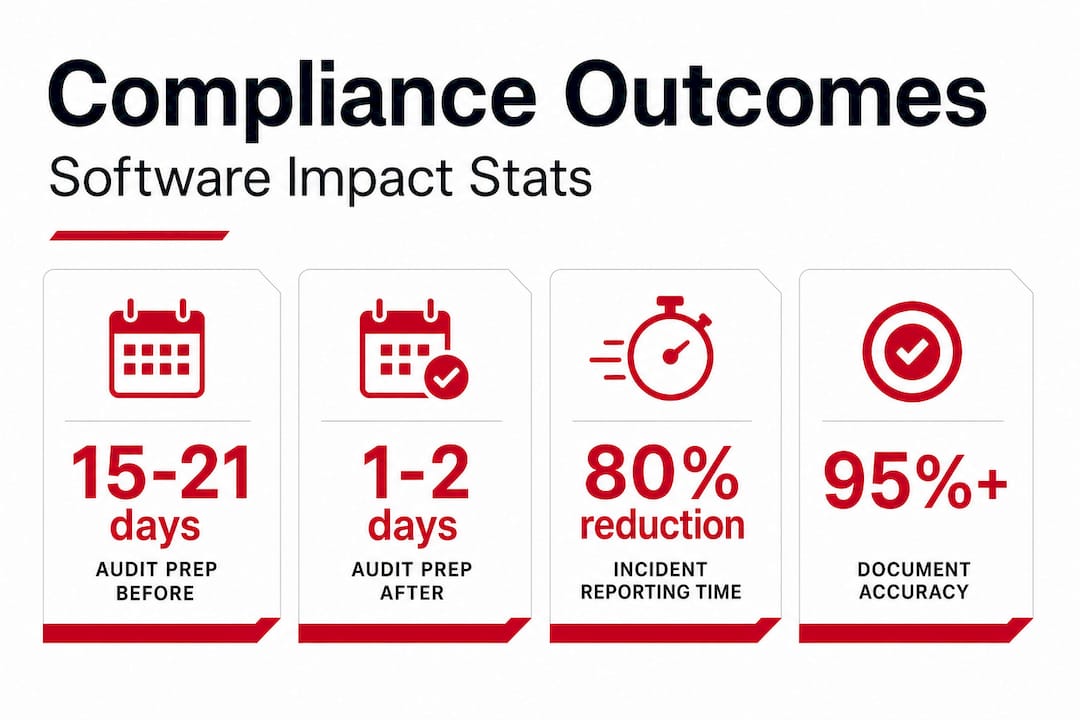
These numbers are compelling. But effective compliance hinges on organisational discipline and lifecycle management enabled, but not guaranteed, by technology. The organisations that achieved these results did not simply deploy software. They redesigned their governance processes, clarified ownership, and embedded accountability into day-to-day operations.
In other words, software accelerated outcomes because the operating model around it was also improved. That distinction matters. A platform can automate reminders, centralise records, and surface risk faster, but it still depends on people following through, leaders reinforcing standards, and teams treating compliance as part of operational excellence rather than an administrative burden.
Addressing the limits: Software and the human element in compliance
Even the best compliance platform has limits. Software can structure information, automate workflows, and improve visibility, but it cannot independently create a culture of accountability. It cannot resolve unclear ownership. It cannot persuade managers to take overdue actions seriously. And it cannot replace leadership commitment when compliance priorities compete with production, delivery, or budget pressures.
This is where many compliance initiatives stall. Organisations invest in a new platform, expecting the tool itself to solve long-standing process weaknesses. But if responsibilities remain vague, if teams are not trained, or if executives do not actively support the new operating model, the software becomes another underused system layered on top of existing confusion.
To avoid that outcome, organisations should focus on several human factors alongside technology:
- Clear ownership: Every obligation, workflow, and escalation path should have a named accountable owner.
- Training and adoption: Staff need practical training tied to their real workflows, not generic platform walkthroughs.
- Leadership reinforcement: Senior leaders must treat compliance metrics as operational metrics, not side reports.
- Process discipline: Automation works best when underlying processes are already defined, repeatable, and measurable.
- Continuous review: Regulatory obligations evolve, so workflows and controls must be reviewed regularly rather than set once and forgotten.
In practice, the strongest compliance environments combine software precision with human judgment. Teams use dashboards to identify risk, but experienced managers still interpret context. Alerts highlight overdue actions, but leaders still decide how to prioritise remediation. Audit trails preserve evidence, but compliance professionals still shape the narrative and ensure the organisation can demonstrate intent, control, and improvement.
Practical takeaway: Treat compliance software as a force multiplier for a well-run programme, not as a substitute for one. The more clearly your organisation defines ownership, escalation, and review, the more value the platform will unlock.
Why treating software as a cure-all for compliance is counterproductive
There is a common trap in enterprise compliance transformation: assuming that buying a modern platform automatically modernises the compliance function. It does not. In fact, this mindset can be counterproductive because it shifts attention away from the root causes of compliance failure.
When organisations over-focus on tooling, they often underinvest in governance design, role clarity, and change management. The result is predictable. Dashboards look impressive, but data quality is inconsistent. Automated workflows exist, but exceptions are handled informally. Alerts are generated, but no one owns the response. Audit records are stored, but the organisation still struggles to explain how controls are actually operating in practice.
Here are the most common reasons a tool-only compliance strategy falls short:
- Poor process design: Automating a broken process only makes the broken process faster.
- Weak accountability: If nobody owns a control, software cannot create real ownership on its own.
- Fragmented data sources: Without integration and data governance, the platform becomes another silo rather than a source of truth.
- Low user adoption: If teams see the system as extra admin rather than part of operations, records quickly become incomplete.
- Limited executive sponsorship: Compliance transformation requires visible support from leadership to sustain behaviour change.
This is why the most effective compliance programmes start with operating principles, not just product features. They define what must be controlled, who is responsible, how evidence is captured, when escalation occurs, and how performance is reviewed. Only then do they select or design software that supports those requirements.
The goal is not to buy more software. The goal is to create a compliance system that is reliable, auditable, and resilient under pressure. Technology is essential to that outcome, but only when it is implemented as part of a broader governance strategy.
Take compliance further with advanced software and partnership
For organisations operating in high-stakes environments, the next step is not simply adopting software. It is choosing the right compliance architecture and the right implementation partner. That means selecting solutions that fit your regulatory environment, integrate with your operational systems, and support the way your teams actually work.
In many cases, that points toward tailored platforms rather than generic tools. Custom or highly configurable compliance systems can align more closely with sector-specific workflows, approval structures, reporting obligations, and legacy infrastructure. They also make it easier to embed compliance into daily operations instead of forcing teams to adapt to rigid software assumptions.
The strongest partnerships go beyond deployment. They help organisations map obligations, define ownership, connect systems, improve reporting, and continuously refine workflows as regulations and operations evolve. That is where compliance shifts from a defensive function to a strategic capability.
- Assess your current-state risk: Identify where manual processes, siloed records, or unclear ownership create exposure.
- Prioritise integration: Connect compliance with asset, HR, project, and operational systems to reduce duplication and improve accuracy.
- Design for accountability: Build workflows around named owners, deadlines, and escalation rules.
- Measure outcomes: Track audit preparation time, corrective action closure, reporting accuracy, and administrative effort.
- Choose a long-term partner: Compliance requirements change, so your software strategy should be adaptable over time.
If your organisation is ready to move beyond spreadsheets, fragmented folders, and reactive audit preparation, smart compliance software can deliver meaningful gains. But the real value comes when technology, governance, and operational discipline work together.
That is how compliance becomes more than a requirement. It becomes a source of resilience, trust, and competitive strength.
Frequently asked questions
What is compliance software used for?
Compliance software is used to manage regulatory obligations, centralise documentation, automate workflows, track deadlines, maintain audit trails, and improve visibility across compliance activities. In critical infrastructure settings, it helps organisations reduce risk and demonstrate control more effectively.
Can compliance software replace compliance teams?
No. Software can automate repetitive tasks and improve oversight, but it cannot replace professional judgment, leadership accountability, or organisational culture. The best results come when software supports skilled compliance teams rather than attempting to replace them.
What features matter most in compliance software?
The most important features typically include document management, version control, audit logs, automated workflows, deadline alerts, role-based access control, reporting dashboards, and integration with existing enterprise systems.
How does compliance software improve audit readiness?
It improves audit readiness by centralising evidence, preserving timestamps and activity histories, reducing version confusion, and making it easier to retrieve records quickly. This can reduce audit preparation from weeks to days or even hours, depending on the maturity of the implementation.
Is off-the-shelf compliance software enough for complex industries?
Sometimes, but not always. Highly regulated or operationally complex sectors often need tailored workflows, deep integrations, and sector-specific controls that generic tools do not fully support. In those cases, custom or highly configurable solutions are often a better fit.