
TL;DR:
- The dedicated team model provides enterprise clients full strategic control while offloading operational burdens to specialised vendors.
- It involves long-term, exclusive cross-functional teams that understand your systems and culture, delivering higher consistency and faster adaptation.
- This approach is ideal for complex, evolving, and long-term projects requiring deep integration and continuous collaboration.
Many IT leaders still equate outsourcing with relinquishing control, handing over a brief and hoping for the best. That assumption is not just outdated, it is actively costly. The dedicated team model inverts the traditional outsourcing dynamic entirely, giving you full strategic authority over a cross-functional team while offloading the operational overhead that quietly drains your internal resources. For enterprise IT managers navigating complex infrastructure builds, digital transformation programmes, or mission-critical software delivery, understanding this model is not optional. It is a competitive advantage.
Table of Contents
- What is the dedicated team model?
- How the dedicated team model works in practice
- When does the dedicated team model make sense?
- Real-world examples: dedicated teams in action
- Dedicated teams and next-generation enterprise projects
- Why most enterprises miss the real opportunity in dedicated teams
- How PODTECH helps you deploy smarter dedicated teams
- Frequently asked questions
Key Takeaways
| Point | Details |
|---|---|
| Model definition | A dedicated team is a cross-functional group working exclusively for one client, acting as an in-house extension. |
| Client control | You retain direct control over project priorities and workflows while the vendor handles staffing and HR operations. |
| Best use cases | The model excels for long-term, complex projects demanding ongoing expertise and close integration. |
| Operational efficiency | Vendors manage recruitment, payroll, and infrastructure so your team can focus on outcomes and strategy. |
| Strategic advantage | Embedding dedicated teams deeply unlocks faster innovation and smoother transformations in the enterprise. |
What is the dedicated team model?
With the stage set, let’s clarify exactly what makes the dedicated team model unique.
At its core, the dedicated team model is an outsourcing approach where a vendor provides a cross-functional group of IT professionals, including developers, QA engineers, project managers, and designers, who work exclusively on one client’s long-term project and act as a seamless extension of the in-house team. This is not a body-shop arrangement. The team is yours in every meaningful sense: they learn your systems, your culture, and your roadmap.
Typical dedicated team compositions vary by project complexity. A mid-scale infrastructure build might include two to three backend developers, a QA engineer, a UI/UX designer, and a technical project manager. For larger platforms, you might see dedicated DevOps engineers, security specialists, data engineers, and business analysts operating in the same formation. Every role is scoped to your actual delivery needs, not a template.
The distinction from other outsourcing models is significant. Consider what differentiates it clearly:
| Model | Client control | Team exclusivity | Flexibility | Best for |
|---|---|---|---|---|
| Dedicated team | High | Full | High | Long-term, evolving projects |
| Fixed-bid | Low | None | Very low | Well-defined, static scope |
| Time and material | Medium | Partial | Medium | Shorter sprints, changing budgets |
When you engage our software development services through a dedicated team model, you are not sharing that team with three other clients. Their sprint velocity, their context, their institutional knowledge: all of it stays with your project.
“The dedicated team model allows organisations to scale their technical capabilities without scaling their management burden, provided the integration is done deliberately.”
This exclusivity matters enormously in enterprise contexts. A developer who has spent six months working on your building management platform understands the domain depth that no freshly introduced contractor can replicate. This is why the model consistently outperforms alternatives on long-running monitoring teams in datacentre projects where continuity is not a luxury, it is a requirement.
How the dedicated team model works in practice
Now that we have defined the model, let’s see how it functions day-to-day on the ground.
One of the most consistent misconceptions is that the client hands over the wheel once the vendor is engaged. The opposite is true. The client controls priorities, roadmap, methodologies such as Agile or Scrum, and sprint planning, while the vendor absorbs all HR functions: recruitment, payroll, performance management, infrastructure provisioning, and team replacement when needed.
This is a meaningful split. You retain strategic authority while the vendor removes the operational friction that typically consumes your internal team’s bandwidth. You decide what gets built and when. They ensure the right people are in place to build it.
The ramp-up and operating rhythm typically follows this sequence:
- Discovery and scoping: You define the project goals, technical constraints, and preferred methodologies. The vendor maps these to team composition requirements.
- Team assembly: The vendor recruits or reallocates specialists aligned to your stack. You interview and approve key hires.
- Onboarding sprint: The dedicated team is embedded into your communication tools, repositories, and sprint ceremonies. Knowledge transfer begins immediately.
- Active delivery: The team operates within your project management framework, attending standups, retrospectives, and planning sessions as full participants.
- Continuous optimisation: The vendor handles team substitutions or capacity adjustments as project demands shift, without interrupting your delivery cadence.
This workflow is most effective when the client has a clear product vision and communicates it early. Your enterprise automation guide processes and platform architecture should be shared from day one, not drip-fed over months.
Pro Tip: Before the first sprint, present the dedicated team with a full product roadmap and architectural overview. Teams that understand the destination navigate ambiguity far more effectively than those who only see the next two weeks.
The interaction between in-house and dedicated team members is most productive when treated as peer collaboration. Assign a single internal technical lead to serve as the primary liaison. This reduces communication overhead and ensures the dedicated team has an authoritative point of contact for prioritisation decisions, not a committee.

When does the dedicated team model make sense?
Having explored how the model works, the next step is understanding if it is the right fit for your next project.
The dedicated team model is ideal for long-term projects requiring continuous collaboration, evolving requirements, or unclear scopes at the outset. This covers a significant portion of enterprise software delivery, particularly in infrastructure-heavy sectors where requirements surface progressively rather than arriving fully formed.
Three project profiles where this model consistently delivers superior outcomes:
- Complex, evolving workloads: Projects where the technical scope is likely to shift as stakeholders gain clarity, such as a data centre management platform integrating multiple third-party systems. Fixed-bid contracts punish this fluidity with change orders and delays.
- Extended delivery timelines: Programmes spanning twelve months or more benefit enormously from team continuity. Context retention, reduced onboarding costs, and compounding institutional knowledge are all direct results.
- Heavy team integration demands: When your delivery depends on deep collaboration between the vendor team and internal engineers, architects, or operations staff, an exclusive, long-term engagement is the only model that produces genuine integration rather than surface-level coordination.
Warning signs that the model may not be appropriate are also worth naming directly. If your project has a fully locked scope, a hard regulatory deadline with no ambiguity, and a well-tested delivery blueprint, a fixed-bid arrangement may actually deliver better cost predictability. The dedicated team model thrives on complexity, not on executing a known and static task list.
Read our enterprise software guide for a broader view of how engagement model selection fits into your overall software strategy.
Pro Tip: If your organisation is undergoing a multi-year digital transformation or building proprietary infrastructure management tools for long-term internal use, these are the clearest indicators that a dedicated team is the right choice. Ownership and evolution are the keywords.
Real-world examples: dedicated teams in action
Theory is helpful, but nothing illustrates real value like proven case studies and concrete comparisons.
Organisations deploying dedicated teams across complex enterprise workloads consistently report measurable improvements across three categories: delivery speed, integration quality, and risk reduction. Our dedicated team case studies illustrate this pattern across sectors including data centres, intelligent building platforms, and financial infrastructure.
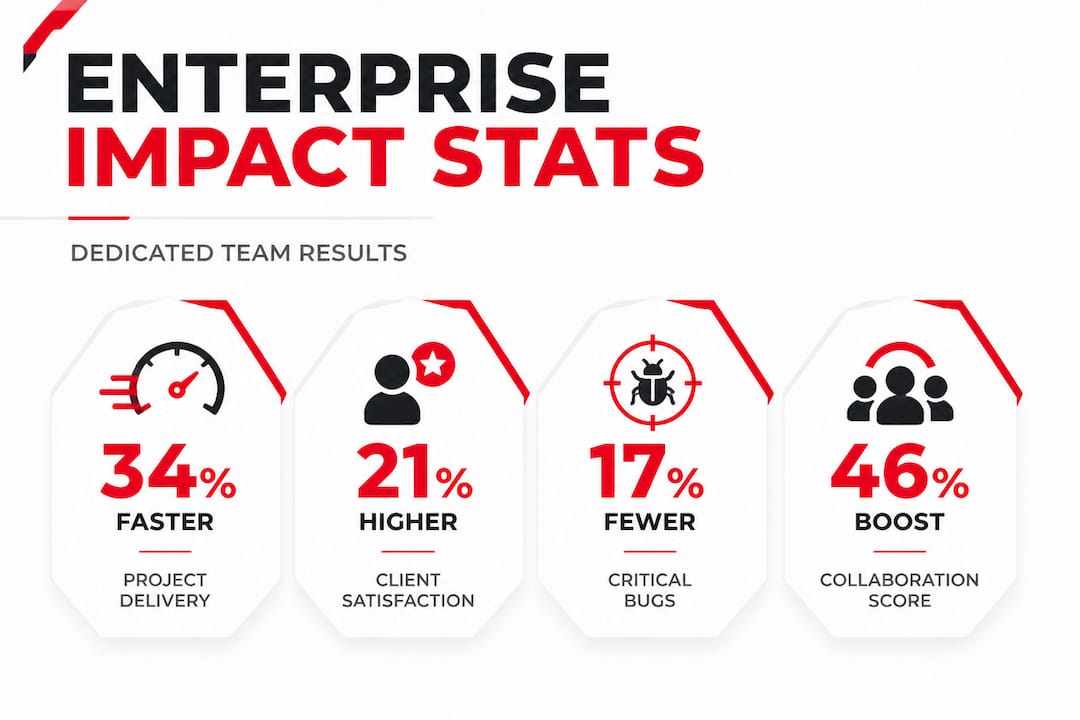
Consider a large-scale building management integration project. The client originally attempted delivery through a fixed-bid arrangement, which collapsed after three months due to shifting integration requirements with an existing NMS platform. On re-engagement using a dedicated team model, the client retained full methodological control while the vendor absorbed all staffing overhead. Delivery resumed within two sprints, and the platform reached production six weeks ahead of the revised schedule.
| Metric | Without dedicated team | With dedicated team |
|---|---|---|
| Average sprint velocity | Inconsistent, 40% variance | Stable, under 15% variance |
| Onboarding overhead per hire | 3 to 5 weeks per resource | Managed by vendor, zero client effort |
| Scope change response time | 2 to 3 weeks | 3 to 5 days |
| Team continuity over 12 months | Typically 3 to 4 changes | Typically 0 to 1 change |
The lesson is straightforward. Dedicated teams do not merely add capacity. They reduce the hidden drag that slows enterprise delivery: fragmented ownership, repeated onboarding, and the loss of context every time a resource rotates off the project.
This is especially relevant in environments where software must coexist with operational technology, legacy systems, and strict uptime expectations. In those settings, continuity is not just efficient. It is risk management.
Dedicated teams and next-generation enterprise projects
The strategic value of dedicated teams becomes even clearer when you look at the kinds of projects enterprises are now prioritising.
Modern enterprise initiatives are increasingly defined by uncertainty, integration depth, and long-term evolution. AI-enabled operations platforms, software-defined infrastructure, predictive maintenance systems, digital twins, and cross-site monitoring environments all share one trait: they are not one-off builds. They are living systems that mature over time.
These programmes rarely fit neatly into a fixed scope. New data sources emerge. Security requirements evolve. Stakeholders refine what success looks like after seeing early releases in production. A dedicated team is structurally better suited to this reality because it preserves knowledge while allowing the delivery model to adapt.
- AI and analytics platforms require iterative model tuning, data pipeline refinement, and ongoing validation against operational outcomes.
- Infrastructure management systems demand deep familiarity with protocols, device behaviours, and integration edge cases that only accumulate through sustained involvement.
- Transformation programmes often span multiple business units, making continuity and governance more important than short-term staffing convenience.
In other words, the more strategic and long-lived the initiative, the more valuable a dedicated team becomes. It gives enterprise leaders a way to scale execution without fragmenting accountability.
Why most enterprises miss the real opportunity in dedicated teams
Many enterprises evaluate dedicated teams too narrowly. They see them as a staffing shortcut or a cost-control mechanism. That framing misses the bigger opportunity entirely.
The real advantage is not simply lower hiring friction. It is the ability to create a stable delivery engine around strategic priorities without expanding internal management overhead at the same rate. That distinction matters. A dedicated team is not just cheaper capacity. It is a way to preserve focus, accelerate learning, and keep execution aligned with business intent over long periods.
Enterprises often underuse the model in three ways:
- They treat the team as external labour instead of integrating it into planning, architecture, and decision-making.
- They withhold strategic context and only share task-level requirements, which prevents the team from making intelligent trade-offs.
- They optimise for short-term cost visibility rather than long-term delivery performance and continuity.
When those mistakes are avoided, the model becomes far more powerful. The dedicated team starts to function as a durable extension of your organisation, capable of carrying institutional knowledge forward while still benefiting from vendor-side operational support.
The highest-performing dedicated teams are not managed at arm’s length. They are embedded deeply enough to understand why decisions are being made, not just what tickets are next in the queue.
For IT leaders, that is the real shift. The model is not about outsourcing responsibility. It is about separating strategic control from operational burden in a way that improves both.
How PODTECH helps you deploy smarter dedicated teams
At PODTECH, we approach dedicated teams as a strategic delivery model, not a generic resourcing package. That means we focus on fit, continuity, and integration from the outset.
We work with enterprise clients to define the right team shape for the actual problem being solved, whether that means backend-heavy platform engineering, DevOps-led infrastructure delivery, or cross-functional product squads that include QA, design, and technical leadership. The objective is not to fill seats. It is to build a team that can operate effectively inside your environment from the start.
- We align team composition to delivery reality, not generic role templates.
- We support deep onboarding, so the team understands your systems, constraints, and operating context quickly.
- We maintain operational continuity, handling staffing, HR, and replacement planning without disrupting delivery.
- We prioritise collaboration models that make dedicated teams feel like a natural extension of your internal organisation.
This is particularly valuable for clients delivering complex software in data centre, building automation, and enterprise infrastructure environments, where domain understanding compounds over time and where fragmented teams create unnecessary risk.
If you are evaluating how to scale delivery without losing strategic control, a dedicated team can be the right answer, provided it is designed and integrated deliberately. That is where our experience matters most.
Frequently asked questions
What is the dedicated team model in software development?
The dedicated team model is an outsourcing approach where a vendor provides a cross-functional team that works exclusively on one client’s project over an extended period. The client directs priorities and workflows, while the vendor manages staffing and operational support.
How is a dedicated team different from fixed-bid outsourcing?
Fixed-bid outsourcing is best for tightly defined scopes and limited change. A dedicated team is better for evolving, long-term work because it offers higher flexibility, stronger continuity, and more direct client control over delivery.
When should an enterprise choose a dedicated team?
Enterprises should consider a dedicated team when projects are complex, long-running, integration-heavy, or likely to evolve over time. It is especially effective for digital transformation, infrastructure software, and platforms that require ongoing iteration.
Who manages the dedicated team day to day?
The client typically manages priorities, roadmap, and delivery direction. The vendor manages recruitment, HR, payroll, infrastructure, and resource continuity. This split allows the client to retain strategic control without absorbing the full operational burden.
Is the dedicated team model cost-effective?
Yes, especially for long-term initiatives. While the value is not only about lower cost, the model often reduces hidden expenses tied to hiring delays, repeated onboarding, team churn, and slow responses to changing requirements.
Final thought
The dedicated team model gives IT leaders something traditional outsourcing rarely could: control without operational drag. When the work is strategic, evolving, and deeply integrated into the enterprise, that combination is not just useful. It is decisive.